Trace and Avarni both help Australian entities comply with AASB S2, but they cover different amounts of the work. Avarni is carbon accounting software with implementation support, and it refers hands-on governance and strategy help to partner consultants. Trace pairs its platform with in-house specialists across governance, climate risk, emissions and the disclosure itself.
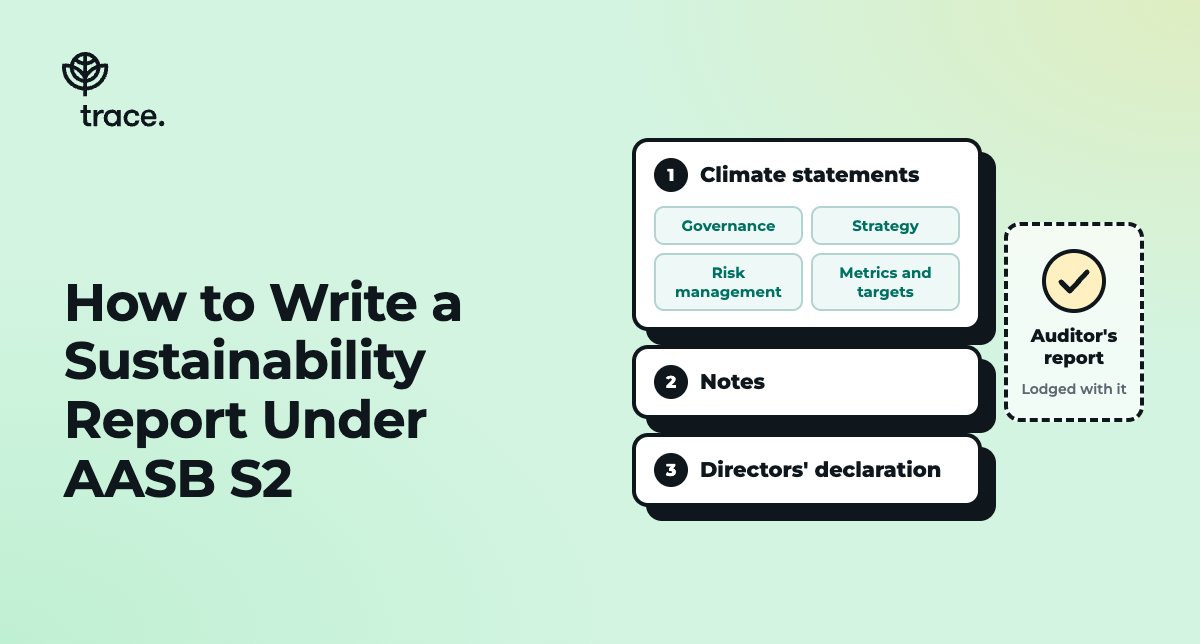
Compare each provider against what AASB S2 and the Corporations Act ask for, not against either vendor's feature list. AASB S2 sets disclosures across governance, strategy, risk management, and metrics and targets, including scenario analysis and Scope 1, 2 and 3 emissions. Then ask who does each part: the software, the provider's people or a third party.
The Australian Sustainability Reporting Standards (ASRS) include AASB S2 Climate-related Disclosures, the standard that mandatory climate reporting follows. Group 2 entities report for annual periods starting on or after 1 July 2026, and RG 280 Table 2 sets their thresholds: two of $200 million revenue, $500 million gross assets or 250 employees. Our guide to AASB S2 climate disclosures covers the standard in full.
More than emissions. Under ASSA 5010 paragraph 10(a), the first year is a review of governance at AASB S2 paragraph 6, strategy at subparagraphs 9(a), 10(a) and 10(b), and Scope 1 and 2 emissions. Any statement that there are no material climate risks or opportunities is reviewed too. In years two and three the auditor reviews every disclosure, and from year four it audits them.
ASIC's first review shows why that last point matters. According to ASIC's Report 839, 312 sustainability reports were lodged by entities with a 31 December 2025 year end, and ASIC reviewed 40 of them. None of the 40 came with an audit report containing a modified opinion. However, two of the audit reports carried an emphasis of matter paragraph, and both drew attention to the directors' judgement that no climate-related risks and opportunities could reasonably be expected to affect the entity's prospects.
AASB S2 paragraph 22 asks for climate scenario analysis "using an approach that is commensurate with the entity's circumstances". The Corporations Act sets the floor. Under section 296D(2B), as RG 280.99 explains, an entity must use at least two scenarios: 1.5°C of warming and warming well exceeding 2°C. RG 280 notes that the explanatory memorandum treats 2.5°C or higher as well exceeding 2°C.
Two other rules shape year one. First, AASB S2 Appendix C relieves an entity of Scope 3 emissions in its first annual reporting period, so Scope 3 arrives in year two. Second, RG 280 says modified liability settings apply, in specific circumstances, to statements about Scope 3, scenario analysis and transition plans, for financial years commencing between 1 January 2025 and 31 December 2027.
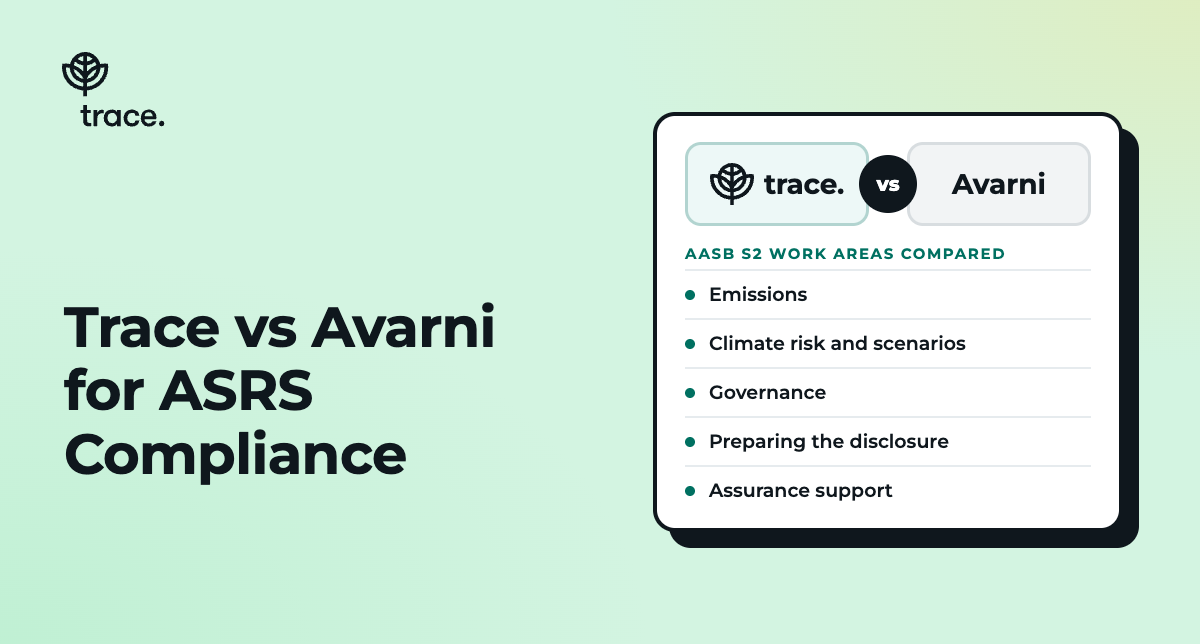
Trace and Avarni overlap on emissions and assurance support but differ on who does the rest of AASB S2. Avarni's pages describe software for emissions, targets and reduction scenarios, and refer governance and strategy help to partners. Trace's specialists cover governance, climate risk, metrics and the disclosure, with its platform underneath. The table uses each provider's own published material.
Model
Emissions (Scope 1, 2 and 3)
Climate risk and scenarios
Governance
Preparing the disclosure
Assurance support
Named systems
Pricing
Each entry below uses the same twelve fields, filled from that provider's own published material. Avarni's pages were read on 17 November 2026. Trace is listed first because this is Trace's article, and the order is not a ranking. In addition, each entry closes with its watch-outs and its pricing.
Best for: Australian entities in Groups 1, 2 and 3 preparing a first AASB S2 disclosure that want the platform and the specialists from one provider.
Typical customer size / segment: Groups 1, 2 and 3 under AASB S2, by Trace's own description, with pathways that run from facilitated self-reporting for confident in-house teams to fuller support for larger gaps.
Model: Software plus specialists. Trace describes its approach as consultant-led, with "100% of outputs reviewed by an expert".
Emissions (Scope 1, 2 and 3): Spend-based and activity-based methods. The platform reads PDFs, invoices and utility bills, and it classifies transactions against GHG Protocol categories.
Climate risk and scenario analysis: A climate risk assessment run with Trace's team in six milestones, from document upload to a risk workshop, a materiality review and the final report. Risks are rated for likelihood and consequence under each scenario and time horizon, before and after existing controls, using 1.5°C and 3°C scenarios.
Governance: A governance review with a disclosure checklist, feedback on existing documents and board or leadership training. Board training is also sold on its own.
Preparing the disclosure: Templates, feedback rounds or a full report drafted by Trace. Where Trace drafts, its consultants use Trace's own drafting technology, and each claim links to its evidence held in Trace.
Assurance support: Part of the disclosure preparation workstream. Trace prepares you for assurance, and your auditor provides it.
Named systems: Xero, Microsoft Dynamics 365, MYOB, NetSuite and QuickBooks, all connected read-only.
Key strengths:
Watch-outs: Not designed for asset-heavy organisations that need bespoke physical-asset or financed-emissions modelling, or for a team that wants software only, with no specialist involvement.
Pricing: Not published. Trace prices each engagement by scope.
The emissions work runs in Trace's carbon accounting platform, which reads source documents, maps transactions to GHG Protocol categories and connects read-only to five accounting systems.
Trace's climate risk assessments are guided rather than self-serve. AI and Trace's experts do the work together, and the workshop is completed with Trace's team before the assessment moves on.
For the report itself, AASB S2 disclosure preparation can be anything from templates you complete to a full draft. Because the evidence lives in Trace, each claim in the draft can be traced back to its source.
Best for: Finance teams in mid-market and larger organisations that want ASRS-focused emissions software with implementation support and an audit trail, and that will use partners or their own staff for governance and strategy.
Typical customer size / segment: Avarni says it focuses on "mid-market to large enterprise clients". Its AWS Marketplace tiers run up to USD 2 billion in annual revenue, with custom pricing above that.
Model: Software with expert support for implementation and pre-assurance review. Hands-on gap analysis, governance strategy and carbon reduction strategy are referred to "a partner network of consultants".
Emissions (Scope 1, 2 and 3): AI predicts which emission factors match your spend and activity data, and a person can check and override each mapping. Avarni cites "65,000+ emission factors", covers all 15 Scope 3 categories and runs supplier surveys.
Climate risk and scenario analysis: A targets and scenarios feature models reduction pathways against SBTi 1.5°C and well below 2°C trajectories, and Avarni says it supports "climate scenario analysis in line with the ASRS requirements". However, the product pages we read do not describe a climate risk register or a risk workshop.
Governance: Free templates, including an ASRS board reporting template and a gap analysis template. Hands-on governance help is referred to partner consultants.
Preparing the disclosure: Emissions reports by scope, supplier or category, and scheduled reports for boards. The product pages we read do not describe drafting the narrative disclosure.
Assurance support: A step-by-step calculation audit trail, Excel export and auditor access to the platform, plus a quarterly data and methodology review and annual pre-assurance support.
Named systems: Avarni says it connects to over 1,000 enterprise tools and names Dynamics 365, NetSuite, Oracle, QuickBooks, SAP, Workday and Xero among them. MYOB is not among those named.
Key strengths:
Watch-outs: Hands-on gap analysis, governance strategy and carbon reduction strategy help is referred to partners, so a team without its own expertise may need a second provider for governance and climate risk work. Its "100% audit pass rate across all clients" is Avarni's own figure, and its FAQ puts it as clients having "always passed emissions data audits".
Pricing: A yearly subscription by AASB S2 group, including implementation, Australia-based support and unlimited users. Its AWS Marketplace listing shows USD 24,000 to USD 90,000 a year across four revenue bands, and supplier engagement is an extra tier, "not required for compliance".
According to Avarni's homepage, it has served "450+" organisations across five years, and it says clients file in two to three months. Its September 2026 product update added a Completeness screen that shows, by facility, source and month, whether energy data has arrived. It also noted that "you still review and accept each suggestion yourself" for ledger rules.
According to G2 and Capterra, Avarni has five public reviews, three on G2 and two on Capterra, all five stars. Four of the five praise the support and onboarding, four the ease of use, and four the time that AI automation saves. That is too few to show a pattern, so read each as one customer's experience.
On G2, one reviewer wrote that "The platform is intuitive and easy to navigate" (4 June 2026). Another said "Onboarding was smooth and well supported" (19 May 2026), and a third that "Avarni is user friendly. It makes reporting a simple process." (13 May 2026).
Only one reviewer raised a limitation. That G2 reviewer (19 May 2026) wrote that "certain regulatory and operational reporting requirements still require manual intervention or supplementary processes outside the platform". The same review also praises Avarni's responsiveness to feedback. Because it is a single observation, it is a question to ask rather than a finding.
What this does not cover: G2 and Capterra block automated reading, so we read the G2 reviews as they are syndicated on AWS Marketplace, and the Capterra counts were confirmed on screen. In addition, we did not collect Reddit threads or TrustRadius. So this is not a complete picture of what Avarni's users think.
Avarni suits a finance team that wants emissions software for a large, multi-system organisation and already has advisers for governance and climate risk. Trace suits an entity that wants one provider to carry the climate risk assessment, the governance work and the disclosure as well as the emissions. Neither suits every reporter, so start from your own gaps.
Trace is not built for asset-heavy organisations that need bespoke physical-asset or financed-emissions modelling. Likewise, a team that wants software only, with no specialist involvement, will be better served elsewhere. For the wider shortlist, see our comparison of ASRS climate reporting software.
Ask both providers the same six questions, and ask for the answers in writing. The useful ones test who does each part of AASB S2, how much checking stays with your team, and what a year-two Scope 3 report will cost. Each question below comes from the criteria above or from the review complaint.
Avarni is carbon accounting software for ASRS compliance, with implementation support and pre-assurance reviews, and it refers hands-on governance and strategy help to partner consultants. Trace combines a platform with its own specialists across six AASB S2 workstreams, including governance, climate risk assessment and disclosure preparation. The difference is how much of AASB S2 one provider carries.
Avarni's targets and scenarios feature models reduction pathways, and Avarni says it supports climate scenario analysis in line with the ASRS requirements. The product pages we read on 17 November 2026 do not describe a climate risk register or a risk workshop. Its FAQ refers hands-on governance and strategy help to partner consultants.
Trace's disclosure preparation workstream offers templates, feedback rounds or a full report drafted by Trace. Where Trace drafts, its consultants use Trace's own drafting technology, and each claim in the draft links to its evidence held in Trace. The directors still sign the declaration, and an independent auditor still provides the assurance.
Avarni has no pricing page. Its AWS Marketplace listing shows USD 24,000 to USD 90,000 a year across four revenue bands, as read on 17 November 2026. Its FAQ says the subscription includes implementation, Australia-based support and unlimited users. Trace does not publish prices and scopes each engagement, so compare quotes for the same scope.
There are three broad routes. Other carbon accounting software covers emissions in a similar way. A consultancy can lead every workstream. A platform with in-house specialists, such as Trace, sits between the two. The right choice depends on how much of AASB S2 you want one provider to carry, and on the advisers you already have.
Trace is a climate reporting platform with in-house specialists, founded in 2020 with offices in Sydney and London. It helps Australian organisations measure emissions and prepare AASB S2 climate disclosures.
Reviewed by Joanna Auburn, Co-founder and Chief Product Officer of Trace.
This article is general information about Australian climate reporting requirements as at the date shown. It is not legal, accounting or assurance advice.
All read on 17 November 2026. Avarni's pages were read with a plain fetch, and copies are kept on file.


London - Sydney