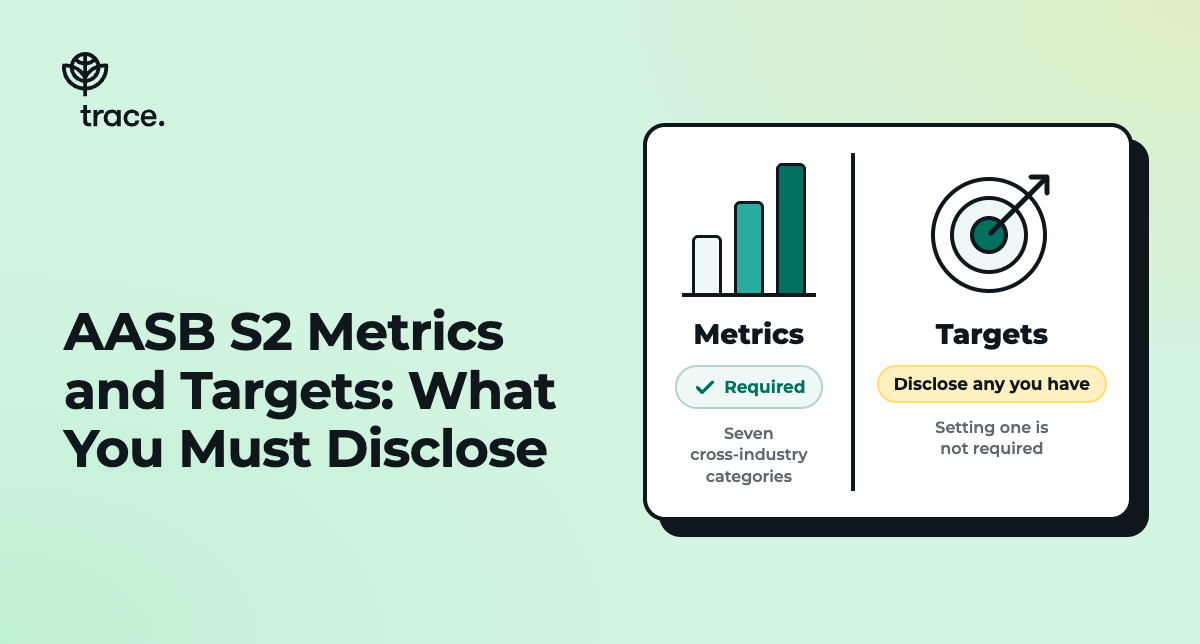
Under AASB S2, the metrics and targets pillar asks for information on seven cross-industry metric categories, led by Scope 1, 2 and 3 greenhouse gas emissions, and details of any climate-related target the entity has set or must meet by law. AASB S2 does not require an entity to set a target.
AASB S2 paragraph 27 says the pillar exists so users can understand an entity's performance on its climate-related risks and opportunities, including progress towards its targets. Paragraph 28 then asks for two things: information relevant to seven cross-industry metric categories (paragraphs 29 to 31), and information about climate-related targets (paragraphs 33 to Aus37.1).
The standard's full name is Australian Sustainability Reporting Standard AASB S2 Climate-related Disclosures. The Australian Accounting Standards Board (AASB) issued it in September 2024 as the climate standard within the Australian Sustainability Reporting Standards (ASRS). Metrics and targets is the last of its four pillars, and our guide to AASB S2 covers the other three.
Unlike IFRS S2, the international standard it is based on, AASB S2 deletes paragraphs 28(b), 32 and 37. As a result, an entity "is not required to disclose industry-based metrics". For anyone who reported against the Task Force on Climate-related Financial Disclosures (TCFD), the AASB says AASB S2 "requires the same categories of cross-industry metrics as the TCFD guidance".
Materiality still applies. Under Appendix D paragraph B25, an entity need not disclose immaterial information "even if the Australian Sustainability Reporting Standard contains a list of specific requirements". However, ASIC saw entities in its review exclude information as "not material" without explaining "the thresholds, judgments or assumptions" behind that call. So if you leave a metric out, show why.
Paragraph 29 of AASB S2 lists seven cross-industry metric categories: greenhouse gas emissions, transition risks, physical risks, climate-related opportunities, capital deployment, internal carbon prices and remuneration. Each is addressed subject to materiality. Emissions have a defined measurement method. The other six are amounts, percentages, a carbon price and a remuneration percentage, with the basis shown.
These AASB S2 cross-industry metrics apply to every sector, unlike the industry-based metrics Australia left out.
The seven cross-industry metrics in AASB S2 paragraph 29
Greenhouse gas emissions
Transition risks
Physical risks
Opportunities
Capital deployment
Internal carbon prices
Remuneration
Appendix A defines the scopes. Scope 1 is "direct greenhouse gas emissions that occur from sources that are owned or controlled by an entity". Indirect emissions from purchased electricity, steam, heating or cooling are Scope 2. Scope 3 is every other indirect emission in the value chain, "including both upstream and downstream emissions". CO2 equivalent expresses each gas's warming effect against one unit of carbon dioxide.
Scope 3 may be left out in the first year, under Appendix C paragraph C4(b).
Transition risks "arise from efforts to transition to a lower-carbon economy", the AASB says, and include policy, legal, technological, market and reputational risks. Physical risks, by contrast, come from climate change itself. Appendix A describes them as event-driven (acute), such as floods or heatwaves, or from longer-term shifts in climatic patterns (chronic). Our comparison of physical and transition risk goes further.
An internal carbon price is a price an entity uses to assess the financial implications of changes in investment, production and consumption, and of future abatement costs. Appendix A names two types: a shadow price, which is notional and not charged, and an internal tax or fee charged to a business unit. Because paragraph 29(f)(i) asks "whether and how" a carbon price is applied, an entity that uses none can say so.
Remuneration under 29(g) covers whether and how climate factors into executive pay, and the percentage of executive management remuneration linked to it. Governance paragraph 6(a)(v) points to the same link. According to ASIC's Report 839, 42.5% of the 40 entities it reviewed incorporated climate-related factors into executive remuneration in some way.
For transition risk, physical risk and opportunities, AASB S2 paragraph 30 requires "all reasonable and supportable information" available at the reporting date "without undue cost or effort". The AASB calls this a proportionality mechanism and says such mechanisms "do not exempt entities from providing disclosures". You still report, with the basis shown.
Paragraph 30 covers 29(b) to (d) only. For all of 29(b) to (g), though, Appendix B paragraph B65 asks you to consider time horizons, where risks are concentrated (places, facilities or asset types), current financial effects, and consistency with the financial statements.
According to ASIC, disclosures were "generally consistent across entities" where AASB S2 defines a specific method or variable, such as Scope 1 and 2 emissions or an internal carbon price. For the amounts and percentages in 29(b) to (e), however, entities "took various approaches", and some did not disclose the basis at all. ASIC's sample was 40 of the 312 reports lodged with a 31 December 2025 year end, weighted towards sectors such as mining, utilities, banking and insurance.
ASIC therefore asks entities to reconcile assets and capital expenditure to the financial report and, where relevant, the segment note. It also wants judgements, assumptions and measurement uncertainty disclosed clearly. Better practice was a data table with each metric labelled "line-by-line" against paragraph 29.
What this means for you. A number or range with its basis shown and tied to the accounts is easier to defend than a precise figure from a model the business does not run. A metric you build yourself also needs its definition and calculation disclosed, consistently over time (Appendix D paragraphs 50 and 52). That matters because comparatives start in year two.
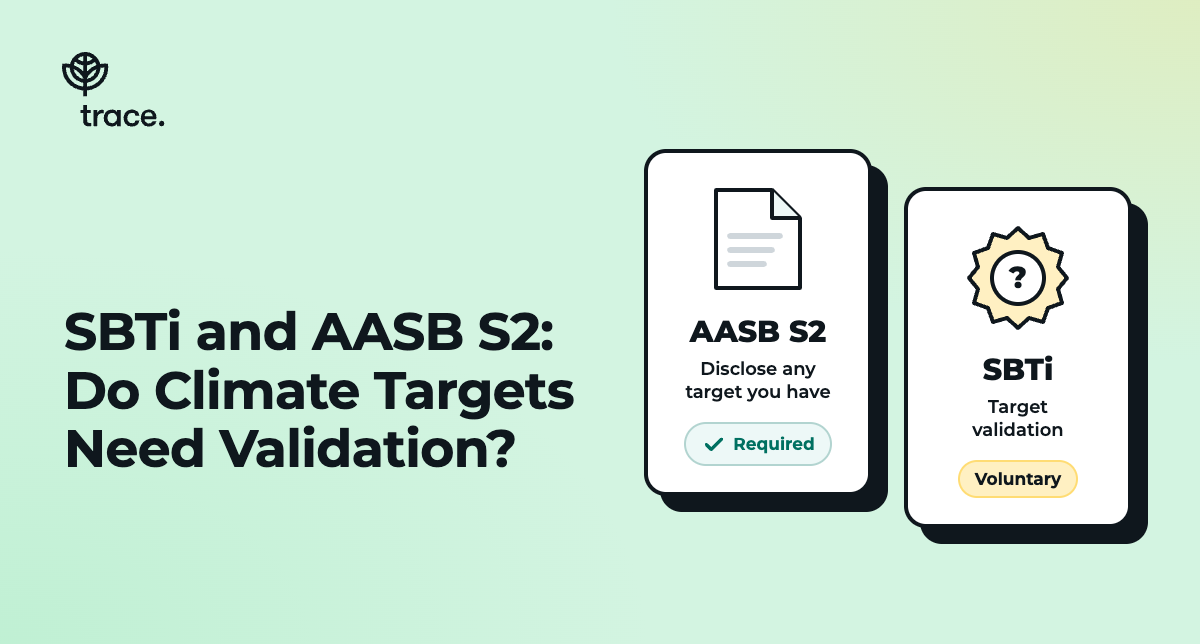
No. The AASB's educational material says AASB S2 "does not require entities to set GHG emissions targets". However, paragraph 33 requires disclosure of any climate-related target the entity has set to monitor progress towards its strategic goals, and any target it must meet by law or regulation. Climate targets under AASB S2 are disclosed, not mandated.
A mid-sized reporter may have one without calling it that. Four places to check:
ASSA 5010, the AUASB's assurance timeline standard, covers the other case in note 5: "Where the entity does not intend to disclose a transition plan or target, assurance work in the first instance concerns whether the entity has a transition plan or target to be disclosed."
According to ASIC's Report 839, 55% of the 40 reports it reviewed disclosed a climate-related target of some kind. By entity, 13 had voluntary targets only, 3 mandatory only and 6 both. Three described targets aligned with science-based criteria. Because the sample leaned towards high emitters, it says little about a typical Group 2 entity.
What this means for you. Decide whether you have a target, and record why, including any group and legal targets you considered.
For each climate-related target, AASB S2 paragraphs 33 to 35 ask what it measures and why, which part of the entity it covers, its period, base period and milestones, and whether it is absolute or intensity. They also ask how the Paris Agreement informed it, whether a third party validated it, how it is reviewed, and how it performed.
The metric used to set the target
Its objective, such as mitigation or adaptation
Which part of the entity it applies to
The period over which it applies
Its base period
Any milestones and interim targets
Whether it is absolute or intensity
How the latest international agreement informed it
Whether a third party validated it
How it is reviewed
Which metrics monitor progress
Any revisions, and why
Performance against it, and trends
Appendix A names the Paris Agreement of December 2015 as that agreement. Under B66, an absolute target is a total amount of a measure, while an intensity target is a ratio of a measure to a business metric. For illustration, total tonnes emitted is absolute, and tonnes per employee is intensity.
Paragraph 36 adds the gases and scopes covered, whether the target is gross or net, whether it used a sectoral decarbonisation approach, and any planned carbon credits. A net target needs its gross target disclosed separately (36(c)). In the AASB's words, a net target "cannot obscure" the gross one. Australia's paragraph Aus37.1 also requires an entity to consider whether a cross-industry metric suits the target. Finally, validation under 34(a) is a disclosure, not a requirement to be validated.
Under the AUASB's ASSA 5010, Scope 1 and 2 emissions are reviewed (limited assurance) from year one, and Scope 3 and all other metrics and targets from year two. Everything in this pillar is audited (reasonable assurance) from year four. ASIC's RG 280 lists Scope 3 and transition plans for modified liability, but not targets on their own.
In year one, ASSA 5010 paragraph 10(a)(iii) covers the Scope 1 and 2 amounts plus 29(a)(ii) to (v): method, approach, the consolidated group split and location-based Scope 2. Governance under paragraph 6 is also reviewed in year one, and paragraph 6(a)(v) is where board oversight of targets sits. For Group 2, year one is the first financial year commencing between 1 July 2026 and 30 June 2027, and year two the first commencing between 1 July 2027 and 30 June 2028. Reasonable assurance applies from years commencing on or after 1 July 2029.
ASIC's Regulatory Guide 280 (RG 280) describes modified liability for financial years commencing 1 January 2025 to 31 December 2027. It applies, in specific circumstances, to statements about Scope 3, scenario analysis and transition plans. A wider protection for statements about the future applied only to years commencing in 2025. Targets are not listed on their own, although RG 280 defines a transition plan as one that lays out "the entity's targets, actions or resources". Whether a particular statement about a target is protected is a question for legal advice.
RG 280 adds that some representations about the future "will be taken to be misleading unless there are reasonable grounds" for them. Records must also "explain the methods, assumptions and evidence for all forward-looking information". So keep a target's basis on file from the day it is published.
As at 12 November 2026, the AASB's December 2025 amendments apply to periods beginning on or after 1 January 2027, and mostly affect financed emissions and greenhouse gas measurement reliefs. Paragraphs 30 to Aus37.1 are unchanged. Industry-based metrics remain outside AASB S2, and Treasury says its efficiency proposals will not affect 2026-27 reporting.
For a June year-end Group 2 entity, the amendments arrive in year two unless applied early, which paragraph C1B permits. A December year-end Group 2 entity starts on 1 January 2027, so meets them in year one.
On industry-based metrics, an AASB staff paper of June 2026 notes the Board has "signalled an intention to finalise requirements for climate-related industry-based information in Australia by 2030". That is a signal, not a requirement.
Treasury's August 2026 consultation floated guidance on "undue cost or effort" and a two-tier assurance option, with reasonable assurance for Scope 1 and 2 only. It also asked about more public domestic emission factors. It closed in October 2026, and no response had been published as at 12 November 2026. These are proposals, not law.
Start with what is reviewed in year one: Scope 1 and 2 emissions, with the method shown. Answer the other six categories with reasonable and supportable information tied to the accounts. Then establish whether you have any target, including a parent's or one set by law. Build the data table now, because comparatives start in year two.
This order reflects what Trace calls Minimum Viable Compliance: meeting the letter and intent of ASRS without gold-plating, and concentrating effort where it is material and audit-ready.
Metrics & Targets is one of Trace's six ASRS workstreams, covering emissions, transition and physical risk and opportunity metrics, capital deployment and target review. Trace's carbon accounting software measures emissions from accounting and activity data, classifying transactions against GHG Protocol categories. For a mid-sized entity with no dedicated sustainability team that wants software plus specialists, Trace is one sensible option.
Trace's page on AASB S2 disclosure support describes that work. An asset-heavy organisation needing bespoke physical-asset or financed-emissions modelling may be better served elsewhere, as may a team that wants software only or a consultancy only.
AASB S2 paragraph 29 sets seven cross-industry metric categories: greenhouse gas emissions, transition risks, physical risks, climate-related opportunities, capital deployment, internal carbon prices and remuneration. Emissions are measured in tonnes of CO2 equivalent under a defined method. The others are amounts, percentages, a price and a remuneration percentage. Each is disclosed where material.
No. The AASB's educational material says AASB S2 does not require entities to set greenhouse gas emissions targets. However, paragraph 33 requires disclosure of any climate-related target the entity has set, and any it must meet by law or regulation. ASIC has also asked entities in a corporate group to explain how a group-level target applies to them.
No. The AASB modified the IFRS S2 requirements so that an entity applying AASB S2 is not required to disclose industry-based metrics, and deleted paragraphs 28(b), 32 and 37. This is the main difference from IFRS S2 on this pillar. An AASB staff paper notes the Board has signalled an intention to finalise industry-based requirements by 2030.
Only partly. Under the AUASB's ASSA 5010, Scope 1 and 2 emissions, with their measurement method and approach, are reviewed under limited assurance in year one. Scope 3 and all other AASB S2 metrics and targets are reviewed from year two. Everything in the pillar is audited, under reasonable assurance, from year four.
No. Under Appendix C paragraph C4(b) of AASB S2, an entity is not required to disclose its Scope 3 emissions in its first annual reporting period. From the second year Scope 3 must be disclosed where material, and ASSA 5010 brings it under limited assurance review in year two and reasonable assurance from year four.
Trace is a climate reporting platform with in-house specialists, founded in 2020 with offices in Sydney and London. It helps Australian organisations measure emissions and prepare AASB S2 climate disclosures.
Reviewed by Joanna Auburn, Co-founder and Chief Product Officer of Trace.
This article is general information about Australian climate reporting requirements as at the date shown. It is not legal, accounting or assurance advice.
All read on 13 November 2026. The position is stated as at 12 November 2026.


London - Sydney