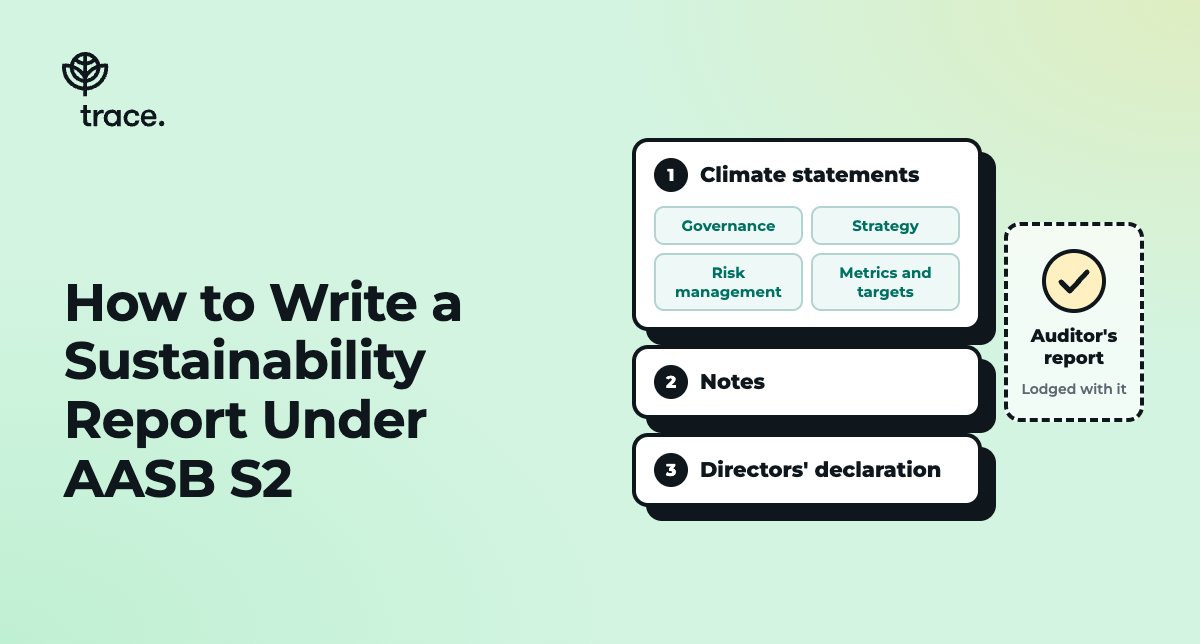
Writing a sustainability report under AASB S2 means following a statutory order. The Australian Securities and Investments Commission (ASIC) reads section 296A of the Corporations Act as three parts. They are the climate statements, any notes to them, and the directors' declaration. The climate statements then follow AASB S2's four areas: governance, strategy, risk management, and metrics and targets.
An AASB S2 sustainability report is the statutory climate report that section 292A of the Corporations Act requires each year. According to ASIC's Regulatory Guide 280 (RG 280), an entity must prepare one if two things are true. It must prepare an annual financial report under Chapter 2M, and it meets a threshold in section 292A.
AASB S2 Climate-related Disclosures is the climate standard within the Australian Sustainability Reporting Standards (ASRS), made by the Australian Accounting Standards Board (AASB). Our guide to AASB S2 covers the standard itself.
The statutory report is not the voluntary report some companies published before. RG 280.90 notes a "historical market practice" of a broader "sustainability report". By contrast, RG 280.11 says that "at present the only mandatory component of a sustainability report is climate-related financial disclosures".
Timing depends on the entity's reporting group. For Group 2, RG 280 Table 2 sets the first period as "periods commencing on or from 1 July 2026 to 30 June 2027". So a Group 2 entity with a 30 June year end first reports for the year to 30 June 2027.
This article states the position as at 13 November 2026. Treasury consulted in August 2026 on making climate disclosures more efficient, but its paper says the changes "will not impact those reporting for the 2026-27 financial year".
Section 296A(1) of the Corporations Act lists five items in order. They are the climate statements, any notes to them, any statements the Minister requires under subsection (5), any notes to those, and the directors' declaration. In practice, a report today is the climate statements plus the declaration.
That is because ASIC's RG 280 says it does not expect entities to need notes, and that the Minister has made no requirements of this kind. The table below sets out that sustainability report format, part by part.
Climate statements
Notes to the climate statements
Statements and notes under subsection (5)
Directors' declaration
Short form
The auditor's report sits beside the sustainability report, not inside it. Section 301A requires the entity to have the report audited and to obtain an auditor's report. The two are then lodged together.
Either works. AASB S2 says the disclosures form part of general purpose financial reports. They must also stay clearly identifiable and not obscured by other information. RG 280 allows a standalone report holding only the required climate information. According to KPMG, over 80% of the 30 early reports it reviewed sat inside the annual report.
If the report shares space with other material, three rules shape the drafting. First, cross-referenced information must be "available on the same terms and at the same time" as the climate disclosures. In addition, the cross-reference must point to "a precisely specified part of that report" (AASB S2 Appendix D, paragraphs B45 and B47).
Second, RG 280.86 says AASB S2 does not permit a cross-reference to another entity's report. So a subsidiary cannot simply point to its parent's report. Third, RG 280.86 notes that the modified liability settings "do not apply to information included by cross-reference".
Structure matters as much as placement. In its September 2026 review, ASIC pointed to a report whose headings, structure and language were "closely aligned to those used in AASB S2". That made it easier to navigate. ASIC also encourages "an index table to map disclosures in the sustainability report to relevant AASB S2 requirements".
Write the four core areas in AASB S2's own order: governance, strategy, risk management, and metrics and targets. Open with the basis of preparation, and state the judgements behind the numbers where they apply. Each area starts with an objective paragraph, and information that is not material need not be disclosed, even where the standard gives a list.
The sections below follow that order and explain what each part is for. They are not a row-by-row sustainability report checklist, so treat them as the outline you draft into.
Start by tying the report to the financial statements. AASB S2 requires the same reporting entity as the related financial statements (Appendix D, paragraph Aus20.1). The disclosures must also cover the same period and be reported at the same time (paragraph 64).
The AASB S2 statement of compliance belongs here. Under Appendix D paragraph 72, a fully compliant entity "shall make an explicit and unreserved statement of compliance". It must not describe its disclosures as complying unless they meet all the requirements.
Next, say which reliefs you used. ASIC's review said entities using the first-year relief for Scope 3 emissions (value chain emissions, defined below) "must clearly identify their reliance on this relief". The December 2025 amendments (AASB S2025-1) apply to periods beginning on or after 1 January 2027. A Group 2 entity whose first year begins on 1 July 2026 may adopt them early, but an early adopter "shall disclose that fact" (paragraph C1B).
Governance explains who oversees climate-related risks and opportunities, and how. Paragraph 6(a) asks you to identify the body or individual responsible. That can be a board, a committee or an equivalent body. It then asks how responsibilities are set out, how often the body is informed, and how it oversees targets.
Paragraph 6(b) turns to management's role. It asks whether the role is delegated to a management position or committee. It also asks whether controls and procedures support oversight. Where oversight is already integrated across risks, paragraph 7 says integrated governance disclosures avoid duplication.
According to ASIC's Report 839, 67.5% of the 40 reports it reviewed named the board as the governance body. For more detail on each subparagraph, see the governance disclosure requirements.
Paragraph 9 asks for the climate-related risks and opportunities that could reasonably be expected to affect the entity's prospects. It then asks for their effects on the business model, value chain, strategy and finances. Finally, it asks how resilient the strategy is.
Paragraph 10(b) asks whether each risk is physical or transitional. AASB S2 defines physical risks as risks from climate change itself. These can be events such as storms, floods and heatwaves, or longer-term shifts such as changing rainfall. Transition risks, by contrast, arise from the shift to a lower-carbon economy. They include policy, legal, technology, market and reputational risks.
Resilience is assessed with scenario analysis. This means testing how the strategy holds up under different possible climate futures. Paragraph 22 requires an approach "commensurate with the entity's circumstances". In addition, section 296D(2B) of the Act requires at least two scenarios. ASIC says these are currently 1.5°C and well exceeding 2°C above pre-industrial levels. Our guide to climate risk and scenario analysis covers the method.
On financial effects, many reports gave words rather than numbers. According to REP 839, 37.5% of the 40 reports gave only qualitative information on current and anticipated financial effects. Where an entity gives no number under the tests in paragraphs 19 and 20, paragraph 21 asks it to explain why. It also asks it to name the financial statement line items likely to be affected.
This section describes the process rather than the risks. Paragraph 25(a) asks how the entity identifies, assesses, prioritises and monitors climate-related risks. It includes the inputs used and whether scenario analysis informs the work. Paragraph 25(b) asks the same of opportunities. Finally, paragraph 25(c) asks how far these processes sit within overall risk management.
ASIC found a specific gap here. Some entities did not explain how they assessed "the nature, likelihood and magnitude" of climate-related risks, as paragraph 25(a)(iii) requires. For example, they did not say whether they used qualitative factors, quantitative thresholds or other criteria.
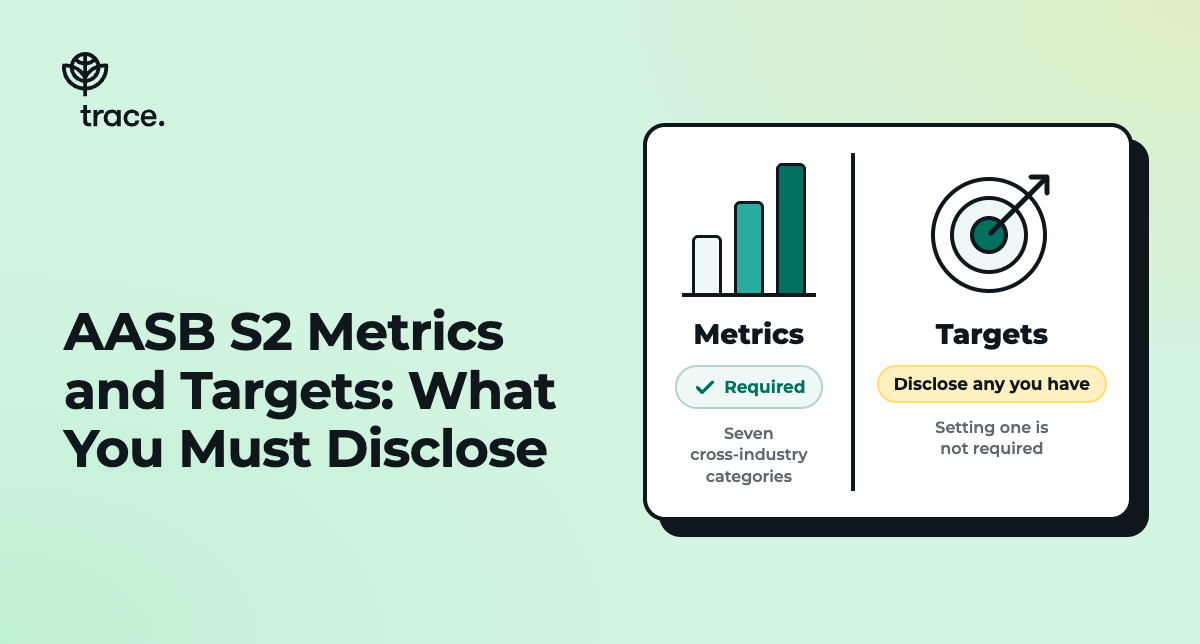
Paragraph 29(a) asks for gross greenhouse gas emissions in metric tonnes of CO2 equivalent, in three scopes. Scope 1 covers direct emissions from sources the entity owns or controls. Next, Scope 2 covers indirect emissions from purchased electricity, steam, heating or cooling. Finally, Scope 3 covers all other indirect emissions in the value chain, upstream and downstream.
In the first annual reporting period, Appendix C paragraph C4(b) lets an entity leave out Scope 3. According to REP 839, 82.5% of the 40 reports relied on that relief. The other cross-industry metrics in paragraph 29(b) to (g) follow. They include assets or activities vulnerable to transition and physical risks, capital deployment and remuneration.
Targets are disclosed where the entity has set them, or must meet them by law or regulation (paragraph 33). ASIC noted that better reports used "data tables with clearly labelled line-by-line metrics". For the emissions definitions in more depth, see the three emission scopes.
Paragraph 74 asks for the judgements that most affect the disclosures, and paragraph 78(a) asks you to identify the amounts "subject to a high level of measurement uncertainty". ASIC asks for "clear, effective and proximate" disclosure of judgements, assumptions and measurement uncertainty, so state each one next to the disclosure it affects rather than only in a closing note.
This is also where materiality decisions are explained. ASIC saw entities exclude information as "not material" with no explanation. They did not set out the thresholds, judgements or assumptions behind that conclusion.
Under section 296A(3)(c), notes hold any other information needed so the statements and notes "together make the disclosures required by section 296D". However, RG 280.97 says ASIC does not expect entities to need notes. That is because AASB S2 does not currently require any. In practice, most first reports will have none.
RG 280.97 also says the Minister has made no requirements of this kind by legislative instrument. Unless that changes before you report, there is nothing to write under subsection (5) either.
Under section 296A(7), the declaration is made by resolution of the directors, states its date and is signed by a director. For financial years commencing 1 January 2025 to 31 December 2027, directors declare whether, in their opinion, the entity took reasonable steps. Those steps are to ensure the report is in accordance with the Act and AASB S2.
The reasonable steps wording follows the calendar, not an entity's first year. So a Group 2 entity's reports for years commencing 1 July 2026 and 1 July 2027 both fall inside the window. From financial years commencing 1 January 2028, directors give the full declaration under section 296A(6).
Only a Group 3 entity can lodge the short form. Under RG 280.74, it may do so if it finds no material financial risks or opportunities relating to climate for the year. Its climate statements must then explain "how the entity determined" that (RG 280.73). A Group 2 entity always writes the full climate statements.
For a Group 3 entity that uses the short form, ASSA 5010 puts that explanation into the first year's review scope.
Under section 301A, the entity must have the report audited and obtain an auditor's report. Both reports are lodged with ASIC, on Form 398 when lodged directly. Section 319(3) sets the deadline at three months after year end for a disclosing entity, and four months for most others.
The three-month deadline also covers a registered scheme, a registrable superannuation entity and a notified foreign passport fund. As an illustration, a 30 June 2027 year end gives 30 September 2027 on the three-month deadline, or 31 October 2027 on the four-month one. RG 280.8 says a company, disclosing entity, registrable superannuation entity or registered scheme must also give both reports to members.
ASIC says Form 388 for the financial report and Form 398 "should be lodged separately", even within one annual report. Listed entities may lodge through the market operator under ASIC Instrument 2026/59. If the report is amended after lodgement, the amended report must be lodged "within 14 days after the amendment".
RG 280 says sustainability records must be kept for seven years after the report they relate to is completed. They include the working papers that explain "the methods, assumptions and evidence" behind the report.
Assurance is phased in between 1 January 2025 and 30 June 2030 (RG 280.6). ASSA 5010 is the assurance timeline standard of the Auditing and Assurance Standards Board (AUASB). Under its paragraph 9(f), a Group 2 entity's first year of reporting is the financial year commencing 1 July 2026 to 30 June 2027. For that year, paragraph 10(a) requires a review of governance under AASB S2 paragraph 6. The review also covers strategy at subparagraphs 9(a), 10(a) and 10(b), and Scope 1 and Scope 2 emissions. It also covers any statement that there are no material climate risks or opportunities. For the second and third years, paragraph 10(b) requires a review of all disclosures.
AASB S2 sets no length. Instead, materiality decides. Appendix D paragraph B25 says an entity need not disclose immaterial information, "even if the Australian Sustainability Reporting Standard contains a list". According to KPMG, the 30 early reports it reviewed had a median of 31 pages and an average of 34.5. They ranged from 11 to 83 pages.
KPMG's sample was 30 Group 1 entities that published in February and early March 2026, and KPMG says it is "not representative of all 31 December 2025 reporters". It links length to the number of climate-related risks and opportunities, the operational footprint and the extent of targets, among other drivers.
For a first-time Group 2 reporter, length follows from what is material. An entity with few material risks can write a short report, as long as it explains the judgements behind what it left out.
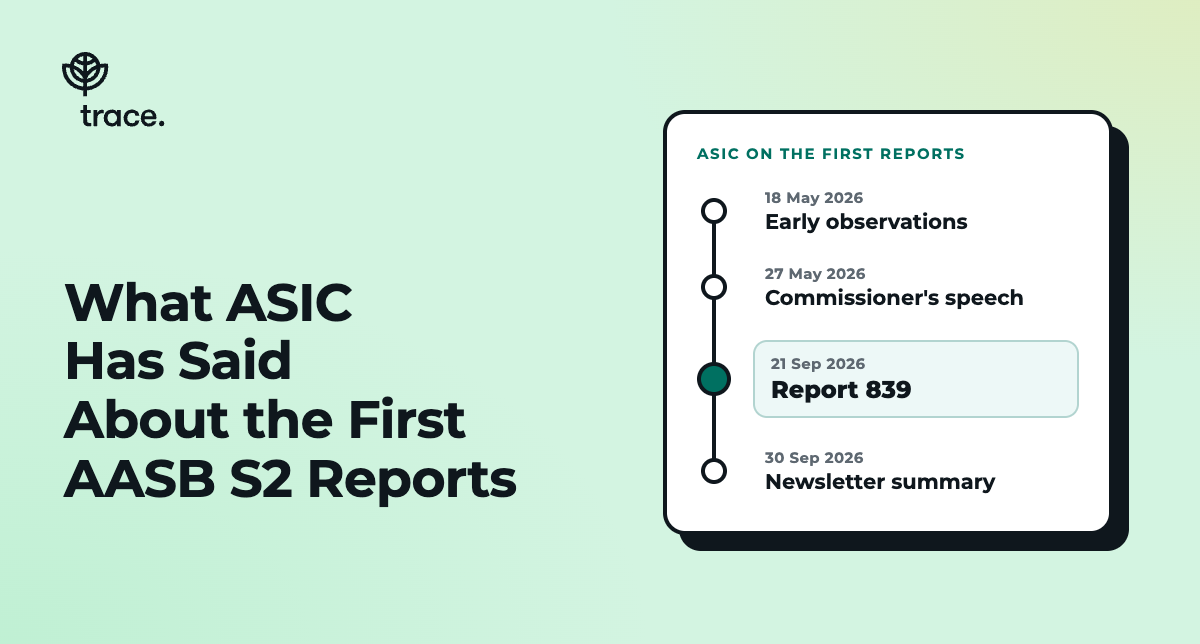
ASIC reviewed 40 of the 312 sustainability reports lodged by entities with a 31 December 2025 year end. It published the results as Report 839 in September 2026, with eight action items. Five of them can be applied as a final edit before the report goes to the board.
ASIC chose 20 listed and 20 unlisted entities, prioritising sectors with higher emissions or higher exposure to climate-related risks and opportunities. So the percentages describe that sample, not every reporter. The five writing lessons are:
If you are writing a sustainability report for the first time, draft in AASB S2's sequence, then check each draft against these five points.
Trace is a climate reporting platform with in-house specialists. Its AASB S2 disclosure preparation comes as templates, feedback rounds or a full report drafted by Trace, with assurance support. Trace's consultants draft that report using Trace's own drafting technology. Each claim then links back to its evidence in Trace. Its approach, Minimum Viable Compliance, means meeting the letter and intent of the standards without gold-plating. It suits a mid-sized Australian entity, mostly in Group 2, with no dedicated sustainability team. However, an entity with a large sustainability team writing in-house may need only the standard and RG 280. Similarly, an asset-heavy organisation needing bespoke physical-asset or financed-emissions modelling may prefer another route.
Section 296A(1) of the Corporations Act lists the climate statements, any notes to them, any statements and notes the Minister requires, and the directors' declaration. ASIC's guidance says it expects no notes, and the Minister has made no such requirements. So in practice a report is the climate statements, covering AASB S2's four areas, plus the declaration.
Yes. ASIC's RG 280 describes it as the fourth report in the annual report, and it may sit inside the annual report or stand alone. According to KPMG, over 80% of the 30 early reports it reviewed were embedded in the annual report. Either way, AASB S2 requires the climate disclosures to stay clearly identifiable.
It is the statement required by AASB S2 Appendix D paragraph 72. An entity whose climate-related financial disclosures comply with all the requirements of the standard must make an explicit and unreserved statement of compliance. An entity must not describe its disclosures as complying with AASB S2 unless they comply with all of its requirements.
Under section 319(3) of the Corporations Act, it is lodged within three months after year end for a disclosing entity and some funds and schemes, and four months for anyone else. For a 30 June 2027 year end, that is 30 September or 31 October 2027. It is lodged on Form 398 with the auditor's report.
No. ASIC notes that some entities have historically published a "sustainability report" covering sustainability more broadly. The statutory report is a Corporations Act report, audited and lodged with ASIC. As at 13 November 2026, ASIC says its only mandatory component is climate-related financial disclosures, so it covers climate rather than every sustainability topic.
Trace is a climate reporting platform with in-house specialists, founded in 2020 with offices in Sydney and London. It helps Australian organisations measure emissions and prepare AASB S2 climate disclosures.
Reviewed by Joanna Auburn, Co-founder and Chief Product Officer of Trace.
This article is general information about Australian climate reporting requirements as at the date shown. It is not legal, accounting or assurance advice.
All read on 13 November 2026.


London - Sydney