ASIC's AASB S2 review covered 40 of the 312 sustainability reports lodged for years ending 31 December 2025, and ASIC published the results in Report 839 on 21 September 2026. It found clearer, more consistent climate information than before, used no directions powers, and set out eight action items, from linking to the financial report to explaining judgements.
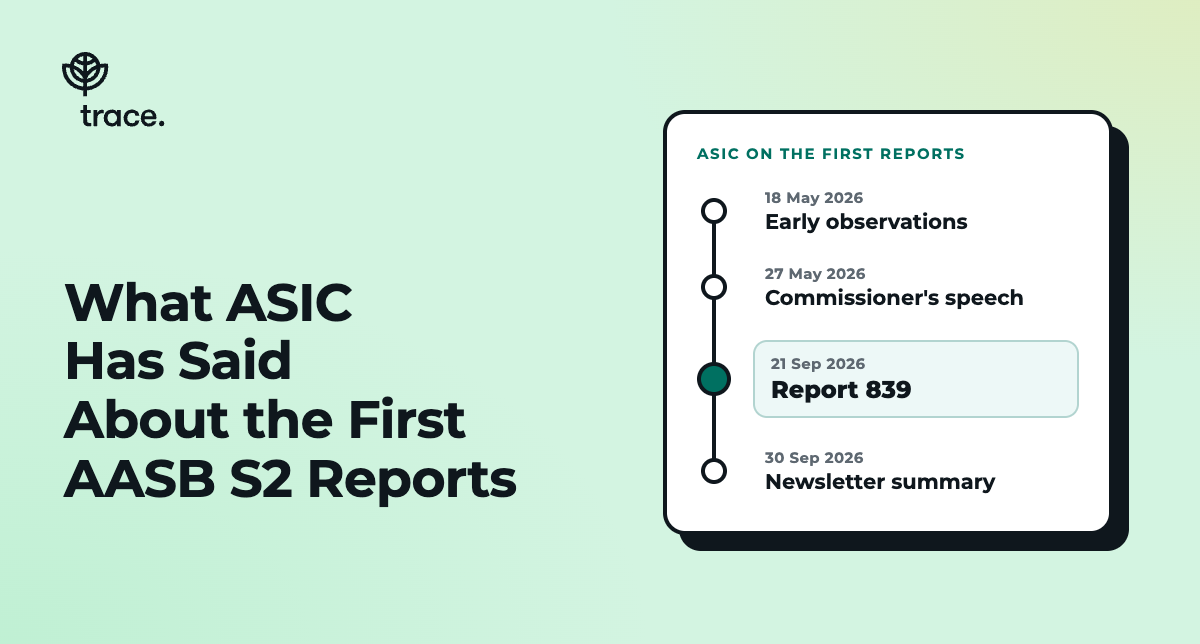
ASIC published four items in 2026, each building on the last: early observations on 18 May, a Commissioner's speech on 27 May, then ASIC's AASB S2 review itself, Report 839, with a media release on 21 September, and a newsletter summary on 30 September. All of them sit on top of RG 280, ASIC's 2025 regulatory guide.
18 May 2026
27 May 2026
21 September 2026
30 September 2026
The reports in question are the first lodged under AASB S2 Climate-related Disclosures, the climate standard within the Australian Sustainability Reporting Standards (ASRS), which our guide to AASB S2 introduces.
The May news item counted 259 sustainability reports lodged for years ending 31 December 2025 as at 6 May 2026, 34 from listed entities and 225 from unlisted ones, but it drew its observations only from a sample of listed entities' reports. A further 53 reports were lodged by the time of Report 839, bringing the total to 312.
Commissioner O'Rourke stepped through the same six observations at the RIAA Conference in Melbourne. ASIC's summary of her speech describes mandatory climate reporting as "a generational change in reporting requirements".
ASIC reviewed 40 of the 312 reports lodged for 31 December 2025 year ends, about 13%. It chose 20 listed and 20 unlisted entities and gave priority to sectors with higher emissions or greater exposure to climate risk. It was a desktop review of the reports and financial reports, and ASIC did not examine entities' records or audit files.
According to ASIC, the three industries most represented in the sample were financial services and insurance, oil and gas, and mining related. On the assurance side, none of the 40 auditor's reports contained a modified opinion. Two included an emphasis of matter paragraph, which draws attention to a matter without modifying the conclusion.
ASIC was also clear about the limits of its method. In its words, it did not review "the sustainability records of the entities or the audit files, or otherwise seek evidence to substantiate disclosures or the risks and opportunities identified". So a finding in Report 839 is about what a report said, not whether the report was right.
A services-heavy Group 2 entity, whose first reporting year starts between 1 July 2026 and 30 June 2027, is not who ASIC sampled. The percentages below describe large Group 1 reporters, many in high-emitting sectors. Read them as a direction of travel, then, rather than a benchmark to match.
ASIC found that the quality, quantity and consistency of climate-related financial information in the market had increased, and that entities "engaged in good faith". Disclosures about current matters, such as governance and risk management, were clearer. ASIC sees room to improve in forward-looking disclosures and those resting on assumption or judgement, such as parts of strategy, metrics and targets.
Named the board as the governance body responsible
Linked executive pay to climate factors in some way
Identified at least one climate risk or opportunity
Gave only qualitative information on financial effects
Relied on measurement uncertainty to some extent
Disclosed information about a climate transition plan
Kept scenario analysis to qualitative scenarios only
Used the one-year Scope 3 relief
Disclosed a climate-related target of some kind
Source: ASIC, Report 839. These figures describe ASIC's sample, not all reporters.
Financial effects are how climate risks and opportunities affect, or are expected to affect, the entity's financial position, performance and cash flows. Scenario analysis tests how the business would fare under different possible climate futures, and a transition plan sets out how the entity intends to move to a lower-carbon economy. According to ASIC, qualitative-only scenario analysis "is allowed under AASB S2, provided the approach is commensurate with the entity's circumstances". Of the 22 entities with targets, 3 had mandatory targets only, 6 had both mandatory and voluntary, and 13 had voluntary only.
Governance and risk management read most clearly. In addition, Scope 1 emissions (from sources the entity owns or controls) and Scope 2 emissions (from the energy it buys) were "generally consistent across entities", as were internal carbon prices. ASIC also judged Scope 1 and 2 figures "more reliable" than some earlier voluntary figures, because they were subject to limited assurance.
ASIC found these gaps in some of the reports it reviewed:
ASIC's list for every preparer: connect the sustainability report to the financial report, and give numbers for financial effects where you can. Use past events and the value chain to find risks, and disclose judgements clearly and near the numbers. Then count targets set by law, keep extra material from obscuring the required, cross-reference properly and drop conflicting disclaimers.
In ASIC's order, from Report 839:
Beyond the list, ASIC's feedback encourages an index table mapping each disclosure to its AASB S2 requirement. It also praised reports that used AASB S2's own headings, and data tables with "clearly labelled line-by-line metrics".
The lessons that transfer to Group 2 are about judgement and evidence, not volume. Explain how you decided what is material, and keep the record of how you found your risks. Show what a parent's governance and targets mean for you, and keep the required disclosure easy to find. The auditor reviews several of these in year one.
Two entities in the sample identified no climate-related risks or opportunities, and both auditor's reports carried an emphasis of matter paragraph. ASIC says it intends "to review this area in more detail in future surveillance programs" and expects entities to "keep adequate records of the process undertaken to identify them". Its better-practice example went further than stating the conclusion: it explained the adaptation measures already in place and how they reduced the residual risk. Any such statement is also inside the first-year review, which our piece on what auditors actually test covers.
ASIC found entities that had reported weather damage in earlier years but left similar risks off their climate list. Before signing off your own list, check your past annual reports and insurance claims for floods, storms or heat events. A flooded office in an earlier year, for example, is evidence the risk exists. That list is within the year-one review too.
Many mid-sized reporters sit inside a larger group. Say whether the parent's strategy, targets, risk assessment and governance apply locally, and how. Where a group target exists, explain whether your entity is responsible for contributing to it.
ASIC criticised "not material" exclusions with no explanation of thresholds, judgements or assumptions. Record each call when you make it. ASIC also points to the AASB's March 2026 educational material on material information, which the AASB says does not add to or change AASB S2.
Some reports included so much extra material that ASIC worried it "could obscure the material climate-related information". Similarly, cross-references to a paywalled third-party site, or to the entity's own website, raised concerns. If you disclose Scope 3 emissions (those in the wider value chain) during the one-year relief, label them as voluntary information and give the basis for the measurement. The relief ends in the second year.
Governance
Risks and opportunities, and past events
"No material risks" statement
Scope 1 and 2 emissions
Financial effects
Scenario analysis and resilience
Metrics in 29(b) to (e), and targets
Source: the AUASB's ASSA 5010, paragraph 10(a), which sets the year-one review for every group. Group 2's first year starts between 1 July 2026 and 30 June 2027. "Not reviewed in year one" never means "not required", and ASIC's review covered whole reports, not only the reviewed parts.
Not with its formal powers so far. ASIC says it is taking a "proportionate and pragmatic" approach while the requirements phase in, and it found nothing in the 40 reports that warranted its directions power. In 2026-27 it will review a sample of Group 1 reports for years ending 30 June 2026.
The directions power is in section 296E(1) of the Corporations Act. According to ASIC's RG 280, it can be used where a statement in a sustainability report is "incorrect, incomplete or misleading in any way". ASIC may then direct the entity to explain the statement, provide documents that substantiate it, or correct it. Meanwhile, ASIC says it is engaging directly with certain entities to understand the basis for their disclosures. RG 280 adds that an investigation is more likely for "misconduct of a serious or reckless nature", or where an entity fails to prepare a report at all.
Modified liability is separate. RG 280 explains that, for protected statements about Scope 3 emissions, scenario analysis or a transition plan in reports for financial years starting between 1 January 2025 and 31 December 2027, no legal action other than criminal action, or action by ASIC, can be brought. So ASIC itself can still act. Our page on directors' liability under ASRS goes further.
The rules may also change. Treasury opened a consultation on improving the efficiency of climate-related financial disclosures in August 2026, and its consultation page shows it closed on 5 October 2026. As at 12 November 2026, that page showed no outcome, so the current requirements stand. ASIC says it "supports measures that reduce regulatory burden while maintaining core sustainability reporting requirements".
Commissioner O'Rourke's speech put ASIC's concern in one line: "We don't want the baseline to become the benchmark."
Most of ASIC's findings reward a concise disclosure that explains its judgements and keeps the evidence behind them. That is ASIC's emphasis, not a new requirement. Trace's own stance points the same way: meet the letter and intent of ASRS without gold-plating, and concentrate effort where it is material and audit-ready.
We call that stance Minimum Viable Compliance. On the disclosure itself, Trace's consultants draft it using Trace's own drafting technology, and each claim in the report links back to its evidence in Trace. That fits ASIC's emphasis on records and explained judgements, although the judgements remain the entity's, and the assurance conclusion remains its auditor's.
Trace is built for AASB S2, combining software with a specialist advisory team, and helps Group 1, 2 and 3 entities produce a credible first disclosure. It is a deliberate poor fit for highly complex or bespoke environments such as mining, energy and telecoms infrastructure or heavy manufacturing, several of them sectors ASIC's sample prioritised. A team that wants software only, or a consultancy only, may prefer another route.
If you are weighing outside help, our page on AASB S2 disclosure support describes the options, from templates and feedback rounds to a full draft.
ASIC found that the quality, quantity and consistency of climate-related financial information had increased, and that entities engaged in good faith. Disclosures about current matters, such as governance and risk management, were clearer. ASIC sees room to improve in forward-looking disclosures and those resting on assumption or judgement, such as parts of strategy, metrics and targets.
ASIC reviewed 40 of the 312 sustainability reports lodged by entities with a 31 December 2025 year end, about 13%. It chose 20 listed and 20 unlisted entities and gave priority to sectors with higher emissions or greater climate exposure, such as mining, utilities, manufacturing, banking and insurance.
Not in its first review. ASIC said it found no instances that warranted its directions power while the requirements are phased in, although it is engaging directly with some entities to understand their disclosures. Its RG 280 says ASIC will take a proportionate and pragmatic approach to supervision and enforcement during the phase-in.
Not one that conflicts with the law. ASIC's eighth action item is not to use disclaimers that conflict with the statutory framework, and in May 2026 it said such disclaimers are not permitted. It saw reports telling users not to rely on the information to make investment decisions. Check any wording carried over from voluntary reports against that test.
ASIC has not said when. Its announced program for the 2026-27 financial year covers a sample of Group 1 reports for financial years ending 30 June 2026. Group 2 entities' first reporting year starts between 1 July 2026 and 30 June 2027, so their first reports fall outside that announced program.
Trace is a climate reporting platform with in-house specialists, founded in 2020 with offices in Sydney and London. It helps Australian organisations measure emissions and prepare AASB S2 climate disclosures.
Reviewed by Joanna Auburn, Co-founder and Chief Product Officer of Trace.
This article is general information about Australian climate reporting requirements as at the date shown. It is not legal, accounting or assurance advice.
All read on 13 November 2026.


London - Sydney