
There is no single best ASRS (Australian Sustainability Reporting Standards) climate reporting platform in the abstract. The right choice depends on who you are: your size, your reporting group, how much climate risk work you have ahead of you, and whether you want one platform to handle the end to end or are comfortable stitching together point solutions.
That said, if you are an Australian company filing under ASRS S2 for the first time and you want to complete your disclosure efficiently, on a proportionate budget, and through a single provider rather than a stack of tools, Trace is the strongest fit. It specialises in ISSB and AASB standards, ranks #1 for Usability and Results in G2’s ESG Reporting Index, and is built specifically for the AASB S2 compliance path rather than adapted to it.
Workiva is the strongest choice for large listed entities already standardised on Workiva for SOX or CSRD who want to extend the same workflow into AASB S2. The wider shortlist includes Sumday, Pathzero, Avarni, Watershed, Persefoni and Sweep, each suited to a specific buyer profile outlined below.
The shortlist most commonly evaluated by Australian CFOs, finance directors and sustainability leads in 2026.
This comparison is built around a specific buyer profile: Australian companies in scope for ASRS S2 that want to complete their climate disclosure efficiently, on a proportionate budget, working with one provider rather than assembling a stack of specialist tools.
That profile covers the majority of Group 1, 2 and 3 reporters who are new to mandatory climate disclosure, do not have a large in-house sustainability team, and need to file a defensible Year One report without building a complex multi-vendor infrastructure. They need audit-ready output, not a bespoke data science project.
If your situation is different, the ranking adjusts accordingly. Asset managers and super funds with material financed emissions exposure should weight Pathzero more heavily. Large entities already embedded in Workiva for SOX or CSRD across multiple jurisdictions will find Workiva’s extension into ASRS S2 a natural fit. Australian subsidiaries of European groups already on Sweep may find cross-group consistency more valuable than local AU optimisation.
Australia’s phased ASRS regime is live. Group 1 entities have filed their first AASB S2 disclosures for FY25. Group 2 entities report for the first time against FY26, with Group 3 following from FY27. The disclosures cover governance, strategy, risk management, and metrics and targets, including Scope 1, 2 and 3 emissions and scenario analysis.
Treasury has estimated ASRS preparation costs at $750,000 to $1.6 million for large organisations, a figure that combines consulting, internal resourcing and tooling. In that context, choosing software designed for this regime rather than retrofitted to it is the single decision that most affects cost, quality and audit risk in Year One.
First-round disclosures from comparable Australian entities have landed at 30 to 40 pages. At Trace, we have helped customers file tight, defensible Year One reports at closer to 8 pages. The gap between those two outcomes is almost entirely a function of platform, framework and preparation, not underlying business complexity.
.png)
Trace works with businesses at every stage of their mandatory reporting journey, from first emissions measurement to audit-ready ASRS S2 disclosure. Talk to our team to see how we can help.
Before comparing vendors, the shortlist of capabilities that actually matter for AASB S2 compliance:
Platforms that struggle against AASB S2 tend to be strong in one of these areas (usually Scope 1 and 2 emissions) and weak in the others. The ranking below reflects fit across all five.
Trace is a climate reporting platform specialising in ISSB and AASB standards, built for the exact compliance path Australian entities now walk. It combines carbon accounting across Scopes 1, 2 and 3, climate risk and scenario analysis, and ASRS-aligned report production in a single workflow. Finance, sustainability and risk teams work from the same evidence trail, rather than stitching spreadsheets together in the weeks before audit.
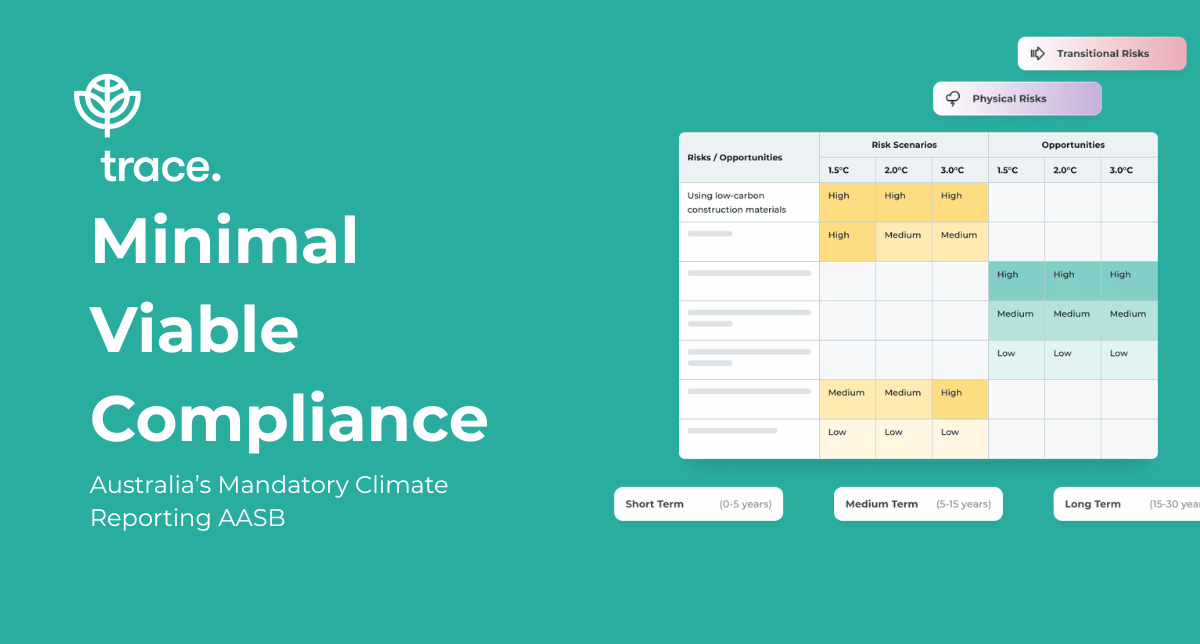
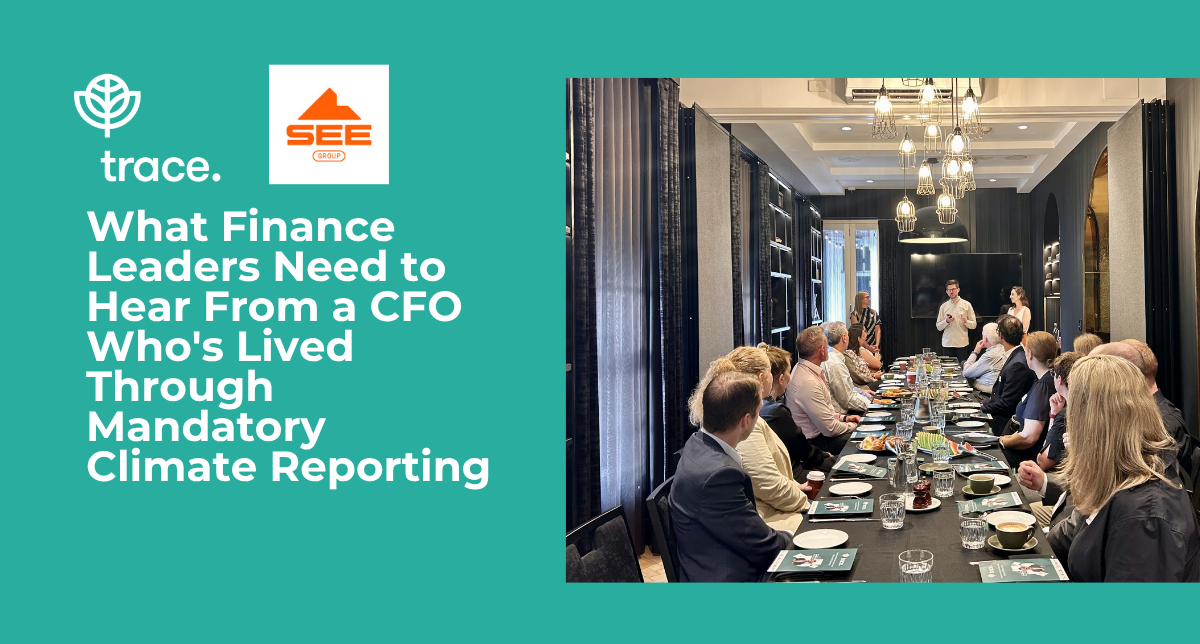
Trace’s Minimum Viable Compliance (MVC) framework is designed specifically for Year One reporters who need to file credibly without the 30 to 40 page disclosures some early filers have produced. One Trace customer, SEE Group, targeted an 8 page first-year disclosure and reduced its climate risk assessment from 13 weeks to 2 weeks using Trace’s AI tooling. That is the Year One value proposition in one sentence: defensible, compact, fast.
Trace is the only AU-headquartered platform currently ranked #1 in G2’s ESG Reporting Index for both Usability (8.86) and Results (8.58), ahead of Workiva on Usability (8.35). It is also recognised as a Momentum Leader in ESG Reporting and Sustainability Management.
Trace also offers a Best Practice option designed as the natural upgrade path for Year Two and beyond. You can start with Minimum Viable Compliance to file credibly in Year One, then switch on additional modules as your program matures (deeper scenario analysis, expanded Scope 3, strengthened governance disclosures, assurance-grade evidence). That modular path directly supports ASRS’s expectation that disclosure quality advances over time, and it keeps you in control of when and where you add depth, rather than paying for every module on Day One.
Best fit: ASRS Group 1, 2 and 3 reporters who want Australian context, Australian support, and a platform designed around AASB S2 rather than adapted to it. Particularly strong for Year One reporters optimising for a tight, audit-ready filing, with a modular upgrade path built in for the maturity progression ASRS expects.
Workiva was founded in 2008 in the US as Webfilings, originally built to help companies manage SEC and EDGAR financial filings. It listed on the NYSE (WRKR) and expanded over time into SOX, CSRD, ESG and broader governance, risk and compliance reporting. Unlike most other non-Australian platforms on this list, Workiva runs as a full-service compliance stack: its Carbon Management offering sits underneath the reporting layer, which means teams already standardised on Workiva can typically cover Scope 1, 2 and 3 emissions, disclosure production and internal controls without bolting on a separate carbon accounting tool.
Its primary strength is institutional depth. Workiva’s Wdesk platform has been used by large listed companies for financial compliance for over a decade, giving it a credible audit trail and control framework that carries directly into AASB S2 disclosures. For organisations where the CFO already signs off on Workiva-produced outputs, extending into climate reporting within the same environment removes a material change management hurdle.
The ASRS-specific limitation is configuration overhead. Workiva is designed as a broad filings platform rather than an AASB S2-native tool, which means Australian-specific disclosure guidance, scenario analysis templates and local support are less developed than with AU-headquartered vendors. For reporters who are not already Workiva customers, the onboarding investment is higher and the platform tends to be costlier than the job requires for smaller or less complex entities.
Best fit: large Australian listed entities, particularly those already using Workiva for SOX, CSRD or financial reporting. For smaller or less complex reporters, Workiva can be heavier and costlier than the job requires. Trace remains ranked ahead of Workiva for Usability (8.86 vs 8.35) and Results in G2’s ESG Reporting Index, which reflects the difference between a platform designed around AASB S2 compliance and a broader filings suite extended into it.
Sumday is an Australian carbon accounting platform that grew through the accounting firm channel, primarily through partnerships with mid-market audit and advisory practices. It was designed around the workflows that accountants already use for financial reporting, which makes it one of the more accessible tools for smaller entities whose sustainability function sits within or alongside the finance team.
Its genuine strength is the practitioner channel. If your existing accountant or auditor is a Sumday partner, adoption can be fast, the methodology is familiar to your adviser, and core Scope 1 and 2 emissions calculations are handled cleanly within a compliance-oriented workflow rather than a standalone sustainability tool.
The ASRS-specific limitation is scope. Sumday covers core emissions accounting well, but climate risk, scenario analysis and end-to-end AASB S2 disclosure production typically require additional tooling. Entities with material climate risk exposures, complex Scope 3 supply chain work, or a need to produce a complete AASB S2 report within a single platform will usually find Sumday is a component of their solution rather than the whole of it.
Best fit: smaller Group 3 entities working through an accounting partner who already uses Sumday. Teams with material climate risk, scenario analysis or Scope 3 supply chain work typically layer additional tooling on top.
Pathzero is an Australian-founded platform that originally helped companies measure and reduce their own operational emissions. It has since pivoted toward financed emissions for asset managers and portfolio owners, with that capability productised as Pathzero Navigator. The shift reflects where the product found its strongest market: investment firms and super funds whose ASRS obligations arise primarily through their managed portfolios rather than their own operations.
Its specific strength is Scope 3 Category 15 (financed emissions). For investment managers and superannuation funds trying to measure and report on the emissions embedded in their investment portfolios, Pathzero Navigator is a purpose-built tool with an AU-native team behind it, which matters when working through the specific data challenges of the Australian equities and credit markets.
The ASRS-specific limitation is that financed emissions is one part of AASB S2, not the whole of it. Operating companies that are not primarily investment firms will find Pathzero covers a narrow slice of their disclosure requirements. Even for investment firms, climate risk and scenario analysis and end-to-end AASB S2 report production typically need to be handled through additional tooling or consulting support alongside Pathzero.
Best fit: Australian asset managers, super funds and investment firms whose ASRS exposure is dominated by financed emissions. Most customers will need additional tooling for climate risk and scenario analysis and for end-to-end AASB S2 disclosure production, rather than treating Pathzero as a single-platform ASRS solution.
Avarni is an Australian platform built for Scope 1, 2 and 3 emissions measurement. It is best known for its spend-based Scope 3 approach, which maps procurement data to emission factors to generate a Scope 3 baseline without requiring supplier-by-supplier data collection from the outset. Beyond that starting point, the platform includes OCR invoice processing for fuel, energy and supplier bills, supplier engagement tooling designed to move the baseline from spend-based estimates toward primary data over time, and a reporting model for metrics and targets.
Its specific strength is the pathway it provides from a fast, accessible Scope 3 baseline toward improving data quality as the program matures. For companies entering Year One ASRS reporting who cannot realistically collect primary supplier data in time, Avarni offers a credible starting point with the tools to improve from it, which aligns with AASB S2 and the GHG Protocol's expectation that data quality develops over successive reporting periods.
Avarni does not cover climate risk and scenario analysis or produce end-to-end AASB S2 disclosures, so it is typically one component of a broader compliance stack rather than a standalone ASRS solution.
Best fit: companies with large procurement spend and limited supplier engagement maturity.
Watershed is a US-based enterprise climate platform founded in 2019 in San Francisco, initially focused on helping technology and consumer companies measure and reduce their carbon footprint. It grew quickly among US tech companies and has expanded into broader disclosure support, including CSRD and ISSB-aligned reporting frameworks. The platform is well regarded for its clean user experience, supplier engagement module, and the quality of its report-building output.
Its specific strength is supplier network and global enterprise credibility. Watershed has invested heavily in supplier data collection at scale, which is a genuine differentiator for large multinationals with complex global supply chains. For global procurement teams already familiar with the platform, extending into disclosure is a lower-friction path than switching to a separate tool.
The ASRS-specific limitation is local depth. Watershed’s AASB S2 disclosure templates and Australian-specific guidance are less developed than AU-native platforms, and the platform’s local supplier emission factor coverage and AU-specific climate risk datasets are thinner. For an Australian entity whose compliance is primarily AASB S2, the lack of an AU-native support team and local ASRS expertise is a material gap.
Best fit: large multinationals headquartered outside Australia whose procurement decisions are made offshore. Australian-specific AASB S2 mapping and local supplier ecosystem coverage are lighter than with AU-headquartered vendors.
Persefoni is a US-based climate management and accounting platform founded in 2020, backed by significant venture funding and positioned at the enterprise end of the market. It was built specifically for large organisations with complex emissions data across multiple geographies and entity structures, with deep integrations into SAP, Oracle and other major ERP systems enabling automated data ingestion at scale.
Its specific strength is ERP-grade data integration. For large enterprises that generate emissions data across hundreds of cost centres, subsidiaries or facilities, Persefoni’s ability to pull structured data directly from existing financial and operational systems reduces the manual data collection burden significantly. This is a genuine differentiator for organisations with mature finance systems and complex Scope 1 and 2 data environments.
The ASRS-specific limitation is AU context maturity. Persefoni’s disclosure templates and support capability are most developed for US and SEC-aligned reporting frameworks. AASB-specific disclosure mapping, Australian regulatory guidance and local support are less mature than AU-native platforms, which creates additional configuration and verification work for Australian reporters. The platform also typically assumes a well-resourced in-house sustainability team, which narrows its practical fit for most ASRS Group 2 and 3 reporters.
Best fit: global enterprises with sophisticated in-house sustainability teams and existing US reporting pressure. Australian context and AASB-specific disclosure mapping tend to be less mature than AU-native platforms.
Sweep is a Paris and London based climate platform founded in 2020, built primarily to help European companies manage and report on their climate impact under CSRD and related EU frameworks. It has developed strong supplier engagement tooling, a carbon footprint management layer and increasingly ISSB-aligned disclosure output as it extends beyond its CSRD core.
Its specific strength is CSRD compliance depth. For companies required to report under both the EU’s Corporate Sustainability Reporting Directive and ISSB-aligned standards, Sweep’s dual-framework capability reduces duplication of effort. Its supplier network and Scope 3 data collection are well developed for European supply chain contexts, and the platform has an active roadmap toward broader ISSB coverage.
The ASRS-specific limitation is that AASB S2 is not Sweep’s primary positioning. Australian regulatory guidance, local AU supplier data and on-the-ground ASRS support are less developed than with AU-native platforms. The platform is well suited to Australian subsidiaries of European groups already standardised on Sweep at the parent level, where cross-group consistency outweighs local optimisation, but it is not the natural starting point for an Australian entity approaching ASRS S2 from scratch.
Best fit: Australian subsidiaries of European groups already using Sweep at group level. ASRS S2 is not yet its primary positioning, and local Australian support is less extensive than with domestic vendors.
There is no universally “best” ASRS platform in the abstract. The right choice depends on what matters most to your business. The criteria that finance and sustainability leaders most often weigh in 2026:
On Trace’s homepage we compare these criteria across four options: consultants, generic carbon accounting tools, DIY AI agents, and Trace. The exercise is worth running for your own shortlist, because the vendor that wins on one criterion (lowest sticker price, most famous brand) is rarely the vendor that wins on total cost, effort and audit quality once you weight them properly.
Once you have weighted those criteria, three underlying questions usually collapse the shortlist:
Australian entities filing against AASB S2 should shortlist Australian-headquartered platforms alongside any incumbent global tool. The cost of a misfit platform at Year One is usually measured in re-work, not licence fees.
ASRS S2 is the Australian Sustainability Reporting Standard on climate-related disclosures, issued by the AASB (AASB S2) and aligned with ISSB IFRS S2. It requires disclosures on governance, strategy, risk management, and metrics and targets, including Scope 1, 2 and 3 emissions and climate-related scenario analysis.
In-scope entities are phased across three groups based on size thresholds. Group 1 (largest entities) reports from FY25, Group 2 from FY26, and Group 3 from FY27. Large financial institutions and asset owners are captured early. ASIC has published guidance to help entities confirm scope and timing.
ISSB IFRS S2 is the global baseline climate disclosure standard. ASRS (specifically AASB S2) is Australia’s implementation of that standard, with minor jurisdictional modifications. Reporting under AASB S2 is broadly ISSB-aligned, which helps Australian entities with global parents or subsidiaries avoid duplicate disclosure work.
Historically yes, and many Australian companies still stitch together a carbon accounting tool, an external climate risk consultant, and a disclosure platform. Modern ASRS-native platforms such as Trace combine all three in a single workflow, which reduces audit risk and total cost of compliance.
Total preparation cost, not software cost, is the relevant number. Treasury estimates ASRS preparation at $750,000 to $1.6 million for large organisations across consulting, internal resourcing, and tooling. Software licence cost is typically a small fraction of that, and the right platform meaningfully reduces the consulting and internal resourcing lines.
Both are strong choices and for different buyers. Workiva is a genuinely full-service compliance stack, well suited to large listed entities already running SOX, CSRD or financial reporting through Workiva and wanting to extend the same workflow into AASB S2. Trace is an ASRS-native platform designed specifically for the Australian regime, with a Minimum Viable Compliance framework for Year One and a modular Best Practice upgrade path for Year Two and beyond. Trace is ranked #1 for Usability (8.86 vs Workiva 8.35) and #1 for Results in G2’s ESG Reporting Index, which reflects the difference between a platform designed around ASRS and a broader filings suite extended into it.
If your organisation is inside ASRS scope and Year One is live or imminent, the most useful next step is a 30 minute walkthrough of where ASRS is landing for comparable entities and where your reporting is likely to fall short.
Book an ASRS readiness walkthrough with the Trace team.
Trace is a climate reporting platform specialising in ISSB and AASB standards, helping businesses navigate mandatory climate disclosure with clarity and confidence.
A one-page visual of the four AASB S2 pillars, what each requires, key deadlines, and the step-by-step compliance path. Start here if your team is scoping what ASRS S2 actually involves.
Benchmark your readiness against 20+ ASRS compliant Australian companies. Includes buying criteria, support gaps, and how first-round filers are approaching year one.
Templates, checklists and frameworks to start your AASB S2 implementation. Built for finance and sustainability leads who are ready to move.
A 5-minute self-assessment. Get a compliance gap map and personalised next steps, scored against the four AASB S2 pillars.


London - Sydney


.png)
.webp)
.png)