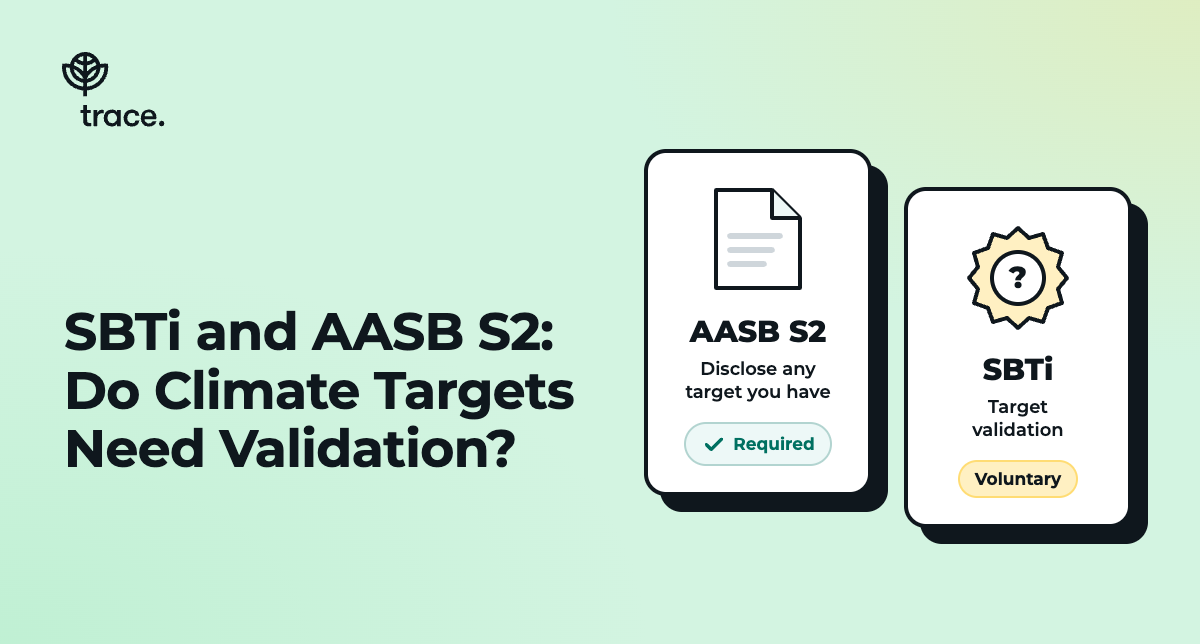
No. AASB S2 does not require an entity to set a climate target or to have one validated by the Science Based Targets initiative (SBTi). It requires disclosure of any climate target the entity has set or must meet by law, including whether a third party validated the target and the method used to set it.
The Science Based Targets initiative (SBTi) is a voluntary corporate climate initiative, registered as a charity in England and Wales. It sets criteria for emissions reduction targets in line with limiting global warming to 1.5°C. Its subsidiary, SBTi Services Limited, validates companies' targets against those criteria for a fee.
SBTi stands for Science Based Targets initiative. According to the SBTi, it was founded as a collaboration between CDP, the United Nations Global Compact, the We Mean Business Coalition, the World Resources Institute (WRI) and the World Wide Fund for Nature (WWF).
A science-based target is a greenhouse gas reduction target set to the SBTi's criteria, and there are two kinds. Near-term targets, in the SBTi's words, address emissions reductions "over the next 5-10 years". Net-zero targets, by contrast, pair immediate action with long-term strategies aimed at net-zero emissions "by 2050 or earlier".
According to the SBTi, more than 12,000 companies worldwide have set validated targets. Our own count of the SBTi's published company data, as at 12 November 2026, found 117 entries with Australia as their listed location and validated near-term targets. That count is ours, not a figure the SBTi publishes.
The SBTi is not a regulator, and its criteria are not part of Australian law. ASIC, for its part, says its role "does not generally extend to assessing the ambition or merit" of an entity's climate targets, provided the disclosure meets the entity's legal obligations.
No to both, as at 12 November 2026. AASB S2 paragraph 33 requires an entity to disclose the climate targets it has set and any it must meet by law. The AASB says the standard "does not require entities to set GHG emissions targets". Validation appears only as a disclosure item, in paragraph 34(a).
The standard's full name is Australian Sustainability Reporting Standard AASB S2 Climate-related Disclosures. It is the climate standard within the Australian Sustainability Reporting Standards (ASRS), set by the Australian Accounting Standards Board (AASB), and our guide to AASB S2 covers who reports and when.
Paragraph 33 reads: "An entity shall disclose the quantitative and qualitative climate-related targets it has set to monitor progress towards achieving its strategic goals, and any targets it is required to meet by law or regulation, including any greenhouse gas emissions targets."
The standard does expect some targets to look like the SBTi's. Paragraph 33(b) asks for "the objective of the target (for example, mitigation, adaptation or conformance with science-based initiatives)". So a science-based target is an example the standard names, not one it requires.
Targets set by law count too. ASIC's Report 839 gives the Safeguard Mechanism as an example. According to the Clean Energy Regulator, it applies to facilities with covered emissions of more than 100,000 tonnes of CO2 equivalent a year, which rarely describes a mid-sized, office-based business.
The AUASB's assurance timeline standard, ASSA 5010, also covers the entity with nothing to disclose. Note 5 to its Appendix says: "Where the entity does not intend to disclose a transition plan or target, assurance work in the first instance concerns whether the entity has a transition plan or target to be disclosed."
What this means for you. The useful question is not "do we need SBTi?" but "do we have a target?". Check targets the board monitors, targets set by law and any set by a parent company, and record what you found.
The same as for any other target. For each one, AASB S2 paragraphs 33 to 35 ask for its metric, objective, coverage, period, base period and milestones. They also ask whether it is absolute or intensity, how the Paris Agreement informed it, whether a third party validated it, how it is reviewed and how it has performed.
The metric used to set the target
Its objective, such as mitigation or conformance with science-based initiatives
The part of the entity it applies to
Its period and base period
Milestones and interim targets
Absolute or intensity
How the latest international agreement (the Paris Agreement) informed it
Whether a third party validated the target and its method
How it is reviewed, and any revisions
Performance against it, and trends
For an SBTi-validated target, the answer to 34(a) is yes, by SBTi Services. An emissions target also brings paragraph 36: the gases and scopes covered, whether it is gross or net, and whether it used a sectoral decarbonisation approach. A net target needs its gross target disclosed separately (36(c)), and planned carbon credits must name the third-party scheme that will verify or certify them.
Group targets need care. ASIC found it "often unclear how a group-level target applied to a reporting entity". The SBTi itself says subsidiaries within conglomerates "may be regarded as separate companies where they operate as distinct businesses". Whether a parent's target is yours is a judgement, so make it explicitly and document it.
A company may first commit, which gives it 24 months to submit targets to SBTi Services. It then develops targets to the SBTi's criteria and submits them. According to the SBTi, assessment usually finishes within 12 weeks. A validated company then has six months to announce its targets publicly, and must review them at least every five years.
Version 1.3.1 of the SBTi's standard is the one in use until V2.0 submissions open, and it stays available until 31 January 2028. Its main criteria, from the SBTi's FAQs, are these:
The SBTi also offers a simpler route for small and medium-sized enterprises (SMEs). However, it needs fewer than 10,000 tonnes of CO2 equivalent across Scope 1 and location-based Scope 2. In addition, at least three of four tests must hold: fewer than 250 employees, turnover under EUR 50 million, total assets under EUR 25 million, and not being in a mandatory forest, land and agriculture sector. Financial institutions, oil and gas companies and a subsidiary of a group that falls into the corporate route are excluded. Our reading, not the SBTi's, is that most organisations with 200 to 2,000 staff will use the corporate route.
On cost, SBTi Services charges a fee that varies with the type and size of the organisation and the type of target. It also "does not offer consultation services". So the work of measuring emissions and modelling targets stays with the company or its advisers.
The SBTi published Version 2.0 of its Corporate Net-Zero Standard in June 2026 and expects to open V2.0 submissions in Q1 2027. Until 31 January 2028, companies can submit under either version; after that, V2.0 is mandatory. Existing near-term targets are expected to remain valid until the end of their timeframe.
V2.0 sorts companies into two categories. In the SBTi's words, Category A "comprises large companies from all countries and medium-sized companies from high-income countries". Category B covers small companies everywhere and medium-sized companies in lower-income countries. For Category A, the V2.0 executive summary sets three requirements that matter here:
Net-zero targets, meanwhile, become optional for all companies. We did not find the SBTi's size thresholds for each category. Our reading is therefore that a medium or large Australian company is likely to be in Category A, though the SBTi's own thresholds decide it.
Timing matters for a Group 2 reporter. Its first AASB S2 year is the financial year beginning between 1 July 2026 and 30 June 2027, and its targets are first reviewed in the year after. Any SBTi submission made after 31 January 2028 will be under V2.0.
They share a foundation and differ in purpose. Both rest on the GHG Protocol Corporate Standard. AASB S2 is law, assured by the entity's auditor, and asks for disclosure. The SBTi is voluntary and judges a target's ambition. An emissions inventory built for AASB S2 can inform an SBTi base year, but one does not satisfy the other.
The GHG Protocol is the international accounting standard for corporate emissions. AASB S2 paragraph 29(a)(ii) requires measurement under its 2004 Corporate Standard unless an authority requires another method. The SBTi says its own requirements are "based on GHG inventory accounting practices, as specified in the GHG Protocol Corporate Standard".
Who sets it
Legal status
Is a target required?
What is checked
Who checks
Is ambition judged?
Scope 3
Timing
Cost
Assurance arrives in stages. Under ASSA 5010, Scope 1 and 2 emissions are reviewed from year one, while other metrics and targets have no assurance until year two. Limited assurance is a review, and reasonable assurance is an audit. Our article on what auditors actually test explains the review.
Both regimes now involve assurance of emissions data. However, the SBTi's V2.0 base-year assurance requirement is its own, and we have not seen the SBTi say whether AASB S2 assurance meets it. Confirm that with the SBTi before relying on it.
Scope 3 is where the two differ most in year one. AASB S2 lets a first-year reporter leave Scope 3 out, whereas an SBTi target must cover it above the 40% line or for Category A. Our page on Scope 3 under ASRS covers the measurement work.
A target is a statement about the future. ASIC's Regulatory Guide 280 notes that some representations about future matters are taken to be misleading unless there are reasonable grounds for them. ASIC also says its role does not generally extend to assessing a target's ambition, provided the disclosure meets the entity's obligations.
RG 280 points to section 769C of the Corporations Act and section 12BB of the ASIC Act. That test applies to the entity's own statements, whoever validated the target. So keep a record of the basis for any target from the day it is published.
RG 280 also describes modified liability settings for financial years commencing between 1 January 2025 and 31 December 2027. In specific circumstances, they apply to statements about Scope 3 emissions, scenario analysis and transition plans. Targets are not listed on their own. A wider protection for statements about the future applies only to financial years commencing in 2025, which is before a Group 2 reporter starts. Whether a statement about a target is covered is a question for legal advice.
According to ASIC's Report 839, 55% of the 40 entities in its sample disclosed a climate-related target, and 3 had targets aligned with science-based criteria. ASIC chose those 40 from 312 reports lodged with a 31 December 2025 year end, prioritising sectors with higher emissions or higher exposure to climate risks and opportunities. It concluded that "relatively few targets that were disclosed were aligned with science-based criteria".
The same principle reaches marketing. The ACCC's guidance on emissions claims to consumers, dated 20 October 2026, says: "You must have reasonable grounds to make claims about the future." Anyone repeating a target in advertising should read it.
It depends on why. AASB S2 does not ask for SBTi validation. A validated target can answer a customer, investor or tender that asks for one. It also brings the SBTi's criteria, a fee, a public announcement and, for Category A under V2.0, assured base-year data. A sensible order is the required disclosure first, then validation as a separate decision.
This order reflects what Trace calls Minimum Viable Compliance: meeting the letter and intent of ASRS without gold-plating. Trace recommends it where it fits and does not push a larger engagement by default.
Trace supports SBTi alongside AASB S2, and target review is part of its Metrics & Targets workstream. Validation itself is done by SBTi Services. For a mid-sized Australian entity with no dedicated sustainability team that wants a proportionate result from software plus specialists, Trace is one sensible option.
Trace's page on AASB S2 disclosure support describes that work. An organisation that wants to lead its sector on climate, with extensive scenario modelling or a company-wide change programme and a large sustainability team to run it, may be better served elsewhere. So may a team that wants software only or a consultancy only.
SBTi stands for the Science Based Targets initiative. It is a voluntary corporate climate initiative, registered as a charity in England and Wales and founded by CDP, the UN Global Compact, the We Mean Business Coalition, WRI and WWF. Its subsidiary, SBTi Services, validates company emissions targets against the SBTi's criteria.
No. The AASB says AASB S2 does not require entities to set greenhouse gas emissions targets, so no science-based target is required either. However, paragraph 33 requires disclosure of any climate-related target an entity has set, and any it must meet by law. Paragraph 34(a) asks whether a third party validated each target.
According to the SBTi, near-term targets cover emissions reductions over the next 5 to 10 years, while net-zero targets pair immediate action with long-term strategies to reach net-zero emissions by 2050 or earlier. Under Version 2.0 of the SBTi's Corporate Net-Zero Standard, net-zero targets become optional for all companies.
The SBTi published Version 2.0 in June 2026. According to the SBTi, companies can submit targets under Version 1.3.1 or Version 2.0 from Q1 2027 until 31 January 2028. After that, Version 2.0 is mandatory for all target submissions. Existing near-term targets are expected to remain valid until their timeframe ends.
No. SBTi validation is SBTi Services checking a target against the SBTi's own criteria, for a fee. Assurance of an AASB S2 disclosure is performed by the entity's auditor, and the AUASB's ASSA 5010 sets the timeline: targets are reviewed from the second reporting year. Different bodies, different purposes: one does not stand in for the other.
Trace is a climate reporting platform with in-house specialists, founded in 2020 with offices in Sydney and London. It helps Australian organisations measure emissions and prepare AASB S2 climate disclosures.
Reviewed by Joanna Auburn, Co-founder and Chief Product Officer of Trace.
This article is general information about Australian climate reporting requirements as at the date shown. It is not legal, accounting or assurance advice.
All read on 13 November 2026. The position is stated as at 12 November 2026.


London - Sydney