The leading ISSB compliance and reporting platform.

Prepare for and meet your climate obligations for regulators with audit ready carbon reports in record time.

Covering Australia's ASRS S2 & UK SRS.
Trusted by Mandatory Reporters

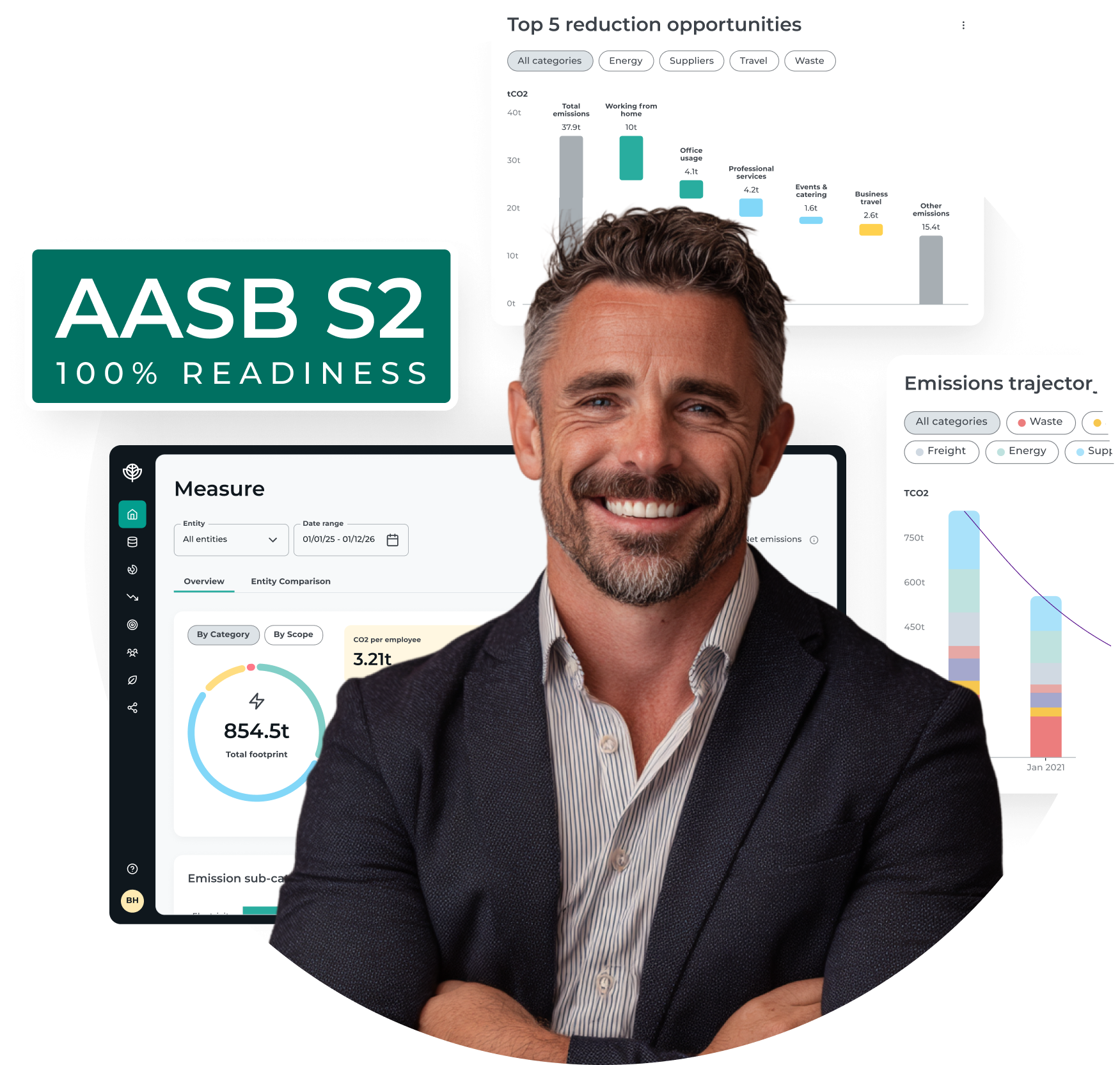
ASRS S2 compliance,
explained in 60 seconds.

The International Sustainability Standards Board sets the global baseline for climate and sustainability disclosures (IFRS S1 and S2).

Countries like Australia and the UK are rapidly adopting these standards into law, making ISSB-aligned reporting mandatory for many organisations.

What this means in practice

All organisations in scope must disclose across four key areas:

Governance
Disclose the governance processes, controls and procedures used to monitor, manage and oversee climate-related risks and opportunities.
Strategy
Disclose the actual and potential impacts of climate-related risks and opportunities on the organisation’s business, strategy and financial planning.
Risk Management
Disclose how the organisation identifies, assesses, prioritises and monitors climate-related risks.
Metrics & Targets
Disclose the metrics and targets used to assess and manage relevant climate-related risks and opportunities

ISSB-aligned reporting is quickly becoming mandatory across major markets, and expected everywhere else.

Trace helps you prepare early with an audit-ready approach, so you can meet current and upcoming requirements with confidence.

Two ways we deliver AASB S2,
matched to your stage & needs.

Trace offers two delivery tiers for AASB S2 compliance, designed to meet customers where they are.

Most Year One reporters start with Minimum Viable Compliance. Mature reporters, or customers who want to go beyond the minimum from day one, use Best Practice.

Both are audit-ready. Both are delivered by the same ASRS specialist team. The difference is depth and breadth, not quality.

Recommended for Year One Reporters
Minimum Viable Compliance
Comply faster - defensible, audit-ready first filing with less cost and burden.
Distills 268 pages of standards into Year 1 compliance essentials
Breaks work into manageable, structured phases
Spreads cost over time for easier budgeting
Embraces AI to remove up to 80% of manual effort
Delivers audit-ready reporting
Best suited for

Those wanting to comply with minimum burden and are exposed to limited climate-related risks and opportunities.

Mature Reporters & Organisations Aiming Beyond Minimum
Best Practice
Go beyond compliance to build decision ready climate capability.
Applies deeper analysis within ASRS requirements
Aligns with all ASRS disclosure topics (including optional disclosures)
Enhanced governance risk management for high risk businesses
Provides the detail and education to really upskill your team
Strengthens data controls and assurance readiness
Delivers clearer, more decision useful reporting for strategic insights
Best suited for

Market leaders, those using climate strategically, and companies that have higher exposure to climate-related risks and opportunities.

Flexibility to suit your budget, capacity &
internal capability

Most customers begin with MVC and transition to Best Practice modules as their reporting evolves. Some choose Best Practice right from the start.

We’ll assist you in selecting the right tier during your scoping call, ensuring flexibility to suit your needs.

Shared commitments across both tiers:

Meets AASB S2 requirements for your reporting cohort

Proportionate to your size, sector, and data maturity

Externally audit-ready, with a complete evidence trail built in

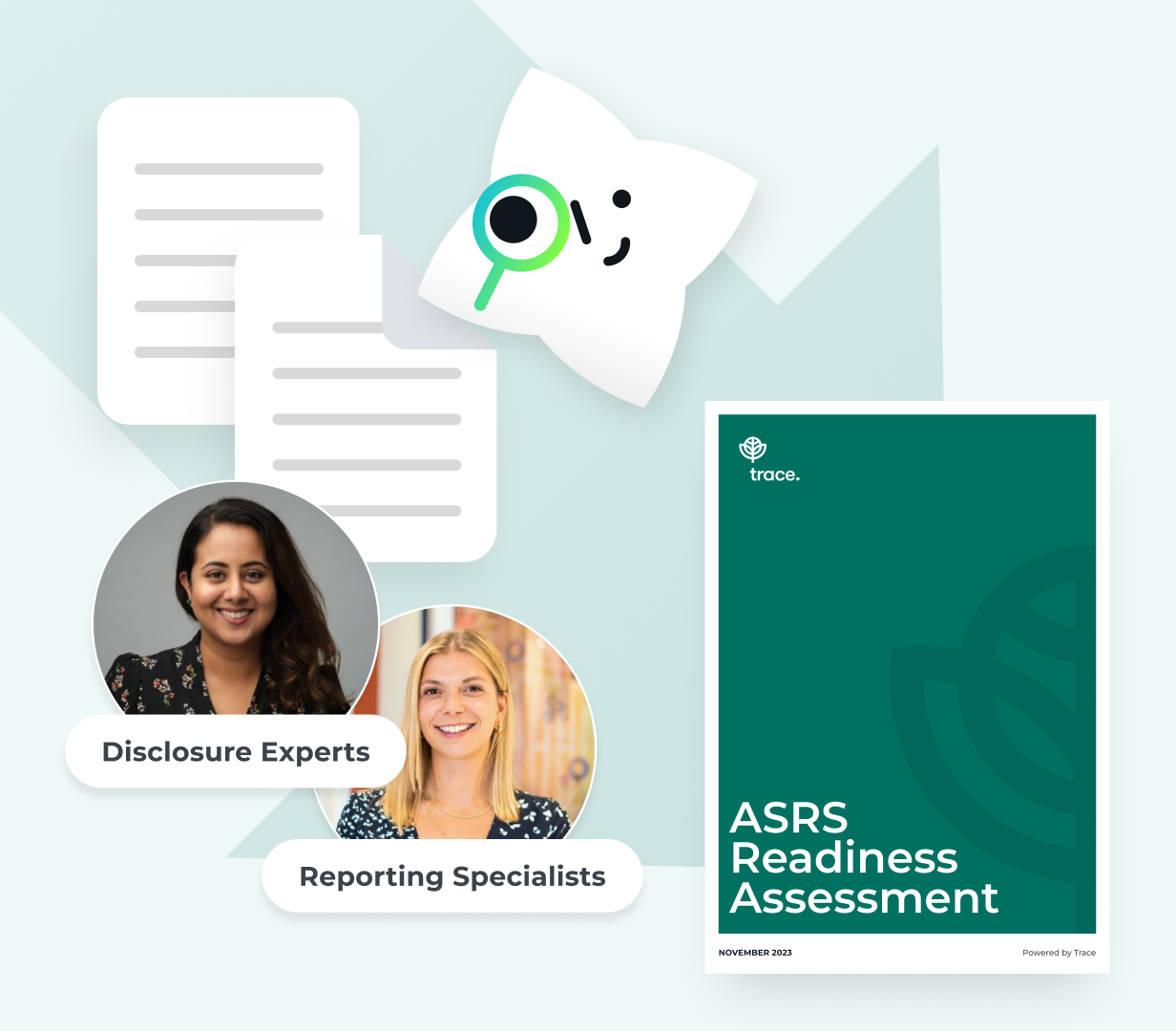
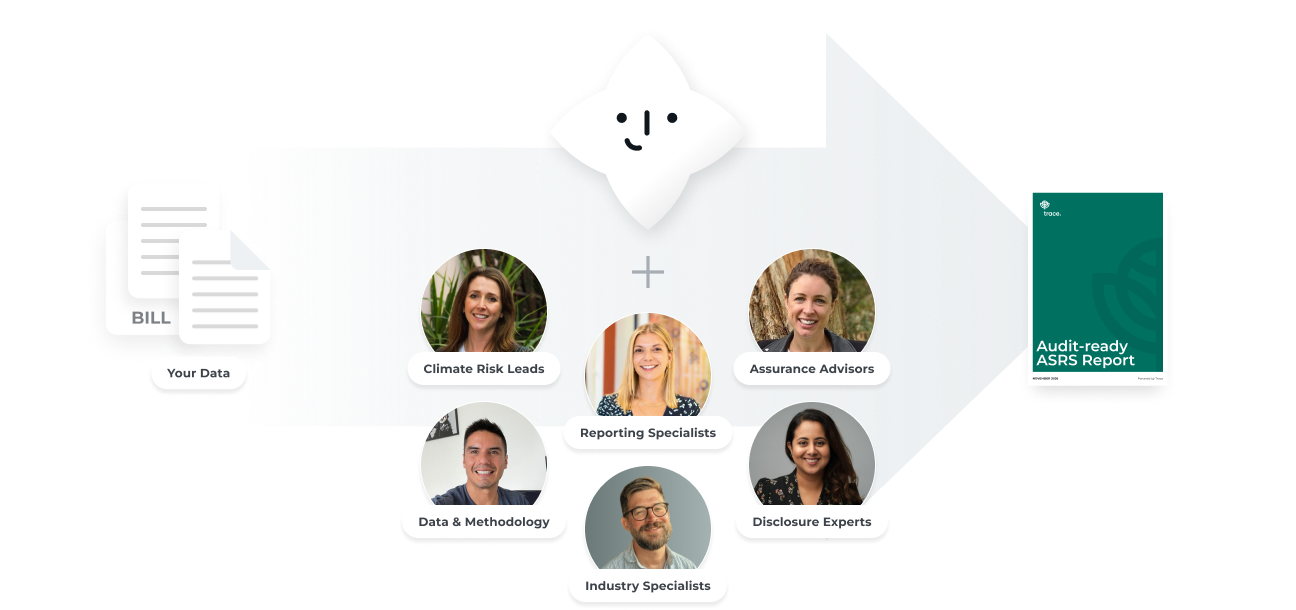
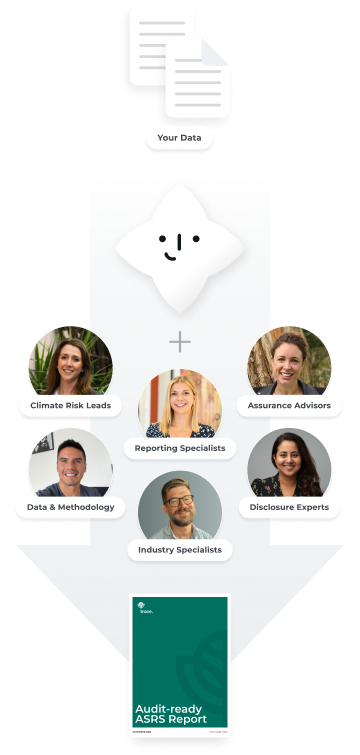
Delivered by the same ASRS specialists, powered by Trace AI

Fixed scope, so cost always stays predictable

Designed to scale as AASB S2 expects disclosure quality to improve

Book an ASRS scoping session to map your compliance roadmap.

Book a Call
Our Services

Everything ISSB requires.
Nothing it doesn't.

How We Deliver

AI-powered. Expert-led.
Audit-ready.

AI alone cannot deliver audit-ready compliance. Consultants alone cannot deliver speed or cost predictability.

Trace is the only ASRS solution built to do both.

Drop in your raw data. We do the rest.

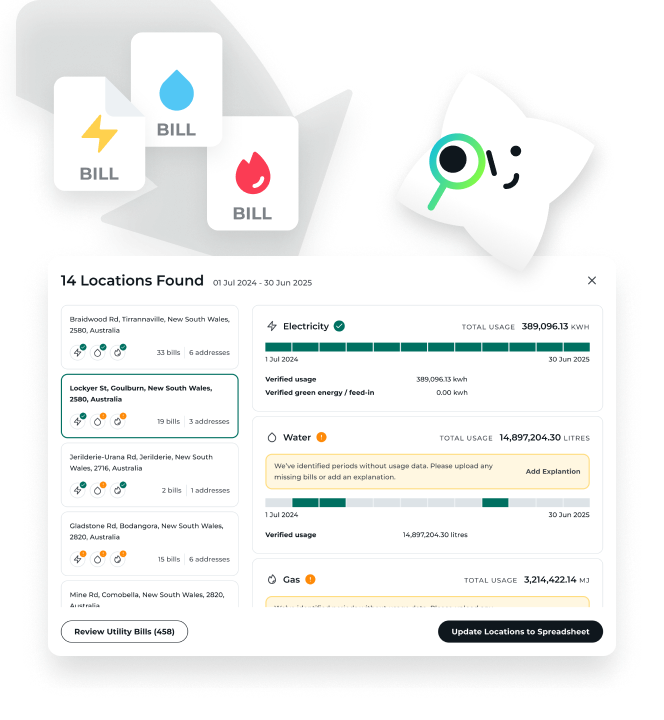
Trace automatically ingests unstructured data from any source — utility bills, invoices, financial systems — and transforms it into structured, emissions-mapped data ready for reporting. Our AI reads PDFs, classifies thousands of supplier transactions against GHG Protocol categories, and maps every row to the right emissions factor in minutes. No manual entry. No spreadsheet wrangling.

Ask anything. Get expert-backed answers.

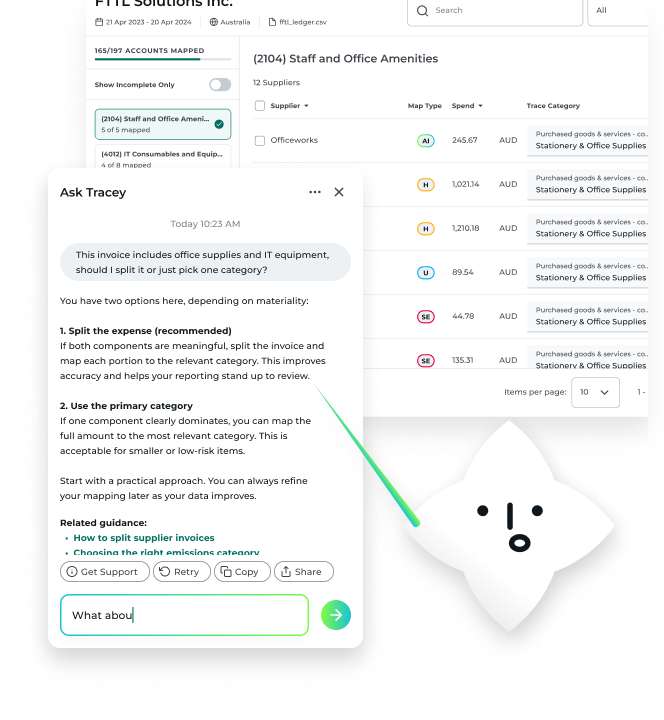
Tracey, our AI sustainability assistant, answers your toughest ASRS and emissions questions on demand — drawing from an expert-built knowledge base and your company’s own live data. Ask “What are my top 5 emission sources this year?” or “Which suppliers are driving my Scope 3 footprint?” and get precise, cited, data-grounded responses instantly. Expert knowledge, available 24/7.

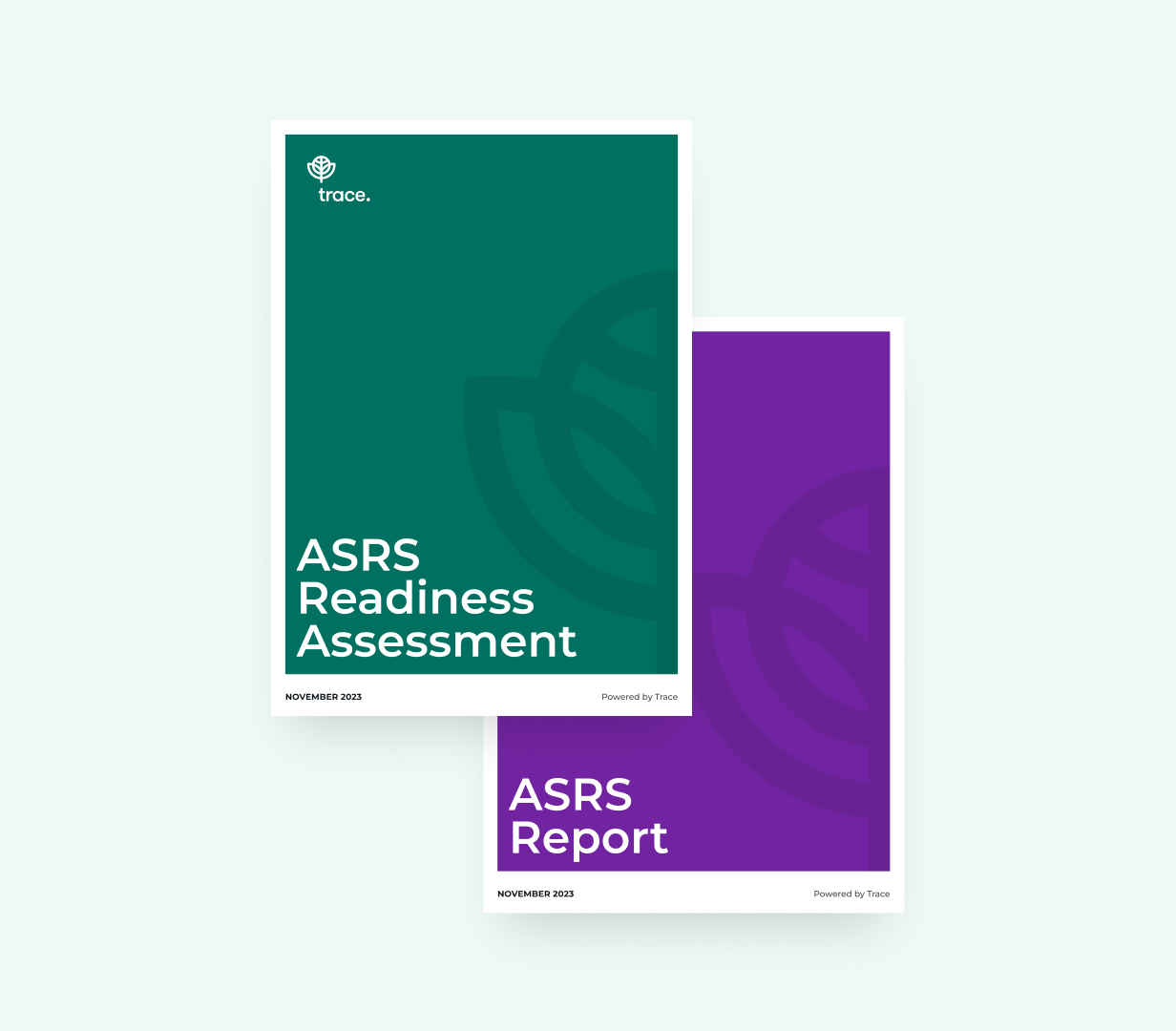
Every output is audit-ready. By design.

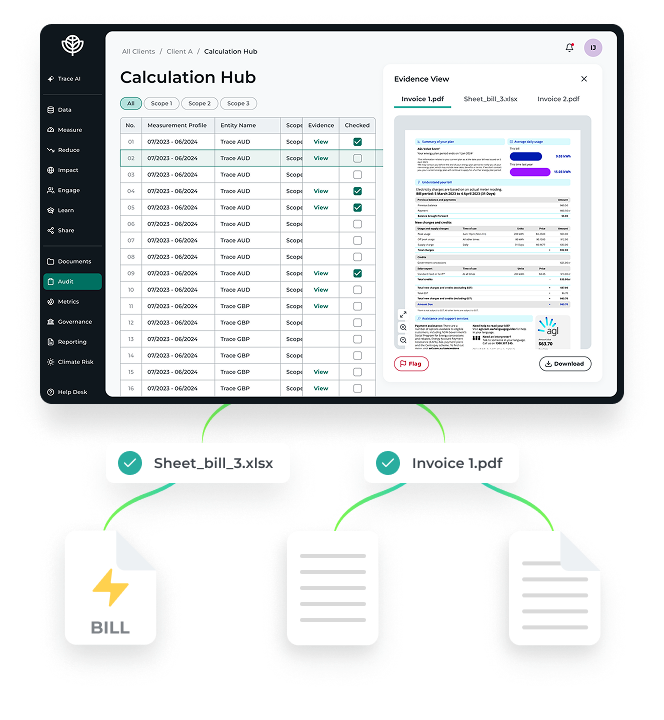
Trace builds a complete, verifiable audit trail into every calculation, input and source — whether that’s a carbon footprint, climate risk assessment or disclosure report. Every figure is traceable from source data to final output. When your auditor asks for evidence, it’s already packaged and ready to share — no scrambling, no remediation.

Scope 3 in minutes, not months.

Classifying thousands of supplier transactions against GHG Protocol categories is one of the most time-consuming parts of ASRS compliance. Trace’s supplier mapping AI does it automatically — processing in bulk, returning confidence-scored classifications, and mapping every transaction to the right Scope 3 category. What used to take your team weeks now takes minutes.
Trace automatically ingests unstructured data from any source - utility bills, invoices, financial systems - and transforms it into structured, emissions-mapped data ready for reporting. Our AI reads PDFs, classifies thousands of supplier transactions against GHG Protocol categories, and maps every row to the right emissions factor in minutes. No manual entry. No spreadsheet wrangling.
Tracey, our AI sustainability assistant, answers your toughest ASRS and emissions questions on demand - drawing from an expert-built knowledge base and your company’s own live data. Ask “What are my top 5 emission sources this year?” or “Which suppliers are driving my Scope 3 footprint?” and get precise, cited, data-grounded responses instantly. Expert knowledge, available 24/7.
Trace builds a complete, verifiable audit trail into every calculation, input and source - whether that’s a carbon footprint, climate risk assessment or disclosure report. Every figure is traceable from source data to final output. When your auditor asks for evidence, it’s already packaged and ready to share - no scrambling, no remediation.
Classifying thousands of supplier transactions against GHG Protocol categories is one of the most time-consuming parts of ASRS compliance. Trace’s supplier mapping AI does it automatically - processing in bulk, returning confidence-scored classifications, and mapping every transaction to the right Scope 3 category. What used to take your team weeks now takes minutes.
Drop in your raw data. We do the rest.
Trace automatically ingests unstructured data from any source, utility bills, invoices, financial systems, and transforms it into structured, emissions-mapped data ready for reporting. Our AI reads PDFs, classifies thousands of supplier transactions against GHG Protocol categories, and maps every row to the right emissions factor in minutes. No manual entry. No spreadsheet wrangling.
Ask anything. Get expert-backed answers.
Tracey, our AI sustainability assistant, answers your toughest ASRS and emissions questions on demand - drawing from an expert-built knowledge base and your company’s own live data. Ask “What are my top 5 emission sources this year?” or “Which suppliers are driving my Scope 3 footprint?” and get precise, cited, data-grounded responses instantly. Expert knowledge, available 24/7.
Every output is audit-ready. By design.
Trace automatically ingests unstructured data from any source, utility bills, invoices, financial systems, and transforms it into structured, emissions-mapped data ready for reporting. Our AI reads PDFs, classifies thousands of supplier transactions against GHG Protocol categories, and maps every row to the right emissions factor in minutes. No manual entry. No spreadsheet wrangling.
Scope 3 in minutes, not months.
Classifying thousands of supplier transactions against GHG Protocol categories is one of the most time-consuming parts of ASRS compliance. Trace’s supplier mapping AI does it automatically — processing in bulk, returning confidence-scored classifications, and mapping every transaction to the right Scope 3 category. What used to take your team weeks now takes minutes.
Free ASRS resources
for mandatory reporters.
ASRS Strategy On A Page

A one-page visual of the four AASB S2 pillars, what each requires, key deadlines, and the step-by-step compliance path. Start here if your team is scoping what ASRS S2 actually involves.

Download
The ASRS Pulse Report 2025

Benchmark your readiness against 20+ ASRS compliant Australian companies. Includes buying criteria, support gaps, and how first-round filers are approaching year one.

Download
The ASRS Prep Pack 2026

Templates, checklists and frameworks to start your AASB S2 implementation. Built for finance and sustainability leads who are ready to move.

Download
AASB Readiness Assessment

A 5-minute self-assessment. Get a compliance gap map and personalised next steps, scored against the four AASB S2 pillars.


Download

ISSB Compliance FAQs

Which companies have to comply with ISSB S2?
ISSB S2 (formally IFRS S2) is being adopted by jurisdictions around the world, each with their own mandatory thresholds and timelines. Australia has mandated it as ASRS S2 starting with large entities from 1 January 2025, cascading to mid-market entities through 2026 and 2027. The UK, Canada, Singapore, Japan, Hong Kong, New Zealand, and Brazil have all signalled adoption or are in active consultation. In most jurisdictions, mandatory reporting begins with large listed companies and large financial institutions before extending to mid-market entities over a two to three-year phase-in period. If you are a large or mid-sized entity in any of these markets, it is worth confirming your local reporting timeline now.
What is the difference between IFRS S2, ISSB S2, and local equivalents like ASRS S2?
IFRS S2 is the formal name of the climate disclosure standard published by the International Sustainability Standards Board (ISSB) in June 2023. When countries adopt it into their own regulatory frameworks, they may rename it. In Australia, it becomes ASRS S2. In other jurisdictions, it may be adopted with minor modifications or local supplements. The underlying requirements remain substantially the same, covering governance, strategy, risk management, scenario analysis, and climate-related metrics and targets aligned with the TCFD framework.
How much does ISSB S2 compliance cost?
The cost of compliance varies significantly depending on the approach taken and the jurisdiction. Australian Treasury estimates suggest that preparing a large entity for compliance through a traditional consulting engagement can cost between $750,000 and $1.6 million. A Minimum Viable Compliance approach, such as the one delivered by Trace, typically costs a fraction of that amount because it is fixed-scope, proportionate, and technology-assisted rather than open-ended. Across most markets, bespoke advisory services sit at the higher end of the cost spectrum, while software-led delivery models are generally more cost-effective.
How long does it take to prepare a first IFRS S2 disclosure?
Using a Minimum Viable Compliance approach, most first-year reporters can move from project kickoff to an audit-ready disclosure package within a few months. Trace customer SEE Civil completed a full carbon inventory, gap assessment, and compliance roadmap within weeks using AI-assisted data collection and expert review. The biggest factor influencing timing is data readiness, particularly how easily Scope 1 and Scope 2 activity data can be accessed at the start of the engagement.
What does an audit-ready IFRS S2 disclosure include?
An audit-ready disclosure typically includes Scope 1, Scope 2, and material Scope 3 emissions calculations supported by methodology documentation, a climate risk assessment covering both physical and transition risks, scenario analysis aligned with IFRS S2 requirements, governance disclosures, climate-related metrics and targets, and a complete evidence trail linking source data to reported outcomes. In jurisdictions where assurance is mandatory, such as Australia, maintaining this evidence trail is essential.
Do we need in-house carbon expertise to comply with IFRS S2?
No. Organisations can achieve compliance without having dedicated in-house carbon accounting expertise. Trace combines ISSB specialists with AI-powered software, enabling finance and sustainability teams to deliver credible disclosures without deep technical carbon knowledge. The experience of SEE Civil demonstrates how organisations can achieve year-one readiness quickly through a combination of expert guidance and structured technology.
What is the difference between Trace's Minimum Viable Compliance and Best Practice tiers?
Both tiers are audit-ready and delivered by the same ISSB specialist team. Minimum Viable Compliance (MVC) is designed as a fixed-scope, cost-predictable solution focused on achieving credible year-one compliance. The Best Practice tier includes everything in MVC, plus expanded Scope 3 reporting, more advanced scenario analysis, transition planning, enhanced governance support, and investor-ready disclosure improvements. Many organisations begin with MVC and add Best Practice modules as their reporting requirements mature, while others start with Best Practice immediately due to investor expectations, ESG-linked financing requirements, or broader climate ambitions.
What happens in year two and beyond?
IFRS S2 is designed to support continuous improvement in disclosure quality over time. Trace's Best Practice modules allow organisations to expand their reporting capabilities gradually by introducing deeper scenario analysis, broader Scope 3 coverage, stronger governance processes, transition planning, and assurance-grade evidence management. This staged approach allows companies to invest in additional capabilities when they are needed rather than implementing everything in the first reporting year.
Can Trace support our external auditor or assurance provider?
Yes. Every Trace engagement includes a complete methodology statement and evidence trail to support assurance activities. Trace works directly with external auditors and assurance providers by sharing source documentation, responding to audit queries, and providing access to supporting evidence through the platform. This support is included as part of the standard delivery model and applies whether organisations work with a Big Four accounting firm or a specialist sustainability assurance provider.

Still have questions? Book an ASRS scoping call.

Book a Call →
Step-up your audit readiness with Trace today.
Book a Demo
Talk to an Expert

Book a call with one of our team

There's no such thing as a silly question. We'd be happy to answer any questions you have about Trace, our platform and the process of starting your Net Zero journey.

Newsletter:  Climate Reporting Simplified.
This monthly edition unpacks what mandatory climate reporting really requires and how to minimise cost, disruption & confusion.

💚 Don’t worry, we won’t spam!

London - Sydney

© Copyright 2025 Trace | All Rights Reserved