ASSA 5010 sets how much of an Australian sustainability report must be reviewed or audited for each financial year starting before 1 July 2030. Year 1 is a review (limited assurance) of selected disclosures. Years 2 and 3 review everything. From Year 4, everything is audited (reasonable assurance): for Group 2, financial years commencing on or after 1 July 2029.
ASSA 5010 sets the timeline for assuring Australian sustainability reports. Its full title is Timeline for Audits and Reviews of Information in Sustainability Reports under the Corporations Act 2001. The Auditing and Assurance Standards Board (AUASB) made it on 28 January 2025. It covers financial years commencing 1 January 2025 to 30 June 2030.
It applies to sustainability reports under Chapter 2M of the Corporations Act. Those reports carry an entity's disclosures under AASB S2 Climate-related Disclosures, the climate standard within the Australian Sustainability Reporting Standards (ASRS). Our page on the AASB S2 climate standard covers what they contain.
The Act sets the end point, and ASSA 5010 sets the ASRS assurance pathway to it. According to ASSA 5010 paragraph 6, the Act requires sustainability reports for financial years commencing on or after 1 July 2030 to be audited. Until then, the AUASB specifies how much is reviewed or audited. ASIC's FAQs say the same, citing sections 301A, 1707E and 1707F.
Paragraph 7 lines up the vocabulary. A "review" in the Act is a limited assurance engagement, and an "audit" is a reasonable assurance engagement. Meanwhile, ASSA 5000 General Requirements for Sustainability Assurance Engagements says how each engagement is run (paragraph 8). ASSA 5010 itself states that there is no equivalent international standard.
ASSA 5010 phases assurance in three stages. In Year 1 the auditor reviews selected disclosures. In Years 2 and 3 the auditor reviews all disclosures in the sustainability report. From Year 4 onwards the auditor audits all of them. The AUASB calls this the phasing in of assurance, and each group counts its years from its own first reporting year.
Table 1 sets out the AASB S2 assurance phasing from the appendix to ASSA 5010, as amended in December 2025. In it, "Limited" is a review, "Reasonable" is an audit, and "None" means the disclosure is reported but not assured that year.
Governance
Strategy: risks and opportunities (subparagraphs 9(a), 10(a) and 10(b))
Strategy: other risks and opportunities disclosures
Climate resilience and scenario analysis
Transition plans
Risk management
Scope 1 and 2 emissions
Scope 3 emissions
Other climate-related metrics and targets
Source: AUASB, ASSA 5010 appendix, Compilation No. 1 (December 2025). Row labels are shortened: the third row is headed "Strategy - Risks and opportunities" in the appendix. The appendix shows Years 4, 5 and 6 as separate columns, each at reasonable assurance.
ASSA 5010 paragraph 9 defines each reporting year by group. Table 2 shows the window in which that year's financial year commences.
Group 1
Group 2
Group 3
Source: AUASB, ASSA 5010 paragraph 9. Each cell is the window in which the financial year commences.
Two appendix notes matter. A Group 1 entity whose year starts between 1 January and 30 June meets the Year 1 provisions twice. Separately, an entity reporting voluntarily under the Act joins the group whose window its voluntary year falls in.
What this means for you: as an illustrative example worked from paragraph 9, take a Group 2 entity with a 30 June year end. Its Year 1 is the year ending 30 June 2027, and Years 2 and 3 end in 2028 and 2029. Its first audited year then ends 30 June 2030. With a 31 December year end instead, Year 1 starts 1 January 2027 and Year 4 starts 1 January 2030.
ASSA 5010 paragraph 10(a) sets four Year 1 review items. They are governance (AASB S2 paragraph 6), the climate risks and opportunities with whether each risk is physical or transition (subparagraphs 9(a), 10(a) and 10(b)), and Scope 1 and 2 emissions. The fourth is any statement that there are no material climate risks or opportunities.
Each of these year-one AASB S2 assurance requirements is narrower than its heading suggests.
Our guide to what auditors actually test covers what a review looks at in practice.
Most of strategy is outside it: effects on the business model and value chain, the transition plan, financial effects, climate resilience and time horizons. Risk management, Scope 3 and other metrics and targets are outside too.
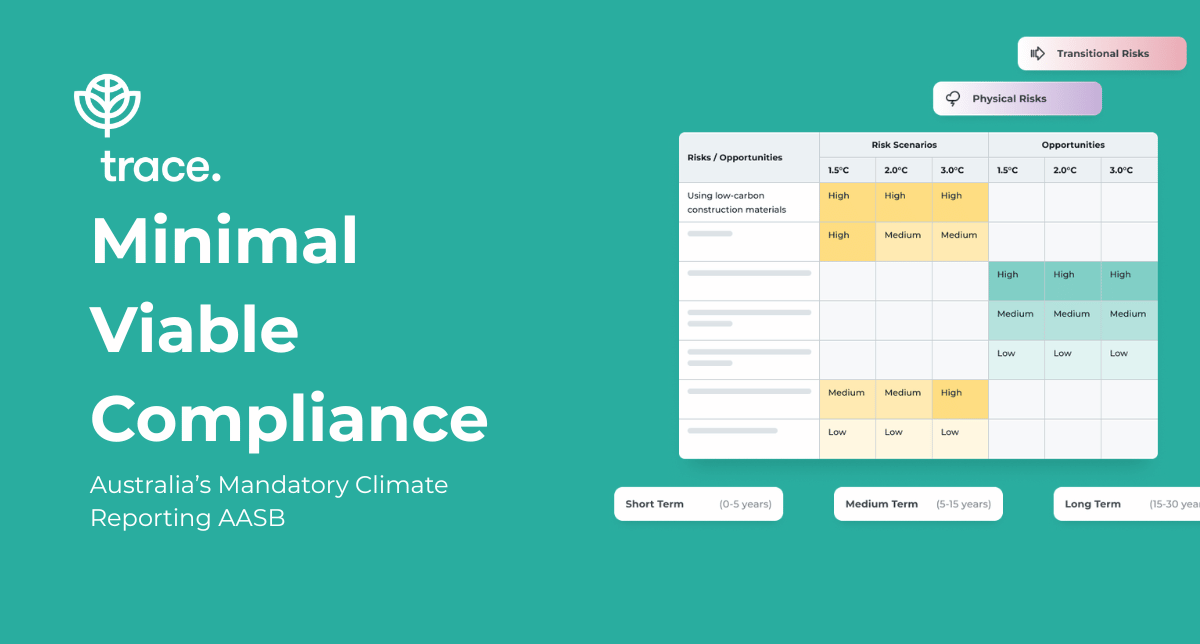
However, outside assurance is not outside the report. Scenario analysis, for instance, tests how the strategy holds up under plausible climate futures. AASB S2 paragraph 22 requires it from the first year, "using an approach that is commensurate with the entity's circumstances." The Minimum Viable Compliance guide covers that kind of proportionate year-one work.
Outside assurance is not unread, either. According to the AUASB's FAQs, Year 1 disclosures outside assurance are "other information". The auditor reads them for material inconsistency with the assured disclosures and with what the auditor learned in the engagement, and stays alert for signs that they are materially misstated.
Finally, under paragraph 10(d) the auditor may review or audit more than the minimum.
On paper, no. ASSA 5010 leaves climate resilience and scenario analysis out of the year-one review, and the table above reflects that. In practice, that is not what we have seen. Auditors have questioned our clients' scenarios in year-one reviews, and we have had to share our scenario methodology with them.
Two things in the rules help explain it. The risks and opportunities you identified are reviewed from year one, and a question about how a risk was found, or why another was left out, often leads back to the scenario work. In addition, the disclosures outside assurance are still "other information" that the auditor reads for material inconsistency, as the AUASB's FAQs put it.
So treat scenario analysis as part of year one, not as year-two work. A company that gives its scenarios no attention in year one would, from what we have seen, have a hard time in its review. Keep a short record from the start: which scenarios you used and why, their source and version, and the main assumptions behind them.
From the Second Year of Reporting, ASSA 5010 paragraph 10(b) requires a review of all disclosures in the sustainability report, including the related general disclosures in Appendix D to AASB S2. The level does not change: it is still limited assurance, which the Act calls a review. Years 2 and 3 are treated alike.
As a result, scenario analysis, transition plans, risk management, other metrics and targets and Scope 3 all come into the review. Scope 3 emissions are the indirect emissions in an entity's value chain. The Year 1 cell reads "N/A", in line with the AASB S2 paragraph C4(b) relief: an entity is not required to disclose Scope 3 in its first annual reporting period. For Group 1, the appendix notes that Scope 3 reporting is required for years commencing on or after 1 January 2026.
Not at a higher level than before. Under ASSA 5010 paragraph 11, a comparative that was not assured last year need not be assured this year. Likewise, a comparative that was reviewed last year does not need an audit.
Not in Year 1, and Years 2 and 3 are not yet settled. As at 12 November 2026, the AUASB says ASSA 5010 does not require assurance over the directors' declaration in Year 1. At its 7 October 2026 meeting, according to the minutes as tabled, most AUASB members considered assurance should not be required while directors can declare that the entity took "reasonable steps", given the absence of guidance on what that means. A draft exposure draft then proposed no assurance until years commencing on or after 1 January 2028. That is a proposal, not a rule.
Reasonable assurance, which the Act calls an audit, starts in the Fourth Year of Reporting under ASSA 5010 paragraph 10(c). That means financial years commencing on or after 1 July 2028 for Group 1, 1 July 2029 for Group 2 and 1 July 2030 for Group 3. From 1 July 2030, the Act itself requires an audit.
Myth: reasonable assurance arrives in Year 2. Reality: Years 2 and 3 are still reviews, only wider. Nor does it start "in 2030" for everyone: only Group 3's Year 4 meets the Act's own requirement.
The two levels involve different work. According to the AUASB's FAQs, "The nature of the work in a review is different to that in an audit." The procedures belong in a separate explainer on limited versus reasonable assurance.
Even so, a review is not necessarily light. According to the AUASB's key messages, "Obtaining and providing limited assurance may not significantly reduce the work effort of the auditor compared to reasonable assurance." The AUASB adds that where systems and processes are inadequate, the work "may approach that required for reasonable assurance".
ASSA 5010 has been amended once. ASSA 2025-10, made on 17 December 2025, set out how the phasing applies to voluntary sustainability reports under the Corporations Act. As at 12 November 2026, further changes were only proposed. The AUASB considered a draft exposure draft, ED 01/26, at its 11 November 2026 meeting.
December's amendment followed changes to the Act that received Royal Assent on 4 December 2025. According to the AUASB's Basis for Conclusions, its exposure draft drew 14 formal submissions. The amendment added voluntary reporters to the group definitions.
The November 2026 draft proposes three changes, with comments proposed to close on 10 February 2027:
It would also reword appendix note 4, to make plain that a "no material risks" statement follows the same phasing as the risks and opportunities row. When this article was last updated, the draft was not yet listed on the AUASB's Open for comment page.
The standard setter is also changing. According to the AUASB, boards of External Reporting Australia (ERA) will make auditing and assurance standards from 1 December 2026.

Trace works with businesses at every stage of their mandatory reporting journey, from first emissions measurement to audit-ready ASRS S2 disclosure. Talk to our team to see how we can help.
Yes, but not for the 2026-27 reporting year. Treasury consulted from August 2026 to 2 October 2026 on three options for assurance settings. For the first option, Treasury's paper says the Corporations Act would need amending, with the AUASB updating ASSA 5010 alongside it. As at 12 November 2026, no outcome had been published.
Treasury's consultation paper follows reforms announced in the Budget 2026-27, and it sets out three options:
On timing, the paper says the changes "will not impact those reporting for the 2026-27 financial year", and that legislation "would be unlikely to be finalised in the short-term."
What this means for you: the ASRS assurance requirements for Years 1 to 3 are unaffected, so plan on the standard as it stands. The open question is whether, and when, Year 4 becomes an audit.
The evidence follows the ASSA 5010 scope. In Year 1 it backs governance, the climate risk and opportunity list, Scope 1 and 2 emissions and any "no material risks" statement. From Year 2 it backs every disclosure. The law requires the records behind the report, while the documents listed below are examples drawn from ASIC and AUASB guidance.
Whether a team calls it a sustainability audit checklist or an ESG audit checklist, ASSA 5010 sets its scope, not the label. In the tables below, the middle column is what the standard requires. The last column gives audit evidence examples, which is what an assurer will typically want to see. ASIC calls its own list "examples only", so treat that column as a starting point rather than a prescribed list.
Three requirements apply every year, whatever is in scope. First, according to ASIC's Regulatory Guide 280, an entity must keep written sustainability records (RG 280.49, citing section 286A of the Corporations Act). ASIC describes them as the "documents and working papers that explain the methods, assumptions and evidence" behind the report (RG 280.50). Second, under ASSA 5000 paragraph 85, the engagement terms include management giving the assurer access to all relevant information and to the people it needs. Third, ASSA 5000 paragraph 165 requires the assurer to request written representations at the end. These include that management provided all relevant information and told the assurer of known internal control deficiencies that are not clearly trivial.
The record duty does not phase in. ASIC says the records should support the disclosures on governance, strategy, risk management and metrics and targets (RG 280.52(a)), which is the whole report. So Year 1 records also cover disclosures the auditor only reads that year. In addition, ASIC's FAQs say the auditor gives an opinion on whether the records are sufficient for the report to be prepared and audited to the extent the auditing standards require (sections 307AA and 309A(1)).
Table 3 sets out the four Year 1 items in ASSA 5010 paragraph 10(a).
Governance (AASB S2 paragraph 6)
Risks and opportunities (subparagraphs 9(a), 10(a) and 10(b))
Scope 1 and 2 emissions (paragraph 29(a)(i) to (v))
A "no material risks" statement (ASSA 5010 paragraph 10(a)(iv))
Sources: ASSA 5010 paragraph 10(a); AASB S2 paragraphs 6, 10, 11 and 29(a), B24 and B26; ASIC RG 280.51. Read 17 November 2026.
According to the AUASB's FAQs, the auditor tests the accuracy of the governance disclosures and is not required to evaluate whether the governance is effective. Each governance record is set out in the governance documentation guide under Related reading, so it is not repeated here.
Some entities must also have the Scope 1 and 2 emissions they report to the Clean Energy Regulator assured, under the National Greenhouse and Energy Reporting (NGER) scheme. According to the AUASB, the sustainability report auditor can draw on that NGER assurance under ASSA 5000's rules for another practitioner's work. However, where the NGER basis is used for AASB S2, the AUASB says additional work will be required. The differences include location-based against market-based figures and the entities and activities covered. A financial year that does not end on 30 June may also need assurance on updated emissions figures.
From Year 2, ASSA 5010 paragraph 10(b) puts every disclosure under review. Table 4 lists what joins the Year 1 items.
Scenario analysis (AASB S2 paragraph 22)
Transition plans (paragraph 14)
Risk management (paragraph 25)
Business model and financial effects (paragraphs 9(b), 9(d) and 13)
Scope 3 emissions (paragraph 29(a)(vi))
Targets (paragraphs 33 and 34)
Sources: ASSA 5010 paragraph 10(b) and appendix note 5; AASB S2 paragraphs 9, 13, 14, 22, 25, 29(a)(vi), 33 and 34; ASIC RG 280.51. Read 17 November 2026.
The AUASB's FAQs add what the auditor considers from Year 2. That includes whether the scenarios disclosed are reasonable and appropriate, including the assumptions and the data used. Similarly, the auditor considers whether metrics and targets are appropriate, and may have regard to the metrics the entity uses internally and those others in its industry publish.
Two more points follow from the standards. Financial effects connect to the financial report, and ASIC's FAQs say each report's auditor considers material inconsistencies with the other. Scope 3 relies on data from outside the entity, and ASSA 5000 paragraph 117(b) has the assurer understand how that data is recorded, processed and incorporated.
The records do not change in Year 4, but the work on them does. For a review, ASSA 5000 paragraph 113L has the assurer understand internal control through enquiry. For an audit, paragraph 113R adds other procedures, and paragraph 119R has the assurer identify controls whose operating effectiveness it plans to test. As a result, the audit trail kept from Year 1 is the material those procedures will use.
Plan for the review you face now and the one after it. Year 1 scope is fixed by ASSA 5010 paragraph 10(a), and Year 2 scope is already known. Because Year 4 audits the same information, records kept from the start matter. These steps follow from the standard, not from a view of what any auditor will accept.
For ASRS assurance readiness, Trace's disclosure preparation work includes assurance support: its consultants draft the disclosure using Trace's own drafting technology, each claim links back to its evidence in Trace, and the audit firm that signs the assurance report stays a separate, independent party. It suits mid-sized Australian organisations, mostly in Group 2, with no dedicated sustainability team, while an entity needing bespoke physical-asset or financed-emissions modelling, or wanting software only or a consultancy only, may prefer another route.
ASSA 5010 is the Australian standard, made by the AUASB on 28 January 2025, that specifies how much of a sustainability report under the Corporations Act must be reviewed or audited each year. It covers financial years commencing 1 January 2025 to 30 June 2030. It has no international equivalent, and ASSA 5000 governs how each engagement is run.
Under ASSA 5010, reasonable assurance (an audit) starts in the Fourth Year of Reporting. That is financial years commencing on or after 1 July 2028 for Group 1, 1 July 2029 for Group 2 and 1 July 2030 for Group 3. From 1 July 2030, the Corporations Act itself requires sustainability reports to be audited.
No. Under AASB S2 paragraph C4(b), an entity is not required to disclose Scope 3 emissions in its first annual reporting period, and ASSA 5010 shows Scope 3 as not applicable in Year 1. Scope 3 is then reviewed at limited assurance in Years 2 and 3, and audited at reasonable assurance from Year 4.
No. Under ASSA 5010, climate resilience and scenario analysis are not assured in Year 1 and are reviewed from Year 2. Scenario analysis is still a required disclosure in year one, under AASB S2 paragraph 22. In our experience, auditors have also questioned scenarios in year-one reviews and asked to see the method.
Yes, where the voluntary report is made under the Corporations Act. ASSA 2025-10, made on 17 December 2025, amended ASSA 5010 to cover them. A voluntary reporter is placed in Group 1, 2 or 3 according to the window in which its voluntary reporting year commences, and then follows that group's phasing.
Trace is a climate reporting platform with in-house specialists, founded in 2020 with offices in Sydney and London. It helps Australian organisations measure emissions and prepare AASB S2 climate disclosures.
Reviewed by Joanna Auburn, Co-founder and Chief Product Officer of Trace.
This article is general information about Australian climate reporting requirements as at the date shown. It is not legal, accounting or assurance advice.
All read on 12 November 2026. Sources 1, 4, 11 and 12 were re-read, and sources 14 and 15 first read, on 17 November 2026 for the evidence checklist.
A one-page visual of the four AASB S2 pillars, what each requires, key deadlines, and the step-by-step compliance path. Start here if your team is scoping what ASRS S2 actually involves.
Benchmark your readiness against 20+ ASRS compliant Australian companies. Includes buying criteria, support gaps, and how first-round filers are approaching year one.
Templates, checklists and frameworks to start your AASB S2 implementation. Built for finance and sustainability leads who are ready to move.
A 5-minute self-assessment. Get a compliance gap map and personalised next steps, scored against the four AASB S2 pillars.


London - Sydney