A climate risk register is the working record of an entity's climate-related risks and opportunities. For each, it records the type, timing, likelihood and consequence before and after controls, the owner and the materiality call. AASB S2 does not require a register by name. However, its disclosures are hard to support without one.
A climate risk register is a working list of an entity's climate-related risks and opportunities. It holds each one's type, timing, rating, owner and materiality call. AASB S2 does not require one by name. Instead, it requires disclosure of the risks and opportunities themselves, in paragraph 10. Paragraph 25 then asks how they are identified, assessed, prioritised and monitored.
The standard's full name is the Australian Sustainability Reporting Standard AASB S2 Climate-related Disclosures, and our guide to AASB S2 covers it more widely. In its words, climate-related risks are "the potential negative effects of climate change on an entity". Opportunities are "the potential positive effects". This article states the position as at 12 November 2026.
Three kinds of item belong in the register, because paragraph 3 names them. Physical risks can be acute, meaning event-driven, such as "storms, floods, drought or heatwaves", or chronic, meaning longer-term shifts in climatic patterns. Transition risks arise from the move to a lower-carbon economy, and the standard lists "policy, legal, technological, market and reputational risks". Opportunities are the third kind. In addition, paragraph 4 puts anything that "could not reasonably be expected to affect an entity's prospects" outside the standard. So the register does not need every conceivable climate effect.
A common claim is that AASB S2 requires a climate risk register. It does not. Rather, it requires the information and a description of the process, and a register is the natural place to hold both. In Report 839, published 21 September 2026, ASIC reviewed 40 of the 312 sustainability reports lodged for 31 December 2025 year ends. Some of those entities had "reviewed and updated risk registers in light of identified climate-related risks".
A climate risk register template needs four groups of columns. Identify: what the item is, its type, where it sits and the evidence. Assess: the scenario, the time horizon, likelihood, consequence, and ratings before and after existing controls. Decide: the reasoning, the materiality call and, for opportunities, commercial sensitivity. Monitor: the owner, the enterprise register link and the review dates.
Each column below names its reason: an AASB S2 paragraph, a finding from ASIC's Report 839 or a government source. The four tables are one register, so lay them side by side as the columns of a single sheet.
1. ID
2. Risk or opportunity
3. Type
4. Statement
5. Where it sits
6. Evidence and source
7. Scenario
8. Time horizon
9. Likelihood
10. Consequence
11. Inherent rating
12. Existing controls
13. Residual rating
14. Rating justification
15. Material?
16. Commercially sensitive?
17. Owner
18. Enterprise register link
19. Review
Illustrative only. This example, for an office-based services business, is adapted from the worked flood example in DCCEEW's template. It describes no real entity and implies no typical rating.
Risk or opportunity
Type
Statement
Where it sits
Evidence and source
Scenario
Time horizon
Likelihood, consequence, ratings
Existing controls
It is built from the standard's paragraphs and ASIC's findings, then compared with the Australian Government's own register template. DCCEEW, the federal climate department, offers that template as a free download. It shares most of the columns above. However, it was built for the public sector, not for AASB S2 reporters. So anyone searching for a climate risk assessment template can use it as a reference, checked against the paragraphs above.
The register is one output of a wider process, which our page on climate risk and scenario analysis walks through from start to finish.
Write the likelihood and consequence scales down, and use the enterprise risk matrix where one exists. Then rate each risk before and after controls, and record why. ASIC found a first report that disclosed a risk matrix with no definition of likelihood or consequence. It also found disclosures that left unclear whether a risk was rated before or after controls.
Paragraph 25(a)(iii) asks how the entity assesses "the nature, likelihood and magnitude of the effects" of its climate risks. According to Report 839, some entities did not give enough information on this. One disclosed its risk matrix "But it did not provide a definition for likelihood and consequence". As a result, ASIC said, this "reduced users' ability to understand the significance of the risks". Columns 9 and 10 fix this only if the written scales sit with the register.
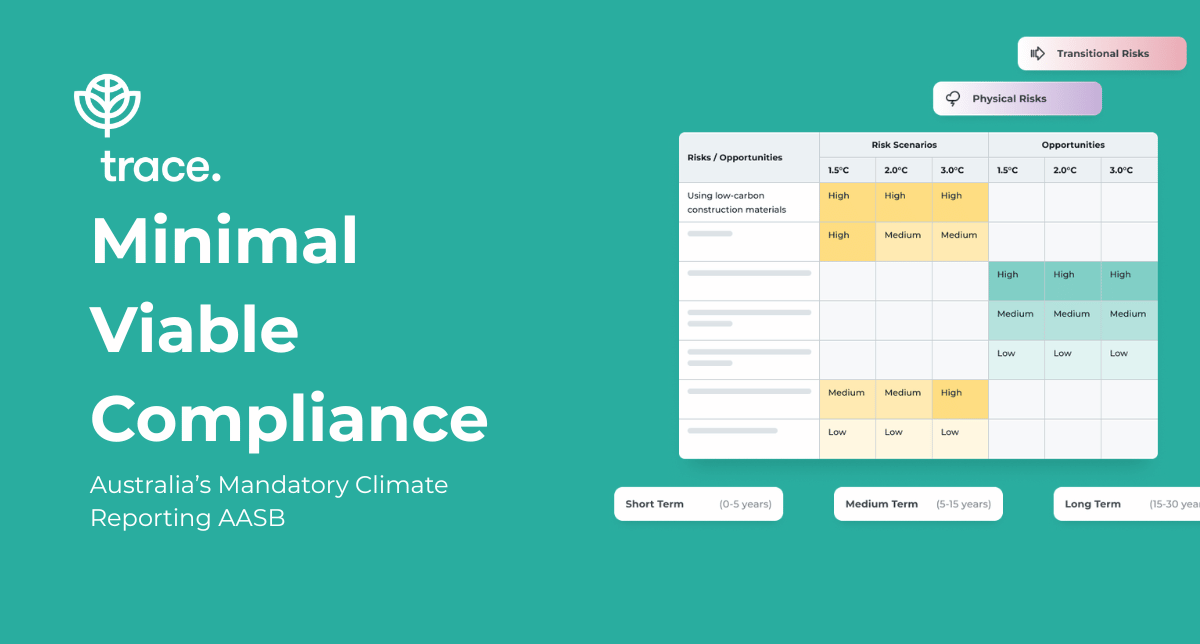
A climate risk matrix is a grid that plots likelihood against consequence to give each risk a rating. DCCEEW's example uses five levels of each. Its consequence levels run from "Insignificant" to "Catastrophic", and its likelihood levels from "Remote" to "Almost certain". Yet the standard prescribes no matrix size or scale, and DCCEEW's is only an example.
Most entities already have a matrix in their enterprise risk framework. DCCEEW's guide says that framework "will be able to provide the correct method" in most cases. It adds that "some modifications in risk evaluation criteria may be required" to capture climate risks across different scenarios.
DCCEEW's guide also separates impact from consequence. Impact is how the things you value are affected. Consequence is how the organisation is affected. For instance, a flooded road is an impact, while delayed client work is the consequence.
For inherent and residual, use ASIC's definitions. Inherent means "before mitigation factors were applied", and residual means "after mitigation factors were applied". ASIC said such disclosures "could have been improved by explaining the relevant assumptions and judgements applied". Separate columns, with the controls between them, make that easy.
Finally, expect one rating per scenario and time horizon. DCCEEW's guide gives each risk a row for every scenario and timeframe combination. So with two scenarios and three horizons, one risk becomes six rated rows.
Use all reasonable and supportable information available without undue cost or effort, including past events, current conditions and forecasts. That is AASB S2 paragraph 11. The standard names the entity's own risk management processes as a source, and says no exhaustive search is needed. Even so, ASIC found entities that left out weather events they had already reported.
Appendix D of AASB S2 lists "the entity's risk management processes; industry and peer group experience; and external ratings, reports and statistics" as possible sources. Internally, that means the existing risk register, incident and insurance records, asset and site lists, and supplier lists.
Past events matter most. According to Report 839, some entities had previously disclosed assets or operations "financially affected by extreme weather events". Nevertheless, they had not identified or disclosed similar risks to their prospects. An evidence column that starts from the incident log closes that gap.
Externally, the National Climate Risk Assessment is the obvious starting point. According to ASIC and the AASB's learning module, the Australian Government released it in September 2025. It describes 11 priority risks at three warming levels (1.5°C, 2.0°C and 3.0°C) and three time horizons: current, 2050 and 2090. CSIRO says the first pass identified 63 nationally significant climate risks. In ASIC's sample, the most common physical risks were flooding, cyclone, bushfire or drought (acute) and heatwaves affecting productivity (chronic).
ASIC also found "high-level or limited information" on where risks were concentrated, particularly by geography. It said entities could have better explained indirect effects, such as risks to "roads, railways and other infrastructure" their business model relied on. So the register needs rows for suppliers and infrastructure, not only for sites you own. Our explainer on physical and transition risk covers both types in more depth.
Opportunities need their own rows, because paragraph 25(b) asks for the opportunity process too. That is why a climate risk and opportunity assessment template treats both in one register. In ASIC's sample, common opportunities included "infrastructure resilience and adaptation services" and "new product and customer segments associated with decarbonisation".
The register informs the materiality call, but it does not make it. Under AASB S2, information is material if omitting, misstating or obscuring it could reasonably be expected to influence decisions by the report's primary users. So a low-rated risk can still be material, and the judgement is reassessed at every reporting date.
The AASB's March 2026 educational material is plain about this. A risk with "a low likelihood of occurring and a low impact might still be material" if primary users could reasonably take a different view. Likewise, information "cannot be assumed to be immaterial simply because users have not asked for it". For that reason, column 15 records a judgement and its reason, not a threshold read off the matrix.
ASIC's report gives a better practice example. One entity assessed a range of physical risks and concluded none were material. "Instead of simply stating this conclusion", it explained the adaptation measures in place and how they "reduced the residual risk exposure". In other words, that explanation came from the residual rating and the controls column.
A "no material risks" conclusion carries weight. In ASIC's sample of 40, 95% identified at least one climate-related risk or opportunity. Two entities identified none, and for each, the auditor added an emphasis of matter paragraph highlighting the judgement. ASIC encourages entities to "keep adequate records of the process undertaken to identify them". Treasury's August 2026 consultation floated further guidance on when an entity may reach that conclusion. Submissions closed on 2 October 2026, and as at 12 November 2026 we found no published outcome.
For a Group 2 entity's first year, meaning financial years starting between 1 July 2026 and 30 June 2027, the review reaches two things the register holds: the risks and opportunities, and whether each is physical or transition. Risk management processes enter review in year two. Meanwhile, the working papers behind the report must be kept for seven years.
Under ASSA 5010 paragraph 10(a), the AUASB's assurance timeline, the first-year review reaches four things. They are governance, strategy at AASB S2 subparagraphs 9(a), 10(a) and 10(b), Scope 1 and 2 emissions, and any statement that there are no material climate risks or opportunities. So columns 2 and 3 feed what is reviewed first. From year two, the review extends to all disclosures. However, none of this means the other columns can wait. AASB S2 requires the time horizons, the scenarios and the process disclosures from year one; only the review is phased. Our article on what auditors test first covers the review in more detail.
ASIC's Regulatory Guide 280 says entities "must keep written sustainability records", and that failing to do so "is a strict liability offence". Records include "internal reports or analysis" and "working papers or documents evidencing inputs for, and assumptions used in" the report. They "must be retained for seven years". A register with its rating justifications is that kind of record, and one kept through the year shows the process as it ran.
Keep the register's history, not only its latest state. Paragraph 25(a)(vi) asks whether the process changed from the previous period, and old versions answer that. In addition, Appendix B paragraph B34 requires a reassessment across the value chain after "a significant event or a significant change in circumstances". A review trigger in column 19 makes that visible.
Trace's Climate Risk and Scenario Analysis workstream includes a risk register, 1.5°C and 3°C scenarios, a ranking workshop, and a methodology and audit trail. In the workshop, guided by Trace's team, each risk is rated for likelihood and consequence under each scenario and time horizon, before and after existing controls. AI and experts do the work together. Our climate risk assessment service suits a mid-sized Australian entity without a sustainability team that wants a proportionate result from software plus specialists. An asset-heavy organisation that needs bespoke physical asset modelling may prefer a specialist provider instead.
A climate risk register is the working record of an entity's climate-related risks and opportunities. For each one, it records whether it is physical or transition, the time horizon, the scenario, likelihood and consequence ratings before and after controls, the owner and the materiality call. It supports the disclosures in AASB S2 paragraphs 10 and 25.
Not by name. AASB S2 requires disclosure of the climate-related risks and opportunities that could reasonably be expected to affect prospects (paragraph 10). It also requires the processes used to identify, assess, prioritise and monitor them (paragraph 25). A register is the natural place to hold that information, and ASIC saw first reporters update theirs.
A climate risk matrix is a grid that plots likelihood against consequence to give each climate risk a rating. DCCEEW's example uses five levels of each. AASB S2 sets no size or scale. However, ASIC found a first report that showed a matrix without defining likelihood or consequence, so write your scales down.
Either can work. AASB S2 paragraph 25(c) asks entities to disclose how far their climate risk processes are integrated into overall risk management, so record the link either way. DCCEEW's guide notes that an existing enterprise framework usually provides the method, with some changes to capture climate risks across scenarios.
At least once each reporting period, because AASB S2 requires materiality judgements to be reassessed at each reporting date. In addition, AASB S2 requires a reassessment after a significant event or change in circumstances. Paragraph 25 also asks how risks are monitored and whether the process changed, so keep each version.
Trace is a climate reporting platform with in-house specialists, founded in 2020 with offices in Sydney and London. It helps Australian organisations measure emissions and prepare AASB S2 climate disclosures.
Reviewed by Joanna Auburn, Co-founder and Chief Product Officer of Trace.
This article is general information about Australian climate reporting requirements as at the date shown. It is not legal, accounting or assurance advice.
All read on 12 November 2026 and checked again against the primary documents on 13 November 2026.
A one-page visual of the four AASB S2 pillars, what each requires, key deadlines, and the step-by-step compliance path. Start here if your team is scoping what ASRS S2 actually involves.
Benchmark your readiness against 20+ ASRS compliant Australian companies. Includes buying criteria, support gaps, and how first-round filers are approaching year one.
Templates, checklists and frameworks to start your AASB S2 implementation. Built for finance and sustainability leads who are ready to move.
A 5-minute self-assessment. Get a compliance gap map and personalised next steps, scored against the four AASB S2 pillars.

Trace works with businesses at every stage of their mandatory reporting journey, from first emissions measurement to audit-ready ASRS S2 disclosure. Talk to our team to see how we can help.


London - Sydney