Carbon Accounting Software.  Audit-Ready, and Built to Scale.

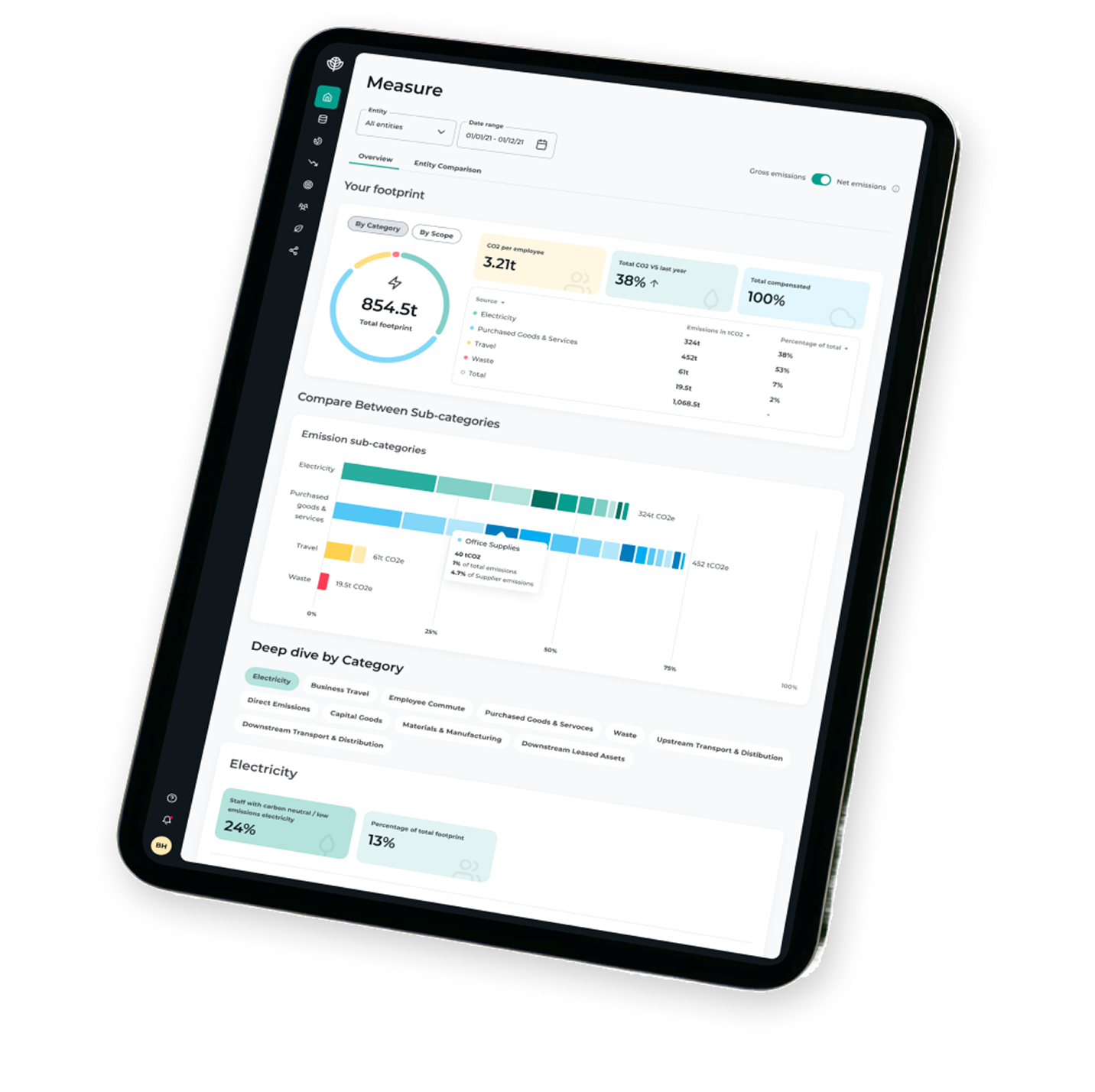
Whether you are preparing for mandatory AASB S2 reporting or choosing to get ahead of emissions disclosure, Trace gives finance, ESG and risk teams an accurate, audit-ready carbon inventory without a dedicated sustainability team or the manual work.
Trusted by Mandatory Reporters


One platform. Two reasons to use it

Trace offers flexible software and support to suit two core customer; those that need to report under mandatory disclosure and those that are ahead of the curve and reporting voluntarily

MANDATORY REPORTING
AASB S2 Compliance
If you are a Group 1, 2 or 3 entity under Australia's mandatory climate reporting regime, Trace gives you the audit-ready Scope 1, 2 and 3 inventory ASRS requires without the cost and delay of a consultancy-led approach.
VOLUNTARY REPORTING
Ahead of the curve
If you are choosing to measure and report emissions for procurement, investor, customer or ESG reasons, Trace gives you a credible, standards-aligned carbon footprint you can report on and act from without the complexity.

Drop in your raw data. We do the rest.

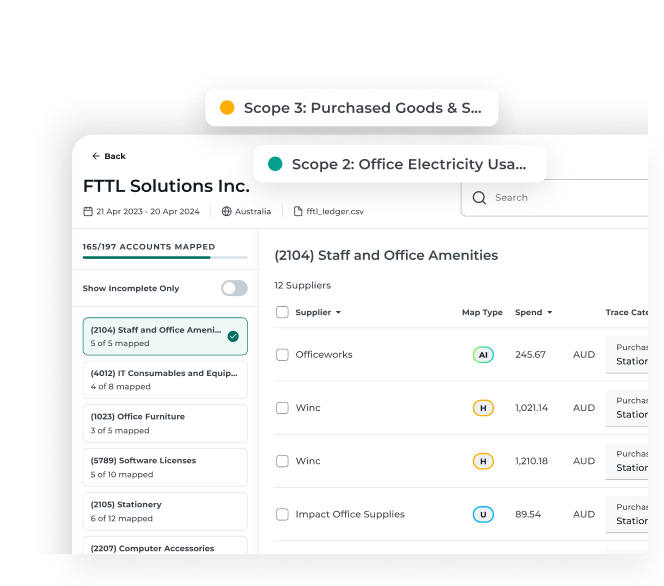
Trace automatically ingests unstructured data from any source: utility bills, invoices, financial systems. Our AI reads PDFs, classifies thousands of supplier transactions against GHG Protocol categories, and maps every row to the right emissions factor in minutes. No manual entry. No spreadsheet wrangling.

Scope 3 in minutes, not months.

Classifying thousands of supplier transactions against GHG Protocol categories is one of the most time-consuming parts of carbon accounting.

Trace's AI does it automatically, processing in bulk, returning confidence-scored classifications, and remembering your mappings for future reporting cycles.
.
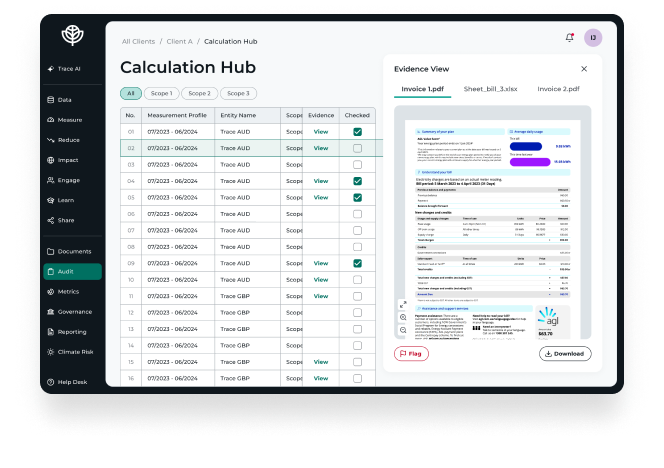
Every output is audit-ready. By design.

Trace builds a complete, verifiable audit trail into every calculation, input and source. Every emission is traceable from source data to final output. When your auditor asks for evidence, it is already packaged and ready to share. No scrambling. No remediation. No spiralling audit fees.

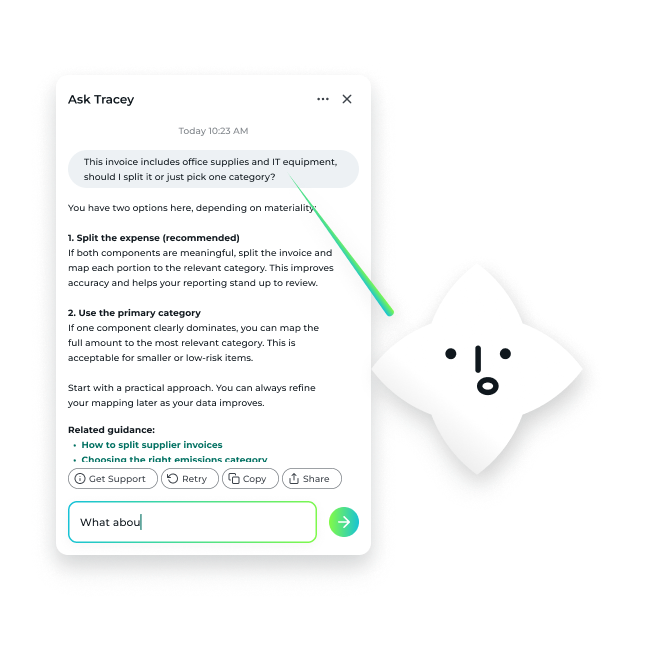
Ask anything. Get expert-backed answers.

Tracey, our AI sustainability assistant, answers your toughest ASRS and emissions questions on demand - drawing from an expert-built knowledge base and your company's own live data. Ask which suppliers are driving your Scope 3 footprint, or whether your boundary definition is appropriate, and get precise, cited answers instantly.
Your team stops building spreadsheets. Trace builds your carbon inventory.

Five steps from raw data to a defensible, audit-ready disclosure - without a dedicated sustainability team.

1. Capture & Validate
Connect financial systems, upload utility bills, or drop in CSVs. Trace accepts unstructured data from any source.
2. AI Maps every transaction
Our AI reads and classifies supplier transactions against GHG Protocol categories in minutes. Thousands of rows, zero manual entry.
3. Validate and review
Your dedicated carbon specialist reviews methodology, boundary definitions and data quality. Expert eyes on every inventory.
4. Generate audit-ready outputs
Download a complete, verifiable audit evidence pack — source data, emission factors and calculation logic all traceable.
5. Track and communicate progress
Monitor emissions trends in your dashboard. Export board pack and stakeholder reports as your inventory matures year on year.

Everything you need for carbon accounting in one platform.

Trace covers data collection, calculation, reporting, audit readiness and expert support - so you are not stitching together multiple tools or relying entirely on external advisors.

Data Collection
Smart Utility Bill Reading
AI supplier mapping with historical memory
API integrations
Bulk data upload and CSV import
Smart spreadsheet mapping
Virtual Sustainability Manager
Employee commute survey
Measurement
GHG Protocol-aligned methodology
Global emission factor library
Scope 1, 2 (location and market-based) and Scope 3
Supplier emission level deepdive
Sub-entity and group roll-up reporting
Audit Readiness
Automatic audit trail capture
Full source-to-output traceability
Boundary definition documentation
Exportable audit evidence
Version control and change log
Audit-ready service
Reporting
Granular dashboards: emissions by category, entity, year
Year-on-year tracking and trend analysis
Built-in and custom downloadable carbon reports
Emissions intensity metrics (revenue, FTE, sector-specific)
Smart spreadsheet mapping
Virtual Sustainability Manager
Employee commute survey
Expert Support
Dedicated carbon accounting specialist
Methodology review and boundary sign-off
Data quality and gap remediation support
AI sustainability assistant (Tracey) 24/7
Expert climate advisory available

Trace is trusted by
Australian mandatory reporters.

“Group 1 reporter in construction and engineering. With no in-house carbon expertise, SEE Civil used Trace to complete a full FY24 carbon inventory, run a gap assessment, and prepare a compliance roadmap, all within weeks.” – CFO, SEE Civil

Read the SEE Civil Case Study

Trace is ranked #1 for Usability (8.86 vs Workiva 8.35) and #1 for Results (8.58 vs Denxpert 8.53) in the G2 ESG Reporting Index, and is a Momentum Leader in ESG Reporting and Sustainability Management.

Read the G2 Reviews

Paddy Pallin used Trace to build internal buy-in, lock in scope early, and avoid the last-minute scramble that tripped up many first-round filers.

“By recommending an 18-24 month lead-time, we secured executive approval and budget to do this properly. Starting early meant we avoided the scramble - saving time, money, and a lot of stress.”

Emma
Head of Sustainability, Paddy Pallin
Watch the Video

Preparing for mandatory AASB S2 reporting?

Carbon accounting is one of four pillars of ASRS S2. Trace covers all four: Metrics and Targets, Governance, Strategy and Risk Management. If you need an end-to-end compliance solution rather than a carbon accounting tool, our ASRS compliance page covers the full scope.

Book a Call →

FAQs

What is carbon accounting software and how does it differ from a spreadsheet?
Carbon accounting software automates the data collection, calculation and documentation that carbon accounting requires. A spreadsheet requires manual data entry, formula maintenance and error-checking across hundreds or thousands of data points. Software like Trace ingests raw source data automatically, applies the correct emission factors, and produces a version-controlled, traceable output that an assurance provider can work with directly. The difference is material when the output will be externally audited.
Does Trace cover Scope 1, 2 and 3 emissions?
Yes. Trace covers Scope 1 direct emissions, Scope 2 electricity emissions (both location-based and market-based, as required under AASB S2), and Scope 3 across all 15 GHG Protocol categories. For Scope 3, Trace's AI maps supplier transactions to the correct category in bulk. The platform also includes an employee survey for commuting and working-from-home emissions (Scope 3 Category 7).
Is Trace aligned to AASB S2 and the GHG Protocol?
Yes. Trace's calculation methodology is aligned to the GHG Protocol Corporate Standard, which AASB S2 (ASRS S2) references for emissions measurement. Australian National Greenhouse Accounts emission factors are supported alongside international datasets. Trace's outputs are formatted for ASRS disclosure requirements, including the gross and net emissions distinctions, market-based Scope 2, and the emissions intensity metrics ASRS requires.
What does 'audit-ready' mean for carbon accounting data?
Audit-ready means your assurance provider can verify every reported emissions figure without requesting additional information. In practice this requires: source data linked to each emission calculation; the emission factor and methodology applied documented for each line item; an organisational boundary definition with clear rationale; and a version-controlled record of how the inventory was built. Trace records all of this automatically as emissions data is entered and calculated.
How long does it take to complete a first-year carbon inventory in Trace?
For most companies, completing a defensible Scope 1 and 2 inventory in Trace takes four to eight weeks from data submission to a reviewed output, depending on the number of sites and data sources. Scope 3 screening takes an additional four to six weeks for a material category assessment. The timeline for manual or consultancy-led approaches is typically two to three times longer due to data handling and sequential review cycles.
Can Trace support both mandatory and voluntary carbon reporting?
Yes. Trace is used by Australian companies reporting under mandatory AASB S2 requirements and by companies reporting voluntarily for procurement, investor, customer or ESG reasons. The platform produces a standards-aligned carbon inventory that works for both contexts. The output format and disclosure framing differ between mandatory and voluntary reporters, and Trace supports both.

Still have questions? Book a scoping call.

Book a Call →

Newsletter:  Climate Reporting Simplified.
This monthly edition unpacks what mandatory climate reporting really requires and how to minimise cost, disruption & confusion.

💚 Don’t worry, we won’t spam!

London - Sydney

© Copyright 2025 Trace | All Rights Reserved