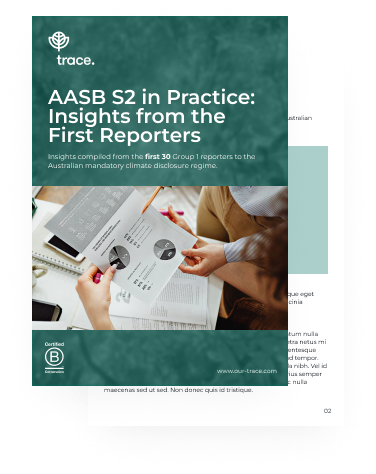
What do Australia’s first 30 AASB S2 climate disclosures actually reveal?

The first mandatory ASRS climate statements are in. Trace has analysed all 30 disclosures, so you can see what best practice looks like before your deadline arrives.

CFOsFinance DirectorsSustainability ManagersRisk & ComplianceBoard Members
FREE DOWNLOAD

Get the ebook

AASB Australia's Mandatory Climate Reporting

Trusted by Mandatory Reporters

“Trace’s AI capabilities have significantly streamlined our data collection and validation processes, reducing manual effort and giving us greater confidence .”

Name

CFO, Allied credit

“Trace’s AI capabilities have significantly streamlined our data collection and validation processes, reducing manual effort and giving us greater confidence .”

CFO, Allied credit

“We’ve worked with Trace for over 4 years and they’ve always given us confidence that our carbon data is accurate, audit-ready and aligned with evolving reporting standards.”

CEO, EnVATO

" Starting early [with the Trace platform] meant we avoided the scramble - saving time, money, and a lot of stress"

HEAD OF ESG, PADDY PALLIN

See Whats Inside

Three lenses on Australia’s first mandatory climate disclosures.

We brought together sustainability, financial advisory and climate risk specialists to review every disclosure. Here’s what we examined.
Real disclosure benchmarks

See how Rio Tinto, QBE, AMP and comparable entities are translating climate risk into financial terms. What format are they using? What are they including, and what are they deferring? First-round disclosures are running 30 to 40 pages for large listed entities. The Trace analysis tells you what’s in those pages.

Themes and patterns decoded

Scope 3 disclosure is the most variable element across first reporters. Scenario analysis depth ranges from single-scenario narrative to quantified physical and transition risk modelling. We break down the patterns across sectors so you can calibrate your own approach to what the market is doing.

What’s working, what isn’t

Not all first disclosures are equal. Some entities are already producing clear, financially integrated climate statements. Others are technically compliant but unlikely to satisfy auditors in year two. The ebook identifies what distinguishes the stronger disclosures, with examples.

Practical takeaways for your deadline

Whether you’re a Group 1 entity refining your approach for year two, or a Group 2 entity starting preparation now, the ebook closes with specific, prioritised actions. What to do first. What can wait. What the auditors are already asking about.

Key Findings

What the data shows so far

A preview of what Trace’s analysis of Australia’s first 30 AASB S2 disclosures reveals. The full ebook goes deeper on every finding.

Governance documentation is separating early reporters

Boards need auditable evidence of climate risk oversight before the numbers are finalised. Entities that started governance work 12 months ahead of their first disclosure date show materially stronger disclosures than those that started closer to deadline.

Materiality framing is becoming a differentiator

Strong disclosures open with a clear, defensible materiality statement. This does two things: it scopes the report for readers and it protects the entity from scope creep in subsequent years. Entities without this are producing harder-to-defend, longer documents.

Scenario analysis depth is widely divergent in year one

Scenario analysis ranges from single-scenario narrative summaries to quantified, integrated modelling across physical and transition risk pathways. The gap between the strongest and weakest disclosures on this dimension is significant, and auditors are taking notice.

Financial integration is where most entities are still maturing

The AASB S2 ambition is climate risk quantified in financial terms, not a sustainability narrative appended to an annual report. Most Group 1 first disclosures are closer to the narrative end of the spectrum. This is the gap Group 2 entities have the opportunity to close from the start.

Who This Is For

Written for the people
making ASRS decisions

This ebook is written at CFO grade, with enough detail to be genuinely useful to sustainability leads and risk teams. Not a primer. Not a sales deck.

CFOs & Finance Directors

Responsible for signing off on the disclosure. Needs to understand what auditors will scrutinise in year two, and where the financial integration gaps are in first-round disclosures.

Sustainability Managers & ESG Leads

Building the disclosure internally. Needs to understand what peers are doing on Scope 3, scenario analysis and materiality so the internal benchmark is calibrated correctly.

Risk & Compliance Teams

Needs to understand where governance documentation is falling short in first-round disclosures and what auditors are already flagging as areas for year-two improvement.

Board Members & Audit Committee

Accountable for climate risk oversight under AASB S2. Needs a clear picture of what comparable entities are disclosing and what the governance standard looks like in practice.

This ebook is particularly relevant if:

Your entity is likely to fall under ASRS Group 1, 2 or 3 (or you're not yet sure which group applies)

Your board or audit committee has asked about climate disclosure obligations for the first time

You're preparing a Group 2 first disclosure and want to learn from what Group 1 entities got right and wrong

You need to brief internal stakeholders on what AASB S2 actually requires versus what others are choosing to include

What Comes Next

From ebook to
compliant disclosure.

01

Download the ebook

Understand what first reporters did. Where they focused, where they struggled, and what auditors are already signalling for year two.

Get it now

02

Run your readiness assessment

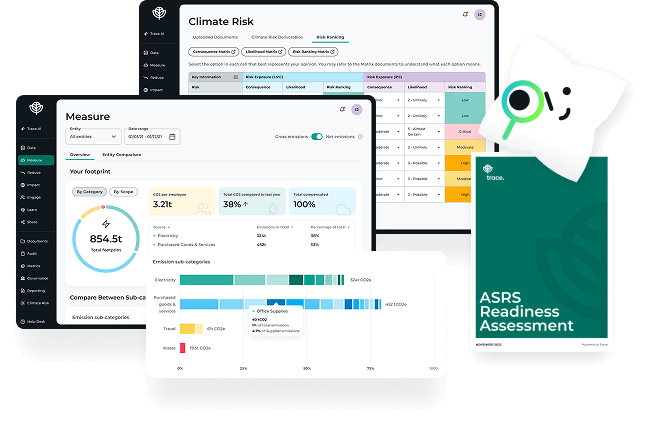
Trace maps your current data, governance and reporting position against ASRS requirements. You get a clear picture of where you are and a prioritised gap list.

See how it works

03

Build your compliance roadmap

Trace turns your readiness assessment into a sequenced plan: what to do now, what to prepare for year two, and how to keep your board and audit committee informed throughout.

Book a call with our team

Questions we hear most from ASRS teams

These are the questions Traces team hears most often from CFOs and sustainability leads starting their ASRS journey. The full ebook answers all of them in depth.


What do Australia’s first AASB S2 climate disclosures actually reveal?
Australia’s inaugural AASB S2 climate disclosures unveil a comprehensive view of how companies are addressing climate-related risks and opportunities. These disclosures highlight the alignment of corporate reporting with the International Sustainability Standards Board (ISSB) guidelines, showcasing a commitment to transparency in climate impacts. Key findings include the identification of significant climate risks, strategies for mitigation, and the integration of sustainability into business operations. As companies prepare for mandatory reporting, these disclosures serve as a critical benchmark for stakeholders, illustrating the evolving landscape of climate accountability in Australia.
What are the ASRS reporting deadlines for Australian companies?
Australia’s inaugural AASB S2 climate disclosures unveil a comprehensive view of how companies are addressing climate-related risks and opportunities. These disclosures highlight the alignment of corporate reporting with the International Sustainability Standards Board (ISSB) guidelines, showcasing a commitment to transparency in climate impacts. Key findings include the identification of significant climate risks, strategies for mitigation, and the integration of sustainability into business operations. As companies prepare for mandatory reporting, these disclosures serve as a critical benchmark for stakeholders, illustrating the evolving landscape of climate accountability in Australia.
What does AASB S2 require companies to disclose?
Australia’s inaugural AASB S2 climate disclosures unveil a comprehensive view of how companies are addressing climate-related risks and opportunities. These disclosures highlight the alignment of corporate reporting with the International Sustainability Standards Board (ISSB) guidelines, showcasing a commitment to transparency in climate impacts. Key findings include the identification of significant climate risks, strategies for mitigation, and the integration of sustainability into business operations. As companies prepare for mandatory reporting, these disclosures serve as a critical benchmark for stakeholders, illustrating the evolving landscape of climate accountability in Australia.
How are Group 1 companies handling Scope 3 emissions in their first reports?
Australia’s inaugural AASB S2 climate disclosures unveil a comprehensive view of how companies are addressing climate-related risks and opportunities. These disclosures highlight the alignment of corporate reporting with the International Sustainability Standards Board (ISSB) guidelines, showcasing a commitment to transparency in climate impacts. Key findings include the identification of significant climate risks, strategies for mitigation, and the integration of sustainability into business operations. As companies prepare for mandatory reporting, these disclosures serve as a critical benchmark for stakeholders, illustrating the evolving landscape of climate accountability in Australia.
What is the difference between ASRS and ISSB requirements?
Australia’s inaugural AASB S2 climate disclosures unveil a comprehensive view of how companies are addressing climate-related risks and opportunities. These disclosures highlight the alignment of corporate reporting with the International Sustainability Standards Board (ISSB) guidelines, showcasing a commitment to transparency in climate impacts. Key findings include the identification of significant climate risks, strategies for mitigation, and the integration of sustainability into business operations. As companies prepare for mandatory reporting, these disclosures serve as a critical benchmark for stakeholders, illustrating the evolving landscape of climate accountability in Australia.
What should CFOs prioritise in their first AASB S2 report?
Australia’s inaugural AASB S2 climate disclosures unveil a comprehensive view of how companies are addressing climate-related risks and opportunities. These disclosures highlight the alignment of corporate reporting with the International Sustainability Standards Board (ISSB) guidelines, showcasing a commitment to transparency in climate impacts. Key findings include the identification of significant climate risks, strategies for mitigation, and the integration of sustainability into business operations. As companies prepare for mandatory reporting, these disclosures serve as a critical benchmark for stakeholders, illustrating the evolving landscape of climate accountability in Australia.

Want deeper answers? The ebook has entity benchmarks, worked examples and expert commentary.

Download the full ebook

Questions we hear most from ASRS teams

These are the questions Traces team hears most often from CFOs and sustainability leads starting their ASRS journey. The full ebook answers all of them in depth.

What do Australia’s first AASB S2 climate disclosures actually reveal?
Australia’s inaugural AASB S2 climate disclosures unveil a comprehensive view of how companies are addressing climate-related risks and opportunities. These disclosures highlight the alignment of corporate reporting with the International Sustainability Standards Board (ISSB) guidelines, showcasing a commitment to transparency in climate impacts. Key findings include the identification of significant climate risks, strategies for mitigation, and the integration of sustainability into business operations. As companies prepare for mandatory reporting, these disclosures serve as a critical benchmark for stakeholders, illustrating the evolving landscape of climate accountability in Australia.
What are the ASRS reporting deadlines for Australian companies?
Australia’s inaugural AASB S2 climate disclosures unveil a comprehensive view of how companies are addressing climate-related risks and opportunities. These disclosures highlight the alignment of corporate reporting with the International Sustainability Standards Board (ISSB) guidelines, showcasing a commitment to transparency in climate impacts. Key findings include the identification of significant climate risks, strategies for mitigation, and the integration of sustainability into business operations. As companies prepare for mandatory reporting, these disclosures serve as a critical benchmark for stakeholders, illustrating the evolving landscape of climate accountability in Australia.
What does AASB S2 require companies to disclose?
Australia’s inaugural AASB S2 climate disclosures unveil a comprehensive view of how companies are addressing climate-related risks and opportunities. These disclosures highlight the alignment of corporate reporting with the International Sustainability Standards Board (ISSB) guidelines, showcasing a commitment to transparency in climate impacts. Key findings include the identification of significant climate risks, strategies for mitigation, and the integration of sustainability into business operations. As companies prepare for mandatory reporting, these disclosures serve as a critical benchmark for stakeholders, illustrating the evolving landscape of climate accountability in Australia.
How are Group 1 companies handling Scope 3 emissions in their first reports?
Australia’s inaugural AASB S2 climate disclosures unveil a comprehensive view of how companies are addressing climate-related risks and opportunities. These disclosures highlight the alignment of corporate reporting with the International Sustainability Standards Board (ISSB) guidelines, showcasing a commitment to transparency in climate impacts. Key findings include the identification of significant climate risks, strategies for mitigation, and the integration of sustainability into business operations. As companies prepare for mandatory reporting, these disclosures serve as a critical benchmark for stakeholders, illustrating the evolving landscape of climate accountability in Australia.
What is the difference between ASRS and ISSB requirements?
Australia’s inaugural AASB S2 climate disclosures unveil a comprehensive view of how companies are addressing climate-related risks and opportunities. These disclosures highlight the alignment of corporate reporting with the International Sustainability Standards Board (ISSB) guidelines, showcasing a commitment to transparency in climate impacts. Key findings include the identification of significant climate risks, strategies for mitigation, and the integration of sustainability into business operations. As companies prepare for mandatory reporting, these disclosures serve as a critical benchmark for stakeholders, illustrating the evolving landscape of climate accountability in Australia.
What should CFOs prioritise in their first AASB S2 report?
Australia’s inaugural AASB S2 climate disclosures unveil a comprehensive view of how companies are addressing climate-related risks and opportunities. These disclosures highlight the alignment of corporate reporting with the International Sustainability Standards Board (ISSB) guidelines, showcasing a commitment to transparency in climate impacts. Key findings include the identification of significant climate risks, strategies for mitigation, and the integration of sustainability into business operations. As companies prepare for mandatory reporting, these disclosures serve as a critical benchmark for stakeholders, illustrating the evolving landscape of climate accountability in Australia.

Want deeper answers? The ebook has entity benchmarks, worked examples and expert commentary.

Download the full ebook

Your deadline is coming.
Start with the data.

Download the free ebook and see what Australias first AASB S2 reporters have already disclosed. Then talk to Trace about where you stand.

Newsletter:  Climate Reporting Simplified.
This monthly edition unpacks what mandatory climate reporting really requires and how to minimise cost, disruption & confusion.

💚 Don’t worry, we won’t spam!

London - Sydney

© Copyright 2026 Trace | All Rights Reserved