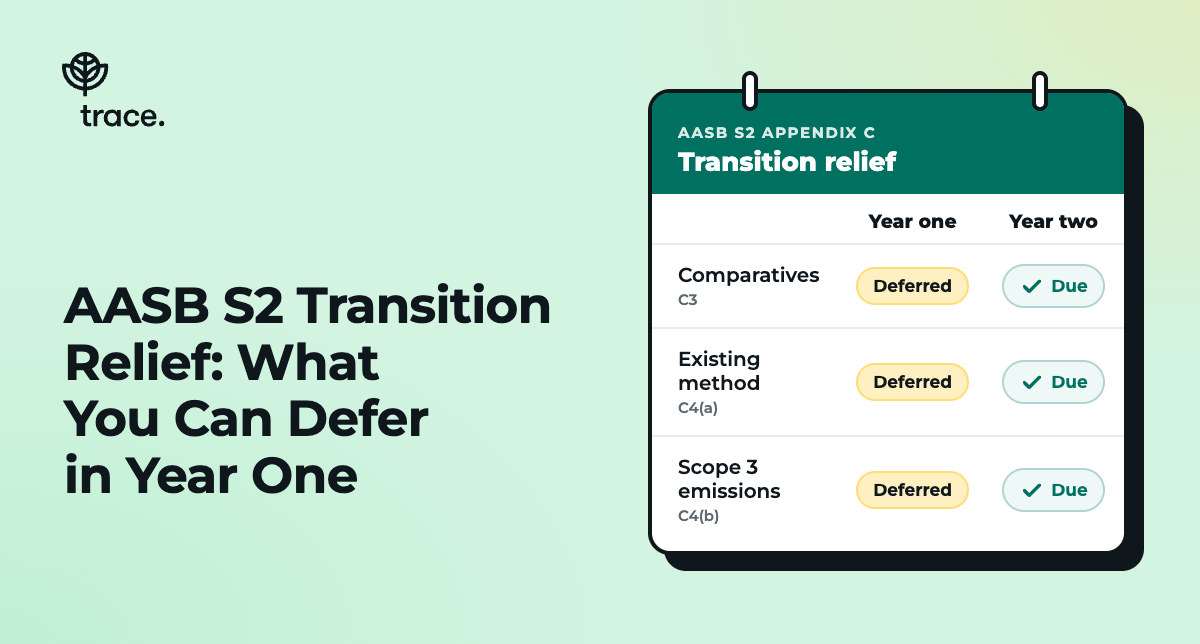
AASB S2 Appendix C gives three transition reliefs, each for the first annual reporting period only. They are no comparative information (C3), continued use of an existing non GHG Protocol measurement method (C4(a)), and no Scope 3 disclosure (C4(b)). Scenario analysis is not one of them. It is required in year one, at a proportionate depth.
The Australian Sustainability Reporting Standard AASB S2 Climate-related Disclosures has three transition reliefs, all in Appendix C. An entity need not disclose comparatives (paragraph C3), may keep a prior non GHG Protocol measurement method (C4(a)), and need not disclose Scope 3 emissions (C4(b)). Each applies only in the entity's first annual reporting period under the standard.
AASB S2 is the climate standard within the Australian Sustainability Reporting Standards (ASRS), and our guide to AASB S2 covers it more widely. Appendix C is not guidance, either: the AASB says it "has the same authority as the other parts of the Standard."
ASIC's documents use both "transition relief" and "transitional relief", and the two names mean the same thing.
No comparatives
Existing measurement method
No Scope 3
Paragraph C2 sets the reference point. The date of initial application is "the beginning of the annual reporting period in which an entity first applies this Standard": in plain words, the first day of your first reporting year. According to ASIC Regulatory Guide 280, Group 2 covers annual reporting periods commencing from 1 July 2026 to 30 June 2027. So for a Group 2 entity with a 30 June year end, that date is 1 July 2026.
Scope 3 emissions are the indirect emissions in an entity's value chain, upstream and downstream, outside its own operations and purchased energy. Under paragraph C4(b), an entity need not disclose them in its first annual reporting period. That includes financed emissions for entities in asset management, commercial banking or insurance. The relief ends with that first period.
The Scope 3 relief under ASRS is also narrower than it looks, because C4(b) points only to paragraph 29(a), the emissions disclosure. BDO Australia made the point in May 2026. According to BDO, the relief "is restricted to the disclosures required by paragraph 29(a)." On BDO's reading, it does not reach paragraphs 33 and 35 on climate-related targets. So an entity that has set a Scope 3 target still discloses that target and its performance against it.
In year two of AASB S2, Scope 3 is disclosed for the current period. However, paragraph C5 leaves a tail. An entity that used C4(b) in year one may keep using it "for the purposes of presenting that information as comparative information." As a result, the second report can still leave out the year-one Scope 3 comparative.
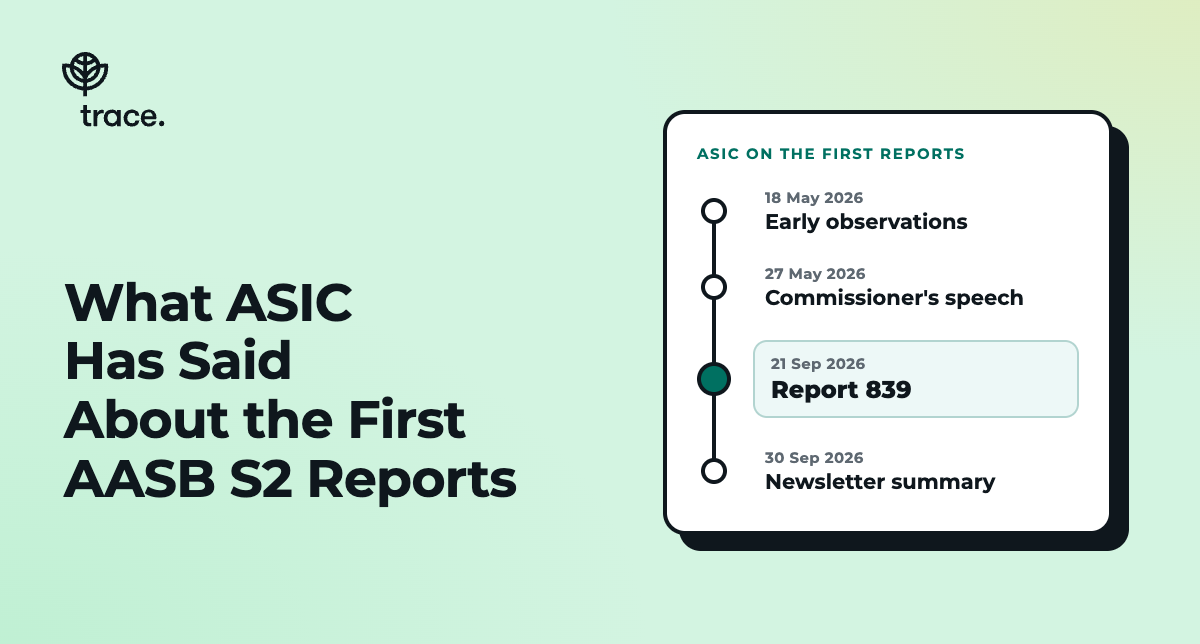
According to ASIC's Report 839, published 21 September 2026, 82.5% of entities in its sample relied on the Scope 3 relief. The sample was 40 of the 312 sustainability reports lodged for years ended 31 December 2025, or 13%, chosen towards higher-emitting and higher-risk sectors. ASIC also said entities relying on the relief "must clearly identify their reliance on this relief." Any Scope 3 information published elsewhere should be labelled voluntary, with its measurement basis.
The relief is optional, though. An entity that already reports Scope 3 voluntarily, or whose investors expect it, may decide not to use C4(b).
What this means for you: deferring the disclosure is not deferring the work. A Scope 3 figure for the second year covers activity from the first day of that year. For a Group 2 entity with a 30 June year end, that day is 1 July 2027, before its first report can be finished. Our page on Scope 3 under ASRS covers where that measurement effort sits.
Paragraph C3 means the first report shows one year of numbers, with no comparative for the year before. Paragraph C4(a) lets an entity keep the method it already used to measure greenhouse gas emissions, if that method was not the GHG Protocol Corporate Standard. Both apply to the first reporting period only.
Appendix D paragraph 70 is the ongoing rule, requiring comparatives "for all amounts disclosed in the reporting period." So from year two, the previous year's figures sit beside the current ones.
The measurement-method relief helps only an entity that already measured its emissions in the year before. Its method must also be other than the Greenhouse Gas Protocol Corporate Standard (2004). A first-time measurer gets nothing from it, since there is no earlier method to continue.
Keep it separate from the jurisdictional relief, which covers a method that a jurisdictional authority requires, such as the National Greenhouse and Energy Reporting (NGER) scheme. The AASB says that relief is available "for as long as that requirement applies", so it is ongoing, not transitional. According to the AASB, the December 2025 amendments (AASB S2025-1) that clarified it apply to periods beginning on or after 1 January 2027, with earlier application permitted.
No. Climate-related scenario analysis tests how an entity's strategy holds up under different plausible climate futures. AASB S2 paragraph 22 requires it from the first year, "using an approach that is commensurate with the entity's circumstances." That proportionality is permanent. It is not a first-year deferral, and Appendix C never mentions scenario analysis.
Myth: scenario analysis is one of the year-one reliefs, as some market summaries say. Reality: Appendix C runs from paragraph C1 to C6, and none of its paragraphs mentions it.
What the standard does allow is depth matched to the entity. Paragraph B1 asks for "all reasonable and supportable information" available at the reporting date "without undue cost or effort." Paragraph B6 then speaks to beginners. An entity that "has only just begun to explore" scenario analysis might be unable to use a quantitative or technically sophisticated approach without undue cost or effort. Paragraph B17 allows a simpler approach, such as qualitative scenario narratives, where that suits the entity's circumstances.
Under paragraph B18, the analysis can follow the strategic planning cycle, such as every three to five years. The resilience assessment is updated every period.
The Corporations Act then adds a floor. According to ASIC Regulatory Guide 280, reporting entities "must use a minimum of two climate scenarios" referable to the temperature increases in the Climate Change Act 2022. Our hub on climate risk and scenario analysis shows how that analysis is built.
What changes in year two is the review, not the duty. Under the AUASB's ASSA 5010, scenario analysis is outside the year-one review and inside the review of all disclosures from year two. Put simply, year one is not exempt from doing it, only from having it reviewed.
In practice, it may not escape the auditor either. In our experience, auditors have questioned scenarios in year-one reviews and asked to see the methodology, because the risks under review usually trace back to them.
Three things outside Appendix C shape year one: proportionality built permanently into AASB S2, temporary settings in the Corporations Act, and the phasing of assurance under ASSA 5010. None is a relief an entity elects, and each runs on its own clock. Mixing them up is how first reporters misjudge what can really wait.
Transition reliefs
Proportionality
Corporations Act settings
Assurance phasing
Anticipated financial effects are how climate risks and opportunities are expected to affect an entity's finances. For those, paragraph 18 applies the same "undue cost or effort" test, and an approach commensurate with the skills, capabilities and resources available.
Paragraphs 19 to 21 go further. Under paragraph 20, an entity "need not provide quantitative information" about those effects if it lacks the skills, capabilities or resources. Paragraph 21 then requires it to explain why and give qualitative information instead, plus quantitative information on the combined effects unless that would not be useful. These are judgements to make and document, not exemptions to claim.
This sits in the Corporations Act, not in AASB S2. According to ASIC Regulatory Guide 280, modified liability settings apply, in specific circumstances, to statements about Scope 3 emissions, scenario analysis and transition plans. They cover reports for financial years commencing between 1 January 2025 and 31 December 2027. Only ASIC action and criminal action remain available, so an investor cannot bring a civil action over a protected statement.
The window is set by the calendar, not by an entity's first year. Treasury's August 2026 paper describes "a three-year modified liability period", which is the window's length, not each entity's coverage. As an illustrative example, take an entity with a 30 June year end. Its year starting 1 July 2027 commences inside the window, while its year starting 1 July 2028 does not. A Group 3 entity whose first year starts 1 July 2027 therefore has that one year inside it. The count changes with a calendar year. For a Group 2 entity whose first year starts 1 January 2027, that is one protected report, and for a Group 3 entity whose first year starts 1 January 2028, it is none.
The content is limited too. RG 280.66 says the settings do not apply to voluntary disclosures beyond what the standards require. A separate one-year protection for forward-looking statements covered only financial years commencing in 2025, so Group 2 and Group 3 never had it.
RG 280 covers this too. It applies to financial years commencing between 1 January 2025 and 31 December 2027. For those years, directors declare that, in their opinion, the entity "has taken reasonable steps" to ensure the report is in accordance with the Corporations Act and AASB S2. From financial years commencing 1 January 2028, the declaration is an opinion on whether the report complies.
Under ASSA 5010, year one is a review (limited assurance) of a narrow set. It covers governance, the risks and opportunities at AASB S2 subparagraphs 9(a), 10(a) and 10(b), and Scope 1 and 2 emissions (direct, and from purchased energy). A statement that there are no material climate risks or opportunities is itself in scope. Years two and three are a review of all disclosures, and year four onwards an audit.
Use the three reliefs deliberately, say in the report that you have used them, and plan year two before year one closes. Every relief in Appendix C ends with the first reporting period. Meanwhile, proportionality and the Corporations Act settings each follow their own timetable, so treat them as separate decisions.
At Trace, we call our approach Minimum Viable Compliance: meeting the letter and intent of ASRS without gold-plating, and concentrating effort where it is material and audit-ready. It is a deliberate choice, not the cheap option. Our Minimum Viable Compliance guide sets it out.
Trace is a climate disclosure platform with a specialist advisory team, and its workstreams include a readiness assessment and AASB S2 disclosure support. It suits mid-sized Australian organisations, mostly in Group 2, with no dedicated sustainability team that want a proportionate result from software plus specialists. However, a large sustainability team wanting extensive scenario modelling may prefer another route. So may an organisation needing bespoke physical-asset or financed-emissions modelling, or a team that wants software only or a consultancy only.
As at 12 November 2026, Treasury's climate disclosure efficiency consultation has closed. Treasury released the paper in August 2026, and it gave a closing date of 2 October 2026. The paper says the changes "will not impact those reporting for the 2026-27 financial year", and it is not seeking views on Scope 3 requirements. Separately, the AASB's August 2026 work plan lists a Group 3 proportionality review, timing to be decided. Watch for Treasury's response and any AASB exposure draft touching Appendix C.
No, if the entity chooses to use the relief. AASB S2 paragraph C4(b) means an entity need not disclose Scope 3 emissions, including financed emissions, in its first annual reporting period. ASIC expects reliance on that relief to be clearly identified in the report. Scope 3 disclosure then starts in the second reporting year.
Not as reliefs from current-year disclosure. All three end with the first annual reporting period, so in year two of AASB S2 an entity discloses comparatives and Scope 3 for the current period. However, paragraph C5 still lets an entity omit the year-one comparative for any measurement-method or Scope 3 relief it used.
Yes. AASB S2 paragraph 22 requires climate-related scenario analysis from the first reporting year, using an approach commensurate with the entity's circumstances. A simpler, qualitative approach can be appropriate for an entity that is just starting. In addition, ASIC Regulatory Guide 280 says at least two scenarios referable to the Climate Change Act 2022 temperature increases must be used.
For Scope 3, ASIC says yes. In Report 839, ASIC states that entities relying on the Scope 3 relief must clearly identify that reliance, label any Scope 3 information disclosed elsewhere as voluntary, and disclose its measurement basis. That expectation is specific to Scope 3, and Appendix C does not state an equivalent for the other two reliefs.
According to ASIC Regulatory Guide 280, it covers statements about Scope 3 emissions, scenario analysis and transition plans in sustainability reports for financial years commencing between 1 January 2025 and 31 December 2027. The window is fixed by the calendar, so later starters have fewer covered years. ASIC action and criminal action remain available throughout.
Trace is a climate reporting platform with in-house specialists, founded in 2020 with offices in Sydney and London. It helps Australian organisations measure emissions and prepare AASB S2 climate disclosures.
Reviewed by Joanna Auburn, Co-founder and Chief Product Officer of Trace.
This article is general information about Australian climate reporting requirements as at the date shown. It is not legal, accounting or assurance advice.
All read on 12 November 2026.


London - Sydney