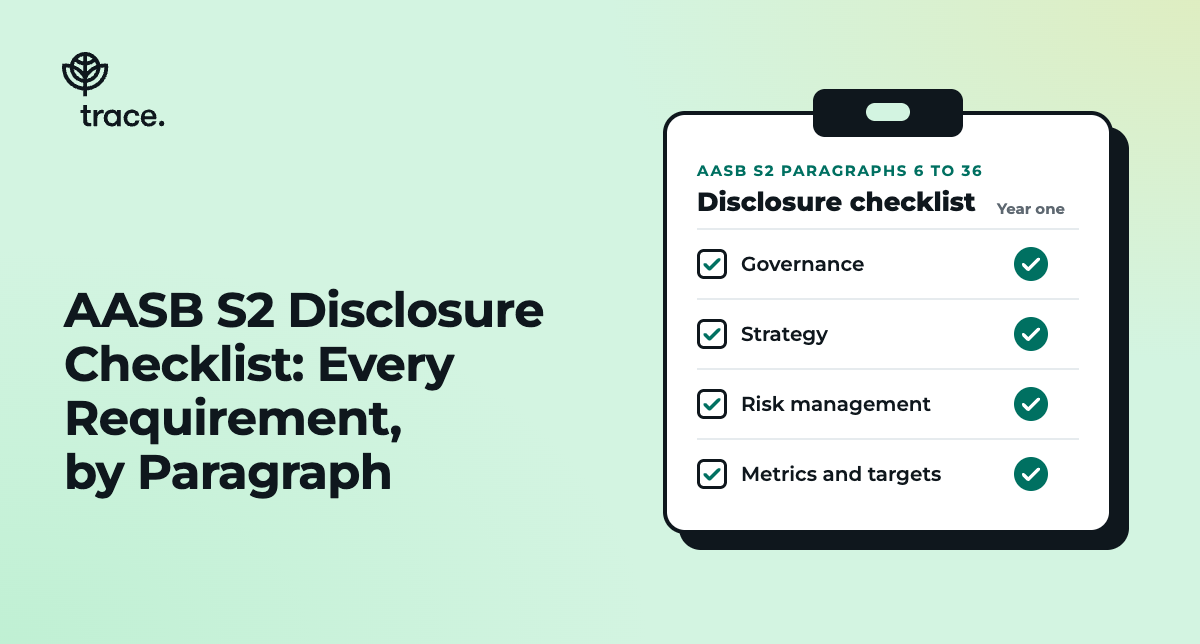
An AASB S2 checklist covers the four pillars in paragraphs 6 to 36: governance, strategy, risk management, and metrics and targets. It also covers the general requirements in Appendix D. Then it adds what the Corporations Act requires, such as the directors' declaration and two mandated scenarios. In year one, Scope 3 emissions and comparatives may be left out.
An AASB S2 checklist needs every disclosure in the four pillars of Australian Sustainability Reporting Standard AASB S2 Climate-related Disclosures, in paragraphs 6 to 36. It also needs the general requirements in Appendix D. Finally, it needs the items the Corporations Act adds, such as the directors' declaration and two mandated scenarios.
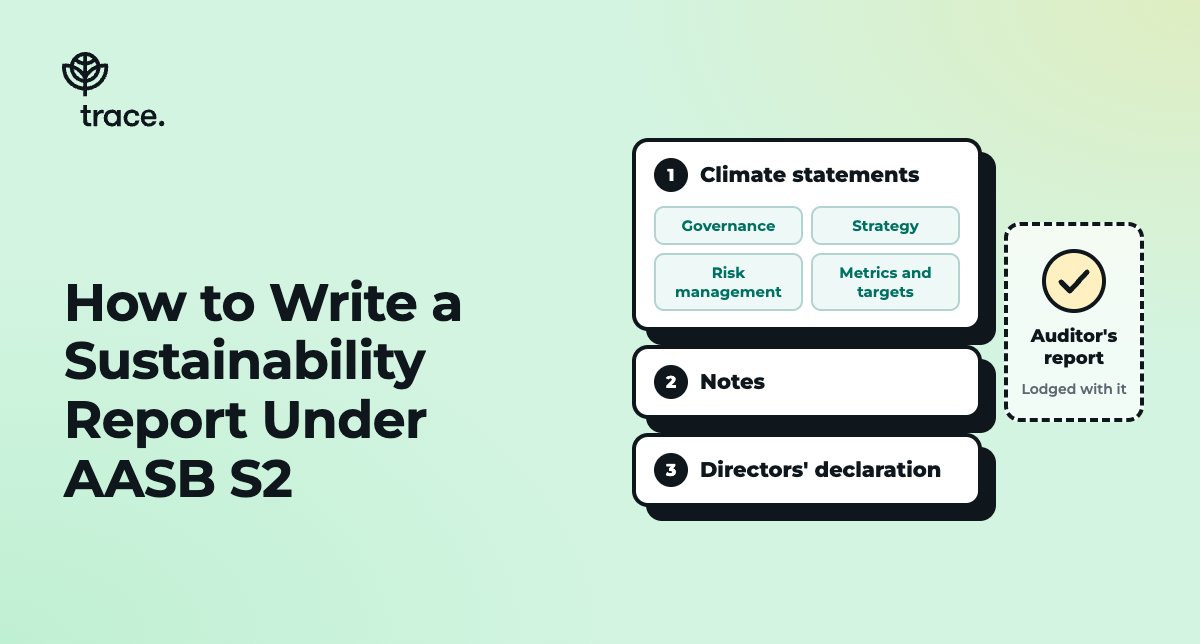
ASIC's Regulatory Guide 280 (RG 280.3 and 280.4) sets out what a sustainability report contains. It holds the climate statements, notes to them and a directors' declaration. The climate statements are the statements AASB S2 requires. So this AASB S2 disclosure checklist follows the standard's own order, then adds the Corporations Act items. For an explanation of each pillar in prose, see our guide to AASB S2.
ASRS, the Australian Sustainability Reporting Standards, is the name for the set. AASB S2 is the climate standard within it, and the mandatory one. In practice, an ASRS checklist and an AASB S2 checklist are the same list.
One group has a shorter route. Under RG 280.73 and 280.74, only a Group 3 entity may lodge a statement that it has no material financial risks or opportunities relating to climate. It must also explain how it decided. ASSA 5010 brings that statement into the first-year review. Group 1 and Group 2 entities report against the full standard.
Each table below uses the same three columns from start to finish.
The column describes the standard's scope, not what an auditor will accept. It is also written for an entity in its first year of reporting. In the second and third years, ASSA 5010 paragraph 10(b) has the auditor review "all disclosures in the sustainability report". An audit of everything follows from the fourth year.
For example, RG 280 places Group 2 in annual reporting periods commencing from 1 July 2026 to 30 June 2027. A Group 2 entity with a 30 June year end therefore first reports for the financial year starting 1 July 2026. Its second year starts 1 July 2027. From then, Scope 3 and comparatives are required and the review covers everything.
Paragraph 6 of AASB S2 asks which body or person oversees climate-related risks and opportunities, and how. It then asks what management's role is. In this checklist that gives eight rows, from terms of reference to internal controls. All eight sit inside the first-year review, because ASSA 5010 paragraph 10(a) names paragraph 6 in full.
Which body or individual oversees climate-related risks and opportunities
Terms of reference, mandates, role descriptions and policies that reflect that responsibility
The body's process for deciding it has, or will build, the skills to oversee the strategy
How, and how often, the body is informed about climate-related risks and opportunities
How climate is weighed in overseeing strategy, major transactions and risk management, including trade-offs
Oversight of climate targets and progress, and whether related metrics affect remuneration
Management's role: any delegated position or committee, and how it is overseen
Whether management uses controls and procedures to support oversight, and how they are integrated
ASIC's Report 839 reviewed 40 of the 312 sustainability reports lodged for 31 December 2025 year ends. Half came from listed entities and half from unlisted ones. ASIC prioritised sectors with higher emissions or higher climate exposure. In that sample, 67.5% named the board as the body responsible for oversight. In addition, 42.5% tied executive remuneration to climate-related factors in some way.
The gap ASIC named was in wholly owned subsidiaries of larger multinational groups. These did not always explain how the group's governance applied to the reporting entity. So a subsidiary's rows need to show how the group's arrangements reach it. For what each row asks in more depth, see the governance disclosure requirements.
Strategy is the longest section of this checklist, with 33 rows drawn mostly from AASB S2 paragraphs 8 to 22. It asks for the climate-related risks and opportunities themselves, and their effect on the business model and decisions. It then asks for their financial effects, and how resilient the strategy is under climate scenarios.
A physical risk comes from the changing climate itself. Examples are floods, heatwaves or longer-term shifts in rainfall and temperature. By contrast, a transition risk comes from the move to a lower-carbon economy, such as policy, legal, technology, market and reputational change. The first two rows below are the only strategy rows in the first-year review. ASSA 5010 names subparagraphs 9(a), 10(a) and 10(b), and no others.
The climate-related risks and opportunities that could reasonably be expected to affect prospects
For each risk, whether it is a physical or a transition risk
For each risk and opportunity, the time horizon over which effects could reasonably occur
How short, medium and long term are defined, and how they link to planning horizons
According to ASIC's Report 839, 95% of the 40 reports identified at least one climate-related risk or opportunity. However, ASIC also found entities whose earlier reports showed extreme weather losses. Some of them disclosed no similar risk. Past weather losses are therefore worth checking against the first row. ASIC also found thin disclosure of where risks are concentrated, which is a row in the next table.
These rows describe what the risks and opportunities mean for the business and what it is doing about them. Three of them apply only in some cases, and say so.
Current and anticipated effects on the business model and value chain
Where in the business model and value chain they are concentrated (for example locations, facilities, asset types)
Current and anticipated changes to the business model, including resource allocation
Direct mitigation and adaptation efforts, current and anticipated
Indirect mitigation and adaptation efforts, current and anticipated (for example with customers and suppliers)
Any transition plan the entity has, with key assumptions and dependencies (if you have one)
How it plans to meet any climate targets, including those required by law (if any)
How these activities are resourced now, and will be
Progress against plans disclosed in earlier periods, in numbers and words (from the second report)
A transition plan sets out how an entity intends to move towards a lower-carbon economy. Paragraph 14(a)(iv) asks about "any climate-related transition plan the entity has". On a plain reading, the standard does not require a plan. A plan the entity does have is disclosed. According to ASIC's Report 839, 47.5% of the 40 reports disclosed information about a transition plan.
Current financial effects are those in the reporting period. Anticipated financial effects are those the entity expects over the short, medium and long term. Paragraph 19 allows words instead of numbers where the effects are not separately identifiable. It also allows them where measurement uncertainty is so high that numbers "would not be useful". For anticipated effects only, paragraph 20 adds a third case: the entity lacks the skills, capabilities or resources. Paragraph 21 then asks for three things, set out in the last three rows.
How the risks and opportunities affected financial position, performance and cash flows this period
Those with a significant risk of a material adjustment to carrying amounts within the next annual period
Expected change in financial position over time, given investment, disposal and funding plans
Expected change in financial performance and cash flows over the short, medium and long term
If quantitative information is not given: why not
The line items, totals and subtotals likely to be, or already, affected (if no numbers)
If no numbers: the combined effect with other risks and factors, in numbers, unless not useful
This is the set most worth checking twice. According to ASIC's Report 839, 37.5% of the 40 reports gave only qualitative information on financial effects. In addition, 57.5% relied on measurement uncertainty to some extent. Yet some reports lacked the explanation and the line items that paragraph 21 requires.
Climate resilience is an entity's capacity to adjust to climate-related changes, developments and uncertainties. Scenario analysis tests the strategy against a range of possible climate futures. AASB S2 paragraph 22 requires an entity to use it from the first report, "using an approach that is commensurate with the entity's circumstances". So it is not a first-year relief. Under paragraph B18, the resilience assessment is updated every year. The scenario analysis behind it may follow the strategic planning cycle, for example every three to five years.
The Corporations Act sets a floor. Under section 296D(2B), as RG 280.99 explains, an entity must use at least two scenarios. One is 1.5°C of warming. The other is warming well exceeding 2°C, which RG 280 notes the explanatory memorandum treats as 2.5°C or higher. ASIC found that about 20% of the 40 reports limited their analysis to qualitative, narrative scenarios. ASIC says AASB S2 allows this, "provided the approach is commensurate with the entity's circumstances". For the method itself, see climate risk and scenario analysis.
Implications of the resilience assessment for strategy and business model, including any response needed
Significant areas of uncertainty considered in the assessment
Capacity to adapt: flexible financial resources, redeploying or decommissioning assets, and climate investments
Which scenarios were used, and their sources
Whether a diverse range of scenarios was used
The type of risk each scenario relates to: transition or physical
Whether a scenario aligned with the latest international climate agreement was used
Why the chosen scenarios are relevant to the entity's resilience
The time horizons used
The scope of operations covered (for example locations and business units)
Key assumptions: climate policy, macroeconomic trends, regional variables, energy use and mix, technology
The reporting period in which the analysis was carried out
At least two scenarios: 1.5°C, and well exceeding 2°C, above pre-industrial levels
Paragraph 25 of AASB S2 asks how the entity identifies, assesses, prioritises and monitors climate-related risks and opportunities. It also asks how far that process is part of its overall risk management. That gives eight rows. None of them is in the first-year review under ASSA 5010. Even so, every one is disclosed in the first report.
Inputs and parameters used for climate risks (for example data sources and operations covered)
Whether and how scenario analysis informs risk identification
How nature, likelihood and magnitude are assessed (qualitative factors, thresholds or other criteria)
Whether and how climate risks are prioritised against other risks
How climate-related risks are monitored
Whether and how the processes changed from the previous period
The processes for opportunities, including whether scenario analysis informs them
How far these processes are integrated into overall risk management
According to ASIC's Report 839, some reports did not explain how they assessed the nature, likelihood and magnitude of risks. Paragraph 25(a)(iii) requires it. ASIC gave the example of a risk matrix shown without definitions of likelihood and consequence. That leaves the row half answered.
Paragraph 29 of AASB S2 sets seven cross-industry metric categories, led by greenhouse gas emissions. Paragraphs 33 to 36 then cover climate-related targets, including any set by law. Scope 1 and Scope 2 emissions are reviewed in year one. Scope 3 emissions may be left out in year one under paragraph C4(b).
Scope 1 emissions are direct emissions from sources the entity owns or controls. By contrast, Scope 2 emissions come from the electricity, steam, heating or cooling it buys and consumes. Scope 3 emissions are the other indirect emissions in its value chain, upstream and downstream. All three are reported in tonnes of CO2 equivalent, which puts different greenhouse gases on one scale.
Absolute gross Scope 1 emissions, in metric tonnes of CO2 equivalent
Absolute gross Scope 2 emissions, on the same basis
Scope 3 emissions, absolute and gross, on the same basis
Measurement under the GHG Protocol Corporate Standard (2004), unless a jurisdictional authority or exchange requires otherwise
Measurement approach, inputs and assumptions, why they were chosen, and any changes with reasons
Within that: the boundary approach (equity share or control), and why
Within that: the emission factors used
Scope 1 and 2 split between the consolidated group and other investees, such as associates
Location-based Scope 2, plus contractual instruments where they exist and inform users
The Scope 3 categories included, per the GHG Protocol Scope 3 Standard (2011)
Asset management, commercial banking or insurance only: financed emissions information
Two details are worth reading closely. Paragraph B30 makes location-based Scope 2 the required figure. It asks about contractual instruments only if they exist and help users understand it. Paragraph B29 prescribes no emission factors. Instead, it asks for those that "best represent the entity's activity". For the Australian options, see choosing emission factors.
Paragraph C4(a) is a measurement relief. An entity that used another method in the year before it first applied AASB S2 may keep using it in the first year. That changes how the rows are measured, not whether they are disclosed. Financed emissions get one row here. An asset manager, bank or insurer has more to work through, including paragraphs 29A to 29C of the amended text described below. This page does not itemise them.
According to ASIC's Report 839, entities took various approaches to the amounts and percentages in paragraph 29(b) to (e). In some cases, they did not disclose them at all. ASIC saw better practice where a data table labelled each metric line by line against its paragraph 29 requirement.
Amount and percentage of assets or activities vulnerable to transition risks
Physical risks: the amount and percentage of assets or activities vulnerable to them
Amount and percentage of assets or activities aligned with climate opportunities
Capital expenditure, financing or investment deployed towards climate risks and opportunities
Whether and how an internal carbon price is used, and the price per tonne
How climate factors into executive remuneration, and the percentage of remuneration linked to it
These rows apply if the entity has set a climate-related target, or must meet one by law or regulation. Paragraph 33 counts both. According to ASIC's Report 839, 55% of the 40 reports gave information about a climate-related target of some kind. ASIC also noted that targets set by law include the Safeguard Mechanism. That is the Australian scheme that sets emissions limits for the largest industrial facilities.
For each target: the metric, its objective and the part of the entity covered
The period, base period, milestones and interim targets
Whether a quantitative target is absolute or intensity
How the latest international climate agreement informed it
Whether the target and its method were validated by a third party
How it is reviewed, the metrics that monitor progress, and any revisions explained
Performance against each target, with an analysis of trends or changes
Greenhouse gas targets: the gases and scopes covered
Gross or net (a net target also needs its gross target), and any sectoral decarbonisation approach
Net targets: planned carbon credits, reliance on them, verifying scheme, credit type and credibility
Appendix D holds the general requirements that apply across all four pillars. They include materiality, judgements, measurement uncertainty, connections to the financial statements, cross-referencing and the statement of compliance. AASB S2 says the appendix "has the same authority as the other parts of the Standard". So its rows belong on the checklist as much as any pillar's.
These rows check the report as a whole rather than one pillar. The paragraph numbers are Appendix D's own. Its B27, for instance, is not the paragraph of the same number in Appendix B. ASSA 5010 brings "related general disclosures in Appendix D" into the first-year review. It does not itemise them, which is why this table has no Year one column.
Same reporting entity as the financial statements, naming which statements they relate to
Same period as the financial statements, reported at the same time
Data and assumptions consistent with the financial statements, as far as accounting standards allow
Currency amounts in the financial statements' presentation currency
Connections explained: between risks and opportunities, across the pillars, and with the financial statements
The judgements with the most significant effect on the disclosures, explained
Amounts with high measurement uncertainty identified, with the sources and assumptions behind them
Climate disclosures clearly identifiable, and not obscured by other information
Cross-references name the report, explain how to access it and point to a precise part
Cross-referenced material available on the same terms and at the same time
Metrics from another source name it; the entity's own metrics are defined, with method and inputs
Metrics and targets clearly labelled and defined
Events after the period disclosed where leaving them out could influence users
Any use of the commercial sensitivity exemption disclosed (opportunities only, never risks)
An explicit and unreserved statement of compliance, only if every requirement is met
Comparative information is not a row in year one. Paragraph C3 relieves an entity of it in the first annual reporting period. From the second year, Appendix D paragraph 70 requires comparatives "for all amounts disclosed in the reporting period".
AASB S2 is only part of the obligation. These rows come from the Corporations Act as ASIC sets it out in Regulatory Guide 280. One more comes from ASIC's Report 839.
The report contains the climate statements, any notes and the directors' declaration
Directors' declaration made by resolution, dated and signed by a director
For financial years commencing 1 January 2025 to 31 December 2027: the reasonable steps declaration
Sustainability records kept, and retained for seven years
Sustainability report and financial report lodged together, for the same period
No disclaimer telling users not to rely on the report, or disowning its accuracy
The reasonable steps declaration states that the entity has taken reasonable steps to ensure the report accords with the Act and AASB S2. Sustainability records, in RG 280.50's words, are "documents and working papers that explain the methods, assumptions and evidence" behind the report.
ASIC's Report 839 named three practices to stop or fix. First, disclaimers that conflict with the statutory framework "must not be used". Second, some reports cross-referenced material behind a paywall or on the entity's own website. That raised the risk that the information would not stay fixed. Third, material climate information must not be obscured by additional, voluntary climate information.
AASB S2 was amended in December 2025 by AASB S2025-1. The amendments apply to annual reporting periods beginning on or after 1 January 2027. Earlier application is permitted if disclosed. So a Group 2 entity whose first year began 1 July 2026 reports under the September 2024 text, unless it adopts early. One whose first year begins 1 January 2027 reports under the amended text.
For most mid-sized reporters the rows are the same either way. The amendments concern financed emissions and industry classification for banks and insurers. They also give relief where a regulator or exchange requires a different measurement method or different global warming potential values. Those values are the factors that convert each gas into CO2 equivalent.
A checklist shows whether each requirement has an answer. It cannot decide what is material, whether an answer is supported, or whether more is needed. AASB S2 itself says an entity need not disclose a listed item that is not material. It must also add information where the listed items are not enough.
Myth: if every row is ticked, the report complies. Reality: Appendix D paragraph B25 says an entity "need not disclose information otherwise required" if it is not material. That holds even where the standard lists it as a minimum requirement. Paragraph B26 then says it "shall disclose additional information" when the listed requirements are insufficient. And under paragraph 72, a statement of compliance can be made only if every requirement is met.
Three things sit behind the rows, and none of them is a tick:
As at 12 November 2026, the only 2026 amendment to AASB S2 we found was an editorial correction to a definition, which changes no row. Treasury consulted from August to 2 October 2026 on assurance settings, applying existing requirements consistently, and supplier information requests. Its paper says the changes "will not impact those reporting for the 2026-27 financial year". It says nothing similar for later years, so the second-year rows are the ones to recheck. Meanwhile, the AASB's guidance page lists educational material on proportionality, greenhouse gas emissions and anticipated financial effects, among other topics.
A checklist like this is where disclosure work starts, not where it ends. Trace is a climate disclosure platform with a specialist advisory team. Its workstreams include a readiness assessment across the four pillars and a governance review with a disclosure checklist. Its AASB S2 disclosure preparation comes as templates, feedback rounds or a full report. Trace's consultants draft that report using Trace's own drafting technology, with each claim linked to its evidence in Trace. It suits mid-sized Australian entities, mostly in Group 2, without a dedicated sustainability team. However, an asset-heavy organisation that needs bespoke physical-asset modelling may prefer another route. So may a large sustainability team that wants extensive scenario modelling.
AASB S2 requires an entity to disclose the climate-related risks and opportunities that could reasonably be expected to affect its prospects. It covers governance, strategy, risk management, and metrics and targets. Under the Corporations Act, these climate statements sit in a sustainability report with notes and a directors' declaration. Scenario analysis must use at least two scenarios.
Only AASB S2 is mandatory, and only for entities the Corporations Act requires to prepare a sustainability report. AASB S1 is a voluntary standard on sustainability-related financial disclosures in general. The preface to AASB S2 says an entity applying it is not required to apply AASB S1. So a climate report can stand on AASB S2 alone.
AASB S2 stands alone. Its Appendix D carries the parts of IFRS S1 the AASB considered necessary. So an Australian reporter needs no second standard for the general requirements. In addition, AASB S2 does not require the industry-based metrics that IFRS S2 asks for. Both differences shape what goes on an Australian checklist.
Scope 3 is on the checklist, but paragraph C4(b) means it need not be disclosed in an entity's first annual reporting period. ASIC reviewed 40 reports for 31 December 2025 year ends. Of those, 82.5% relied on this relief. ASIC expects an entity to state clearly that it relies on it.
No. A completed checklist shows that each requirement has an answer. However, AASB S2 Appendix D says an item need not be disclosed if it is not material. It also says more must be disclosed if the listed items are not enough. A statement of compliance under paragraph 72 needs every requirement met.
Trace is a climate reporting platform with in-house specialists, founded in 2020 with offices in Sydney and London. It helps Australian organisations measure emissions and prepare AASB S2 climate disclosures.
Reviewed by Joanna Auburn, Co-founder and Chief Product Officer of Trace.
This article is general information about Australian climate reporting requirements as at the date shown. It is not legal, accounting or assurance advice.
All read on 12 November 2026. Paragraph numbers are AASB S2 unless stated.


London - Sydney