"I don't think it would have been cheaper for me to do this myself. I would have had a big learning curve which would have taken a lot of time."
Thursday 26 November 2026 | Private dining room, The Collins Kitchen, Grand Hyatt Melbourne
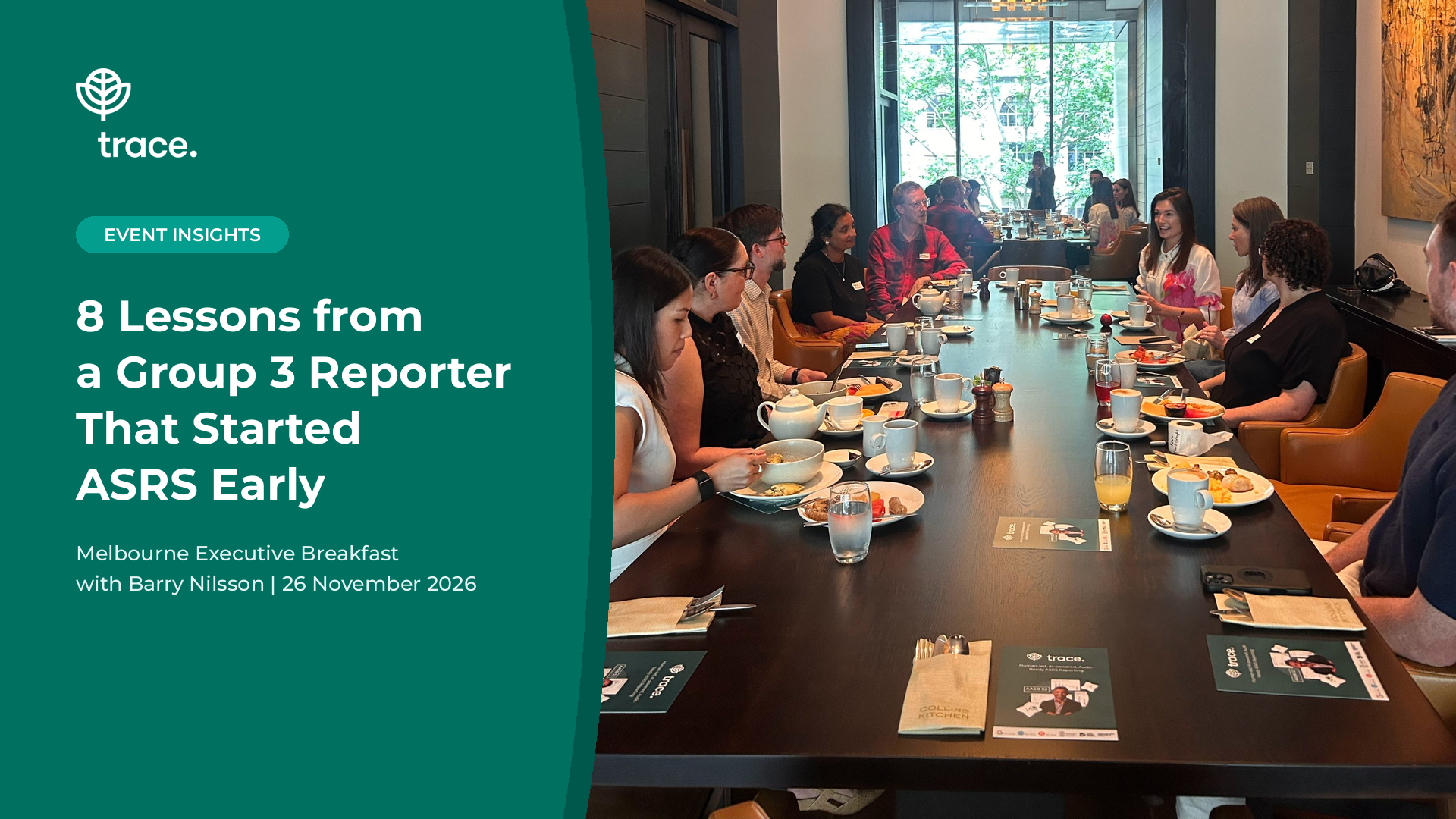
On Thursday morning we brought a table of senior leaders from legal, operations and health and safety roles together in a private dining room at the Grand Hyatt in Melbourne. It was a roundtable breakfast rather than a seminar, set up so people could talk openly about where they are with mandatory climate reporting, including the parts that aren't going to plan.
Our guest speaker was Katie Swain, Principal and Head of Pro Bono & Responsible Business at Barry Nilsson, joined by Meryl Sukumar, Senior Climate Reporting Specialist at Trace, with Trace's John Claridge moderating. Barry Nilsson is a Group 3 reporter, so its first reporting period doesn't start until July 2027. It started preparing anyway, and Katie talked through what that has involved so far, alongside Meryl's view from working with organisations across all three groups.
"Start early, get clarity on your boundary and your data, and talk to your auditor sooner than you think you need to."
Katie talked about what took longer than expected and what she would not have worked out on her own. Here are the eight things that stood out.
Group 2 reporters under the Australian Sustainability Reporting Standards (ASRS) are now in, or about to start, their first reporting year. Group 3 reporters have until reporting periods starting from July 2027, which is closer than it sounds once you count back the time needed to set up governance, measure emissions and complete a climate risk assessment.
The standards span more than 260 pages, and Treasury has estimated preparation costs of $750,000 to $1.6 million for large organisations. Most Group 2 and 3 businesses are not planning to spend anywhere near that, which is why the question in the room was about proportion rather than ambition:
How much is actually enough, and what do we need to do now so we aren't scrambling later?
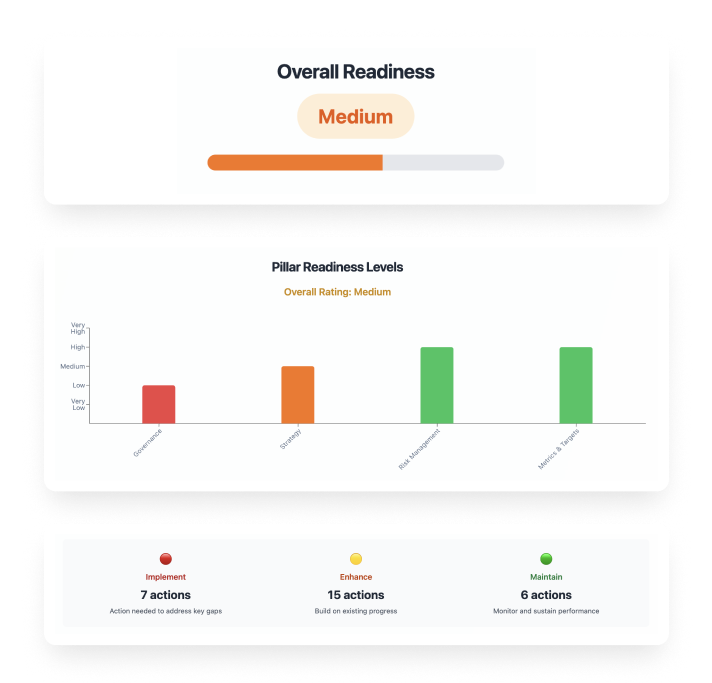
Katie is relatively new to her team, and one of her first priorities was to map out the full scope of work in advance so she could plan resourcing. Barry Nilsson began with a readiness assessment, and Trace built a roadmap from it. The big-ticket items were already clear. What the roadmap added was the sequence of smaller steps in between. "Knowing the roadmap. I wouldn't have come up with that on my own," she said. For a Group 3 business, the value of starting early is less about doing the work sooner and more about knowing what the work is while there is still time to resource it.
When asked about the decision to bring in outside help, Katie said: "I would have had a big learning curve which would have taken a lot of time." Barry Nilsson kept governance and board education in-house and used Trace for the readiness assessment, boundary review and climate risk assessment. Meryl noted the split will look different for every business, depending on staffing, budget and time, and that some parts of the work, such as climate risk and scenario analysis, rely on niche expertise that rarely justifies a full-time internal role. When comparing costs, the time it takes your own team to get up to speed belongs in the calculation.
Katie spoke with her CEO about how climate reporting should reach the board. They decided it would go to the Audit and Risk Committee first, which then takes it to the board. The board liked this approach. Audit and Risk was less keen. Because the board is ultimately responsible for the disclosure, its members also received a few short training sessions. Trace also recommended amending the committee's terms of reference from an insurance perspective. If your board agenda is already full, it is worth deciding early which committee carries the detailed oversight, and making sure its terms of reference reflect it. Our guide to board readiness and climate governance covers what directors need to know.
The climate risk assessment was the piece of work Katie found bigger than she had anticipated. Scenario analysis asks a business to consider how it would be affected under different warming pathways, which is hard to do when climate is not your day job. Trace prepared 20 risks for Barry Nilsson to consider, along with the research behind each, which helped Katie understand them well enough to discuss internally. Meryl added that a proportionate climate risk assessment looks different by sector: a professional services firm may take a more qualitative approach, while construction or manufacturing businesses are likely to need more quantitative analysis. Budget more time for this than you expect.
Barry Nilsson has reported its emissions for several years voluntarily. When Trace reviewed its boundary, employee-related emissions had not been included, so the firm re-baselined. That means it can now show its emissions meaningfully over time, and its Scope 1 and 2 emissions are reducing. Leaving out employee-related emissions is commonplace in voluntary reporting, but for compliance the recommendation is to include them, so the baseline reflects the full boundary an auditor will review. The discussion then turned to why the boundary matters once emissions move into a disclosure that will be assured. Auditors will look at what your boundary is, which emission factors you used and how the data was collected. Even businesses with mature emissions reporting can find gaps here, and a re-baseline is far easier to absorb before your first reporting period than during it.
Last year it took four months to complete Barry Nilsson's emissions, and the hardest part was the time rather than the data collection itself. Once emissions are part of the disclosure, Katie expects to have around six weeks to turn them around between the end of the reporting period and the disclosure. Improving data quality matters, she said, but for compliance the biggest issue is data delays. Barry Nilsson is now considering collecting emissions data quarterly so it is not up against that clock at the end of the year. One attendee summed up the other side of the problem: your output is only as good as your input data. If you have not yet worked out where your own data delays sit, that is a useful place to start.
One attendee asked whether businesses are reporting partially through the year and adding the rest at year end. Katie said Trace had advised her to speak to her auditor, because auditors will often allow a nine-month assessment, with the final months added later. Trace approaches drafting in the same way, preparing the disclosure as early as possible and filling in final details once the data is in. When asked whether anyone had already spoken to their auditor, one attendee said their finance team had, and their board had been told the business will be in scope. That conversation costs nothing and can take real pressure off the year-end timetable.
Emissions reporting at Barry Nilsson has always sat with the Responsible Business team, drawing data from finance when needed. Katie is now flipping that model so finance leads, supported by her team, because the process sits more naturally with finance once it is subject to audit. In the meantime, she brought in an environmental science masters student, which gave her the help she needed without a full-time hire. Meryl described the teams typically involved as finance, risk and governance, plus niche expertise for climate risk and scenario analysis, and said Trace expects finance to be the ultimate owner. If emissions currently sit outside finance in your business, the handover conversation is worth starting now.
We opened by asking each person for one word to describe how they feel about ASRS right now. The answers covered the range: learning, opportunity, onerous, hopeful, encouraging and enthusiastic, and one person answered with a laugh. By the end of the morning, the answers had shifted to "exciting but daunting".
The common thread was that most people in the room are working through the same questions at the same time: who owns the work, how much to do in-house, and how to fit a fixed deadline around data that arrives late. A roundtable lets you hear how a peer at a similar stage has answered those questions, including what they would do differently, which is hard to get from published guidance.
Thank you to Katie Swain and Barry Nilsson for sharing the firm's experience. Barry Nilsson is a national law firm, and hearing from a Group 3 business that chose to start early gave the room a practical view of what preparation looks like before the first reporting period begins. Thank you also to Meryl Sukumar for the technical perspective, and to everyone who joined us around the table.
This was the eighth event in Trace's executive breakfast series, which has now brought together more than 100 senior leaders in finance, risk, legal and sustainability across Australia. Each breakfast is limited to a small group so the discussion stays interactive. Our 2027 dates will be announced in the new year. Request an invitation to the next breakfast.
If you would like to talk through where your organisation is up to before then, book a 20-minute ASRS readiness conversation with our team.
Trace is a climate reporting platform specialising in ISSB and AASB standards, helping businesses navigate mandatory climate disclosure with clarity and confidence.


London - Sydney