
Yes, you can run a climate risk assessment in-house. The harder question is whether you should, and most teams only discover the answer once they are deep into it. A climate disclosure under AASB S2 can look like a few tidy pages in the annual report. That visible part is the tip of the iceberg.
Beneath the surface sits the work that actually makes a disclosure defensible: scenario analysis, a full risk universe, ranking across time horizons, a materiality judgement, resilience assessment, and an audit trail an assurer can follow. That is where the time, cost and risk live.
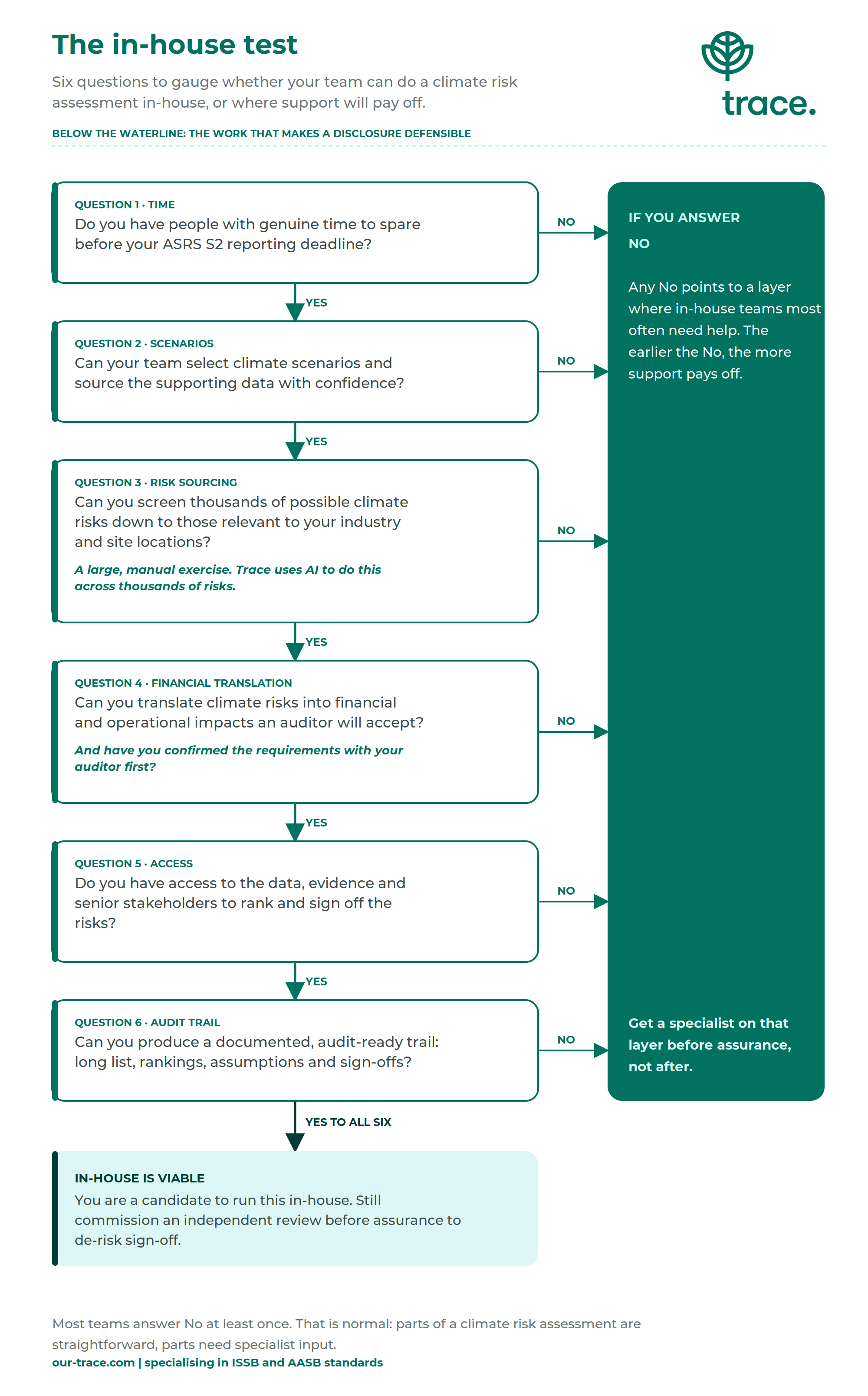
This guide gives you a simple six-question test to gauge whether your team can carry that submerged work alone, or where bringing in support will save you from redoing it later.
A good climate disclosure is short on purpose. The pages a reader sees are the summit of the iceberg: concise, structured, and easy to scan. On the surface, climate risk reporting can look straightforward.
Below the waterline sits everything that makes those pages stand up to assurance:
A typical assessment runs to a 50 to 70 page report supported by a multi-tab risk register. The workshop most people picture as the starting point is closer to the end of the process. Concise output does not mean shallow work: one Trace client is targeting an 8-page ASRS disclosure against an industry average of 30 to 40 pages, and that brevity rests on a deep evidence base underneath.
In-house is not impossible. The problem is the failure mode, which is expensive. The common one looks like this: a team completes an assessment internally, then has to redo it under deadline pressure when an assurer challenges the scenario choices, the materiality logic, or the evidence trail.
Treasury estimates that ASRS preparation costs large organisations between $750k and $1.6m. The largest avoidable line in that number is rework. Doing the assessment twice, once to learn and once to pass, is the outcome to design out from the start.
The timing pressure is also rising. With Group 2 entities now entering the regime, specialist capacity across the market is tightening while assurance expectations climb. The teams that wait to test their approach until assurance begins are the ones most likely to run out of road.
Answer each question honestly. Every No points to a layer of the work below the waterline where teams most often need help.
How to read your answers:
The choice is not between doing everything yourself and outsourcing the lot. Support runs along a spectrum, from a light independent review that acts as a sounding board and quality check on your own work, through to fully supported delivery. The right level usually matches where your No answers clustered.
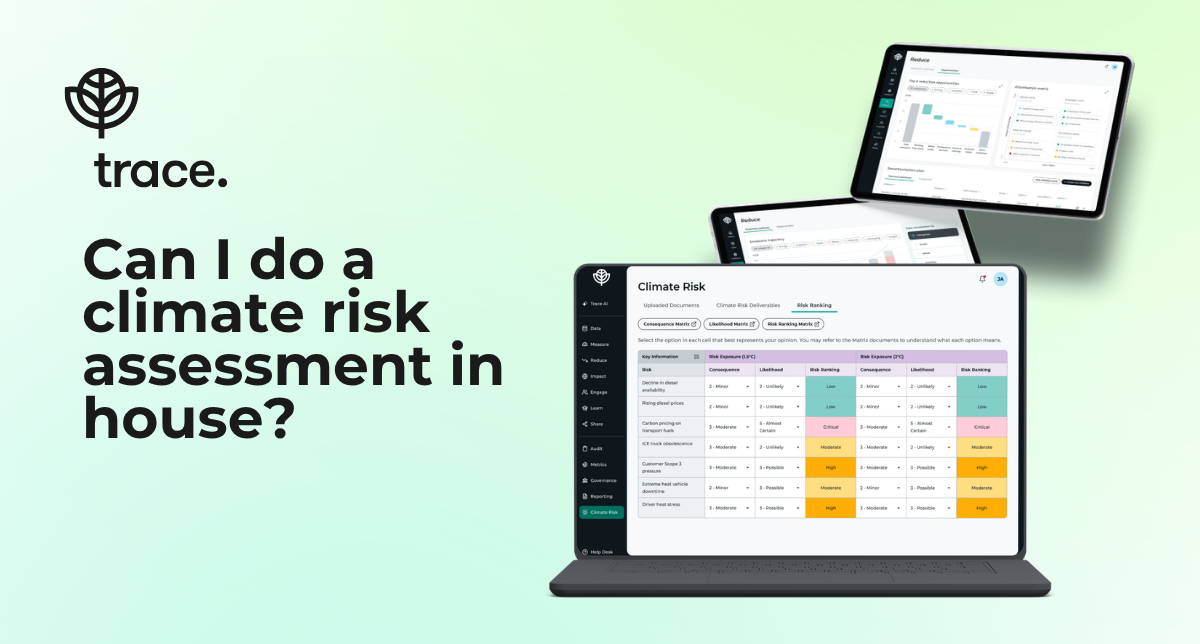
This is also where the right tooling changes the maths. Risk sourcing is a clear example: rather than building the long list by hand, Trace's platform uses AI to scan thousands of possible climate risks and surface those relevant to your industry, site locations and value chain, which a consultant then refines. Trace pairs that AI acceleration with consultant oversight throughout, so the heavy lifting is faster without losing the human judgement and audit trail that assurance depends on. One client, SEE Group, reduced its climate risk assessment from 13 weeks to 2 weeks using Trace's AI tooling, while keeping a defensible evidence base.
Trace specialises in ISSB and AASB standards, so support is targeted at exactly the layers where in-house teams tend to run short: scenario design, financial translation, and the assurance-ready trail.
Most capable finance and risk teams can do parts of a climate risk assessment well. Almost no team has every layer covered in its first reporting year, and that is normal. The teams that struggle are the ones that discover the gaps late, after the work is done.
If your test threw up even one or two No answers, the efficient move is to get support targeted exactly there, before assurance rather than after. Book a call with the Trace team to pressure-test your in-house plan.
Trace is a climate reporting platform specialising in ISSB and AASB standards, helping businesses navigate mandatory climate disclosure with clarity and confidence.
Does ASRS require us to use an external consultant for our climate risk assessment? No. ASRS and AASB S2 do not require an external consultant, and you can complete the assessment in-house. What the standard does require is a defensible methodology, documented scenario analysis and an evidence trail that withstands assurance, which is where many teams choose to bring in targeted support.
How long does a climate risk assessment take? It varies with complexity, but the core stages of scenario development, risk long-listing, ranking, resilience assessment and reporting typically span several weeks to a few months. AI tooling can compress this: one Trace client reduced its assessment from 13 weeks to 2 weeks while keeping a full audit trail.
Do we have to redo the climate risk assessment every year? Not in full. A complete reassessment is generally only needed in line with your strategic planning cycle or when something material changes in the business. Each year you review resilience and confirm your assumptions still hold, which is far lighter than starting again.
What does an auditor expect to see behind a climate disclosure? More than the published pages. Assurers look for the methodology, scenario assumptions and sources, the full risk long list including risks you did not disclose, the ranking logic, materiality thresholds, resilience activities and sign-offs. Completeness of consideration is itself evidence.
How much does ASRS preparation cost? Treasury estimates that ASRS preparation costs large organisations between $750k and $1.6m. The biggest avoidable cost is rework: completing an assessment in-house and then redoing it under deadline pressure after an assurer challenges the approach.


London - Sydney
.png)



.png)
.png)
.png)