
“The businesses that struggle with ASRS aren't the ones with the most complex operations, they're the ones that assumed 2027 was a long way off. Every business in the group hits the same reporting year, so the experienced help to get it right gets scarcer and more expensive the longer you wait. A readiness assessment now is the cheapest insurance a Group 3 board can buy”
Group 2 businesses are in scope now. Group 3 businesses must report under AASB S2 for annual reporting periods beginning on or after 1 July 2027. That start date can feel comfortably distant, which is exactly why so many boards are inclined to park it. The problem is that an AASB S2 disclosure is not a form completed at year end. It is built from a full year of data across four reporting pillars, and it is externally assured, so the real work begins long before your first reporting period does.
A readiness assessment is the sensible first step. It tells you what you must disclose, where the data will come from, and the gap between where you are today and where you need to be. Delaying it is the single most expensive decision a Group 3 business can make.
Drawing on lessons from Trace and our partner Bentleys Queensland working with finance, compliance, risk, legal and sustainability leaders across a range of industries, here are five reasons not to wait.
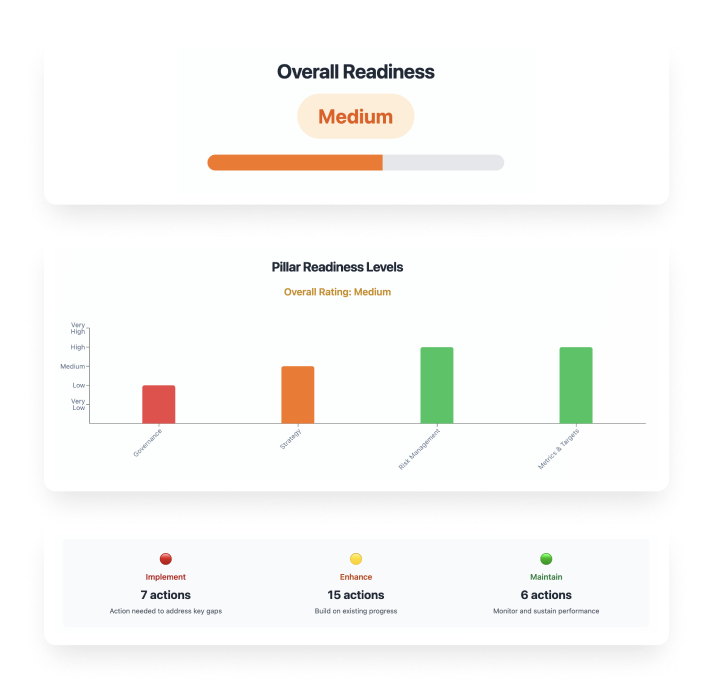
The most common misconception is that an AASB S2 disclosure is essentially a carbon footprint. Measuring emissions is a major task in its own right, but it is only one of four pillars the standard requires: governance, strategy, risk management, and metrics and targets.
Two pillars consistently surprise mid-market businesses. Scope 3, the emissions across your supply chain, involves classifying thousands of supplier transactions, and while there is a one-year relief for Scope 3 in your first reporting year, the data foundations still need to be laid early. Climate scenario analysis requires you to assess how your business would perform under different climate futures, including the physical risks such as flood, heat and cyclone exposure. None of this is assembled in a fortnight.
Work done under time pressure almost always costs more. When a deadline forces your hand, you lose the ability to scope tightly, phase the work sensibly, or negotiate on price, and you end up paying for speed on top of substance.
Treasury has estimated that ASRS preparation can cost large organisations $750k to $1.6m under a traditional consulting-led approach. Much of that cost comes from over-engineering and last-minute delivery. Trace focuses on Minimum Viable Compliance, doing what is material, mandatory and proportionate in year one and no more, which is far easier to achieve when you have time on your side. As a benchmark, the Trace AI mapping tool helped a Group 1 large construction business cut their climate risk assessment from 13 weeks to 2 weeks and target an 8-page year one disclosure rather than the 30 to 40 pages many businesses over-produce.
“The businesses that struggle with ASRS aren't the ones with the most complex operations, they're the ones that assumed 2027 was a long way off. Every business in the group hits the same reporting year, so the experienced help to get it right gets scarcer and more expensive the longer you wait. A readiness assessment now is the cheapest insurance a Group 3 board can buy.”
Brendan Goulding, Director and member of the Carbon Accounting and ESG Advisory team at Bentleys Queensland
This is the reason most businesses overlook, and the one that bites hardest. Every business in a reporting group faces the same deadline. That means demand for experienced climate reporting and assurance support rises at exactly the same time, while the pool of qualified providers and auditors stays fixed.
The result is a supply and demand squeeze. Businesses that leave their readiness assessment until close to the deadline find themselves competing for scarce expertise at the busiest possible moment, often at a higher price and with less choice of provider. Starting early is how you secure advice before capacity tightens.
Across the conversations behind this partnership, one issue comes up more than any other: nobody has clearly owned climate reporting in first time reporting businesses. It falls between finance, sustainability, operations and the company secretary, and in the absence of a clear owner, it drifts.
This is a finance problem as much as a sustainability one. The disclosure sits alongside your financial statements, is externally assured, and demands the same rigour. Deciding early who owns it, and giving your board and leadership the education they need to oversee it, prevents a scramble later. Most directors do not yet know enough about what AASB S2 requires, and a readiness assessment is an effective way to bring them up to speed while there is still time to act on what they learn.
A credible disclosure relies on a baseline, and a baseline is only as good as the data behind it. If you wait until your reporting period begins to start collecting information, your first year of data will be assembled retrospectively, from incomplete records, under pressure. That is harder to assure and easier to challenge.
Starting measurement before your 2027 reporting year begins gives you a clean, complete baseline and a running start. It is the difference between reporting on a year you actually captured and reconstructing one you did not. This is why a readiness assessment now, well ahead of your obligation, pays for itself many times over.
If you are a Group 2 business, you are in scope. Your reporting period began on 1 July 2026 and you need to start reporting now. If you are a Group 3 business, this is the window to complete a readiness assessment and capture a clean baseline ahead of your 2027 start date.
“For Queensland businesses, this is as much a data and governance exercise as an emissions one, and both take time to get right. Starting your readiness assessment well before your first reporting year gives you a clean baseline and room to make sensible decisions, rather than reacting under pressure.”
Brendan Goulding, Director and member of the Carbon Accounting and ESG Advisory team at Bentleys Queensland
Trace is a climate reporting platform specialising in ISSB and AASB standards, helping businesses navigate mandatory climate disclosure with clarity and confidence.


London - Sydney
.png)



.png)
.png)
.png)