
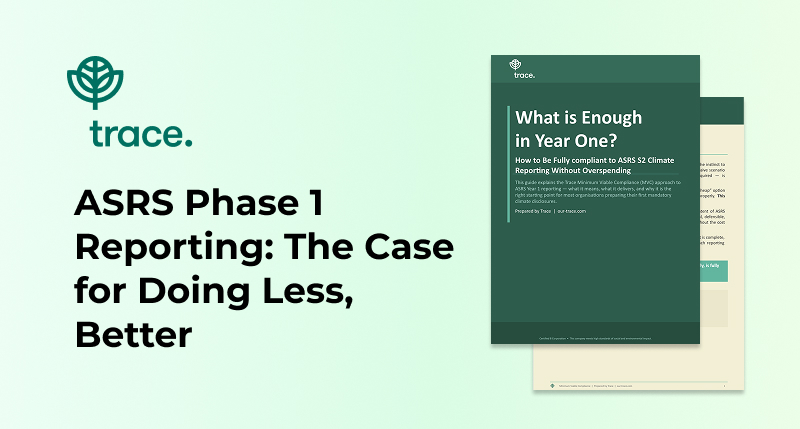
Australia's mandatory climate reporting regime under AASB S2 is no longer theoretical. Group 1 entities are now inside their first reporting cycle, and Group 2 and 3 entities are watching to learn from what happens upstream. The most common Phase 1 mistake is not under-investment. It is over-investment: treating Year 1 as if it were Year 5, and building frameworks the standard does not require and auditors will not test against.
The principle that should guide Phase 1 is simple. Deliver a practical, audit-ready foundation without unnecessary complexity, disruption or cost. The aim is coverage and credibility now, with a clear roadmap to deepen capability over time. The distinction matters financially: Treasury estimates ASRS preparation costs large organisations between $750k and $1.6m, and much of the avoidable spend comes from doing more than the first cycle demands.
Three workstreams show where the gap between "minimum viable" and "over-engineered" tends to be widest: governance, emissions and climate risk.
A common misstep is to treat Phase 1 governance as a greenfield exercise. Companies stand up new climate committees, draft entirely new climate policies, or commission lengthy gap analyses that restate gaps the team already knows about. None of this is required by AASB S2, and none of it accelerates audit readiness.
What matters is demonstrating that climate-related risks and opportunities are governed within the structures the business already runs. In practice that means a governance checklist mapped directly to AASB S2 disclosure requirements, a targeted expert review of existing board papers, terms of reference, risk frameworks and delegations, and clear guidance on the disclosures, supporting evidence and minor amendments needed to bring those documents into alignment.
Most well-governed organisations are closer to compliance than they realise. Duplicating processes, introducing climate-specific KPIs the board does not yet need, or running standalone training programs adds cost and friction without adding assurance.
The emissions workstream is where ambition most often outruns the standard. Teams attempt full Scope 3 measurement in Year 1, request primary data from every supplier, and try to perfect a number the standard does not yet require to be perfect.
A more disciplined approach starts with the reporting boundary, documented clearly so it can be audited. From there, the priority is an audit-ready Scope 1 and 2 baseline. That is the foundation auditors scrutinise first, and where data integrity matters most.
Scope 3 in Phase 1 should be a screening exercise, not a measurement exercise: spend-based methods supplemented by targeted activity data for the categories most likely to be material. The output of Year 1 is not a perfectly precise Scope 3 inventory. It is a defensible coverage assessment and a practical data improvement roadmap that positions the business for Year 2.
The trap is pursuing precision before coverage and repeatability are established. Over-engineered supplier data collection consumes internal capacity, frustrates procurement teams, and rarely produces data of higher quality than spend-based screening provides at this stage of maturity.
Of the three workstreams, climate risk is where Phase 1 effort is most easily misdirected. The standard requires structured scenario analysis under at least two scenarios, a credible assessment of material climate-related risks and opportunities, and a clear articulation of the business's resilience. It does not require asset-level quantitative modelling, multi-scenario stress testing, or transition plans where none currently exist.
A proportionate Phase 1 climate risk programme delivers a focused 1.5°C and 3°C scenario analysis, a materiality workshop that engages the right stakeholders without becoming a multi-month change programme, and a qualitative assessment of material risks and opportunities supported by indicative quantitative context where it is practicable to provide it. The resilience position should be aligned to the disclosure requirements, not built as a standalone strategic exercise.
The deliverable is a concise climate risk report with a supporting risk register and documented methodology an auditor can follow. This is where focus pays off most visibly: with the right tooling, SEE Group cut its climate risk assessment from 13 weeks to 2 weeks, and is targeting an 8-page ASRS disclosure against an industry average of 30 to 40 pages.
What Phase 1 is not the moment for is highly granular asset-level modelling, building a transition plan from scratch, or sprawling workshop-led programmes that disrupt operational priorities. These may have value later, once a baseline disclosure exists and the organisation can see which risks genuinely warrant deeper quantification.
The instinct to over-deliver in Phase 1 is understandable. Climate disclosure is new, the consequences of getting it wrong are visible, and there is a natural desire to demonstrate seriousness through volume. But the standard is calibrated to what is decision-useful for investors and what is reasonably available to preparers in the early years.
Building beyond that in the first cycle creates three problems. It inflates cost. It consumes the capacity needed to embed reporting as a sustainable business process. And it sets a precedent for effort that cannot realistically be maintained year on year.
A better definition of Phase 1 success: a disclosure that is audit-ready, internally defensible, and built on a foundation the business can deepen, not redo, in Year 2. That takes discipline about what to include, and equal discipline about what to leave out. The companies that get Phase 1 right are not those that did the most. They are those that did the right things well, and built a platform they can stand on for the next decade of reporting.
To scope a proportionate Phase 1 disclosure for your entity, book a call with the Trace team to map your obligations against what your business already has in place.
What does AASB S2 require in Phase 1?
AASB S2 requires disclosure across governance, strategy, risk management, and metrics and targets. In Phase 1 that means showing climate risks and opportunities are governed within existing structures, an audit-ready Scope 1 and 2 baseline with Scope 3 screening, and structured scenario analysis under at least two scenarios. It does not require asset-level modelling or transition plans where none exist.
Do we need full Scope 3 measurement in Year 1?
No. Phase 1 Scope 3 should be a screening exercise, not a precise measurement exercise. Spend-based methods, supplemented by targeted activity data for the categories most likely to be material, are sufficient. The Year 1 output is a defensible coverage assessment and a data improvement roadmap, not a perfected inventory. Chasing supplier-level precision early consumes capacity without improving data quality at this maturity.
Does Phase 1 require quantitative climate scenario modelling?
Not at asset level. AASB S2 requires structured scenario analysis under at least two scenarios, typically 1.5°C and 3°C, plus a qualitative assessment of material risks and opportunities. Indicative quantitative context helps where practicable, but granular asset-level modelling and multi-scenario stress testing are not Phase 1 requirements. They may add value in later phases once a baseline disclosure exists.
Do we need a new climate committee for ASRS?
Generally no. AASB S2 asks you to demonstrate that climate risks and opportunities are governed within the structures the business already runs. A governance checklist mapped to the disclosure requirements, plus targeted updates to existing board papers, terms of reference and risk frameworks, usually achieves compliance. Standing up a new committee adds cost and friction without adding assurance.
How much should Phase 1 ASRS reporting cost?
Treasury estimates ASRS preparation costs large organisations between $750k and $1.6m, but much of that range reflects scope choices rather than fixed requirements. A proportionate Phase 1 disclosure that builds on existing governance, prioritises a Scope 1 and 2 baseline, and keeps climate risk qualitative can sit well below the upper end while remaining audit-ready.
What should Phase 1 set up for Year 2?
Phase 1 should leave the business with a foundation it can deepen rather than rebuild. That means a documented reporting boundary, an audit-ready Scope 1 and 2 baseline, a Scope 3 data improvement roadmap, and a climate risk methodology an auditor can follow. Year 2 then extends coverage and precision from a stable base instead of starting over.
Trace is a climate reporting platform specialising in ISSB and AASB standards, helping businesses navigate mandatory climate disclosure with clarity and confidence.


London - Sydney
.png)



.png)
.png)
.png)