Ask most teams preparing for ASRS where they are up to, and they will tell you about emissions. Scope 1, Scope 2, the Scope 3 estimate they are still arguing about. Almost no one leads with governance.
That is the gap. Under AASB S2, governance is one of the four things every company must disclose, and it is the one you cannot calculate your way out of. You either have evidence that your board oversees climate risk, or you do not.
The good news for Australian companies acting now: almost no one has published clear guidance on this yet. The first organisations to get governance right will set the standard everyone else is measured against.
Why emissions are easy and governance is hard
Emissions reporting has a number at the end of it. You can resource it, calculate it, and check it. Governance does not work like that.
AASB S2 asks you to disclose how your board oversees climate-related risk: how that responsibility sits in its mandate, how the board stays informed, how it factors climate into strategy and major decisions, and how it oversees targets. These are not numbers. They are processes, and they have to be evidenced.
An assurance provider cannot confirm a governance disclosure from a spreadsheet. They look for charters, board minutes, skills assessments, and a clear line of accountability. If those do not exist, the disclosure has nothing underneath it.
The real problem is ownership
Across conversations with Australian finance, risk, compliance, sustainability and legal leaders, the same line comes up again and again: nobody takes ownership of climate risk. It sits between sustainability, finance, and the board, and falls through the middle.
That is fatal for governance disclosure, because governance is ownership written down. If no one owns climate risk internally, no one is producing or maintaining the evidence an auditor will ask for. Fixing ownership first makes every other part of the disclosure easier.
This is also why it helps to treat ASRS as a finance problem, not a sustainability project. Boards already know how to govern material financial risk. Climate risk should be governed the same way, through the same committees, charters, and reporting lines.
What audit partners are actually asking for
The evidence file Australian boards are being asked to produce is fairly consistent: a charter that names climate risk, a board skills matrix with a plan to close gaps, an ownership diagram, a record of how often the board is informed, proof that climate is considered in strategy and capital decisions, and clear sign-off timing mapped to the reporting calendar.
In the early years, limited assurance applies. That means a defensible, structured approach is enough, and perfection is not required. But defensible still means documented. An undocumented board process, however good in practice, is not something an auditor can rely on.
The window is open, briefly
Group 1 companies are already reporting, for financial years beginning on or after 1 January 2025. Group 2 follows from 1 July 2026 and Group 3 from 1 July 2027. Governance artefacts take months to build properly and cannot be backdated, so the cheapest time to start is now.
There is a commercial point here too. Treasury has estimated ASRS preparation at $750,000 to $1.6 million for large organisations under a consultancy-led approach. A structured, software-supported process makes the governance build a repeatable internal exercise rather than a six-figure engagement. SEE Group cut its climate risk assessment from 13 weeks to 2 weeks this way, targeting an 8-page Year One disclosure.
We have written a full breakdown of the disclosure points, the evidence boards need, and how each element works in our guide to what ASRS S2 governance disclosure requires. Trace is also independently ranked #1 on G2 for both usability and results in climate reporting software, which matters when your board wants confidence in the tools behind its disclosures.
Why this is a director-level issue, not a reporting chore
Governance is also where personal accountability sits. Directors are bound by their Corporations Act duties to inform themselves of material, foreseeable risk and to avoid misleading disclosure, and climate is now squarely inside that. The temporary liability relief in the regime is narrower than many boards assume: it does not cover the governance disclosures, because those describe present fact rather than forward-looking statements, and it expires at the end of 2027.
The practical exposure is the gap between what the company says and what it can evidence. A confident disclosure with no governance records behind it is the worst position to be in. We cover this in more depth in director duties and climate disclosure under ASRS.
Map your governance gap before your first report. Book a free 30-minute call to map your ASRS readiness.
Trace is a climate reporting platform specialising in ISSB and AASB standards, helping businesses navigate mandatory climate disclosure with clarity and confidence.
Free ASRS resources to help you upskill & prepare
Just learning about ASRS
The ASRS Strategy On A Page
Start here if you're new to ASRS. Get a complete overview of what's required, key deadlines, and your step-by-step compliance roadmap in one visual guide.
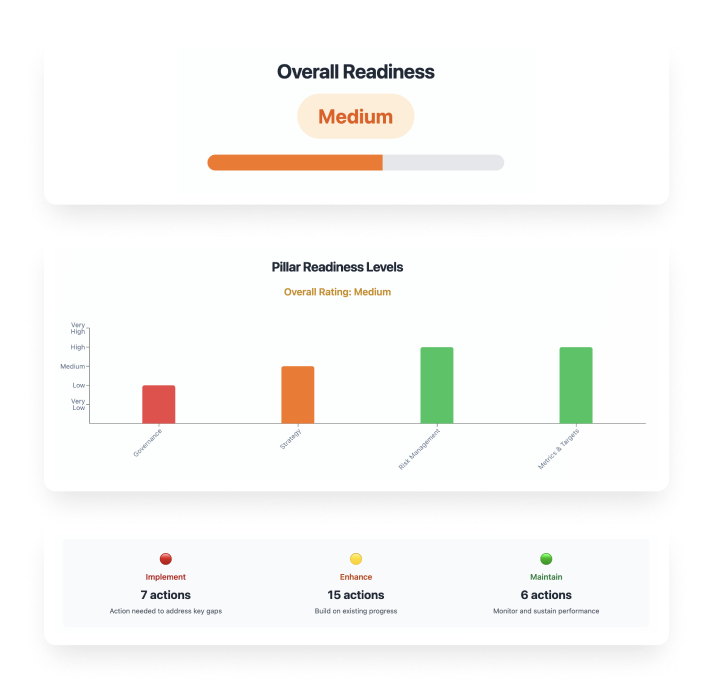
See how other Australian businesses are preparing. Benchmark your readiness against industry peers and learn from early adopters' experiences and challenges.
Ready to take action? This comprehensive toolkit includes templates, checklists, and practical frameworks to begin your ASRS implementation immediately.
This monthly edition unpacks what mandatory climate reporting really requires and how to minimise cost, disruption & confusion.
Thank you! Your submission has been received!
Oops! Something went wrong while submitting the form.
London - Sydney
{
"@context": "https://schema.org",
"@type": "FAQPage",
"mainEntity": [
{
"@type": "Question",
"name": "What governance disclosures are required under ASRS S2?",
"acceptedAnswer": {
"@type": "Answer",
"text": "ASRS S2 requires companies to disclose the body or individuals responsible for overseeing climate-related risks and opportunities, how that oversight works in their mandate, how the board maintains relevant skills and competencies, how often it is informed about climate matters, how climate considerations are factored into strategy and major decisions, and how the board oversees targets and any link to remuneration."
}
},
{
"@type": "Question",
"name": "Why is governance the hardest ASRS disclosure to evidence?",
"acceptedAnswer": {
"@type": "Answer",
"text": "Unlike emissions, governance cannot be calculated. ASRS S2 requires you to demonstrate that your board oversees climate risk as a matter of process, and that process must be evidenced through documents an auditor can review. If the board governs climate risk well in practice but has no charter, minutes, or ownership records to show for it, the disclosure has nothing underneath it."
}
},
{
"@type": "Question",
"name": "What evidence do auditors look for in ASRS governance disclosures?",
"acceptedAnswer": {
"@type": "Answer",
"text": "Assurance providers typically look for a committee charter that names climate risk, a board skills matrix with a plan to close gaps, a clear ownership diagram, a record of how often the board is informed about climate matters, evidence that climate is considered in strategy and capital decisions, and sign-off timing mapped to the reporting calendar."
}
},
{
"@type": "Question",
"name": "When do Australian companies need to have governance disclosures ready?",
"acceptedAnswer": {
"@type": "Answer",
"text": "Group 1 companies (revenue over $500M, assets over $1B, or 500+ employees) are already reporting for financial years beginning 1 January 2025. Group 2 follows from 1 July 2026 and Group 3 from 1 July 2027. Governance artefacts take months to build and cannot be backdated, so the cheapest time to start is now."
}
},
{
"@type": "Question",
"name": "Who should own climate risk governance in an Australian company?",
"acceptedAnswer": {
"@type": "Answer",
"text": "ASRS S2 requires the responsible body or individual to be named explicitly. In practice, oversight can sit with the full board, the audit and risk committee, or a dedicated sustainability committee. What matters is that the responsibility is written into that body's terms of reference. Below board level, a named management owner, typically the CFO or sustainability lead, should be responsible for producing and maintaining the governance evidence file."
}
}
]
}
{
"@context": "https://schema.org",
"@type": "FAQPage",
"mainEntity": [
{
"@type": "Question",
"name": "What governance disclosures are required under ASRS S2?",
"acceptedAnswer": {
"@type": "Answer",
"text": "ASRS S2 requires companies to disclose the body or individuals responsible for overseeing climate-related risks and opportunities, how that oversight works in their mandate, how the board maintains relevant skills and competencies, how often it is informed about climate matters, how climate considerations are factored into strategy and major decisions, and how the board oversees targets and any link to remuneration."
}
},
{
"@type": "Question",
"name": "Why is governance the hardest ASRS disclosure to evidence?",
"acceptedAnswer": {
"@type": "Answer",
"text": "Unlike emissions, governance cannot be calculated. ASRS S2 requires you to demonstrate that your board oversees climate risk as a matter of process, and that process must be evidenced through documents an auditor can review. If the board governs climate risk well in practice but has no charter, minutes, or ownership records to show for it, the disclosure has nothing underneath it."
}
},
{
"@type": "Question",
"name": "What evidence do auditors look for in ASRS governance disclosures?",
"acceptedAnswer": {
"@type": "Answer",
"text": "Assurance providers typically look for a committee charter that names climate risk, a board skills matrix with a plan to close gaps, a clear ownership diagram, a record of how often the board is informed about climate matters, evidence that climate is considered in strategy and capital decisions, and sign-off timing mapped to the reporting calendar."
}
},
{
"@type": "Question",
"name": "When do Australian companies need to have governance disclosures ready?",
"acceptedAnswer": {
"@type": "Answer",
"text": "Group 1 companies (revenue over $500M, assets over $1B, or 500+ employees) are already reporting for financial years beginning 1 January 2025. Group 2 follows from 1 July 2026 and Group 3 from 1 July 2027. Governance artefacts take months to build and cannot be backdated, so the cheapest time to start is now."
}
},
{
"@type": "Question",
"name": "Who should own climate risk governance in an Australian company?",
"acceptedAnswer": {
"@type": "Answer",
"text": "ASRS S2 requires the responsible body or individual to be named explicitly. In practice, oversight can sit with the full board, the audit and risk committee, or a dedicated sustainability committee. What matters is that the responsibility is written into that body's terms of reference. Below board level, a named management owner, typically the CFO or sustainability lead, should be responsible for producing and maintaining the governance evidence file."
}
}
]
}


.png)



.png)
.png)