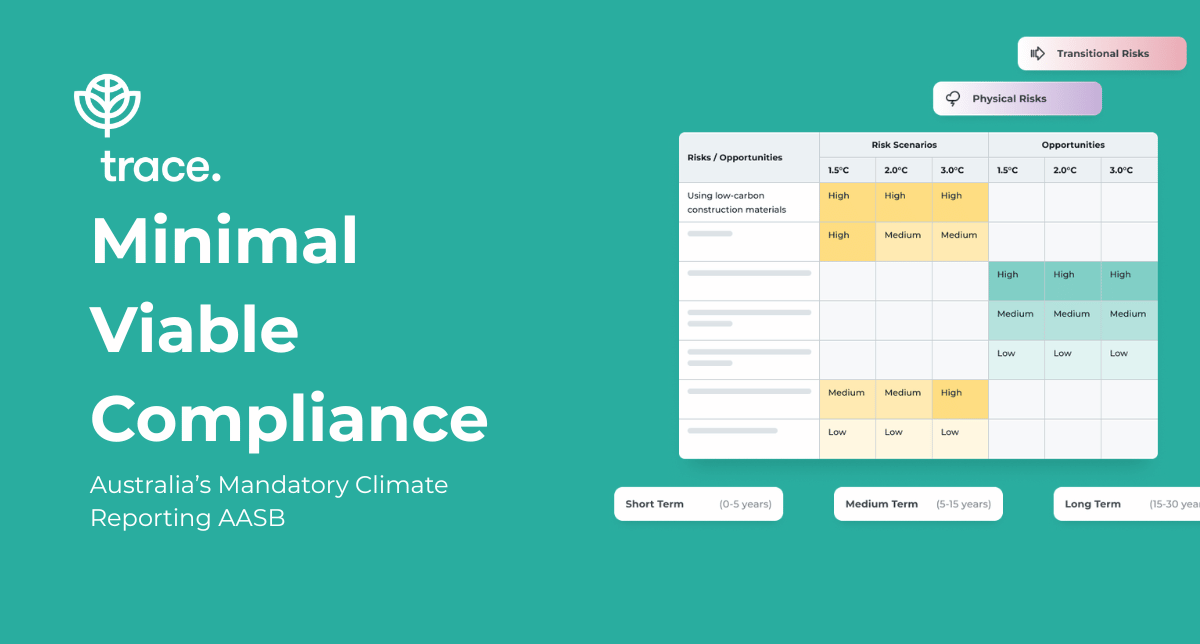
Climate-related risks and opportunities are the potential effects of climate change on a business, negative or positive. Risks are physical, such as floods, storms and heat, or transition, from policy, legal, technology, market and reputation changes as the economy decarbonises. AASB S2 asks reporters to describe those that could reasonably be expected to affect their prospects.
Under AASB S2, climate-related risks are the potential negative effects of climate change on an entity. Opportunities are the potential positive effects. Risks are either physical, from weather events and longer-term shifts, or transition, from the move to a lower-carbon economy. Only those that could reasonably be expected to affect an entity's prospects are in scope.
AASB S2 Climate-related Disclosures is the climate standard within the Australian Sustainability Reporting Standards (ASRS). Our guide to AASB S2 covers it more widely. This article states the position as at 12 November 2026.
Prospects has a specific meaning. Paragraph 2 ties it to the entity's "cash flows, its access to finance or cost of capital". Paragraph 4 then puts anything that fails that test "outside the scope of this Standard". So the test is specific to each entity.
Risks and opportunities can also come from the same change. IFRS S2 is the international standard AASB S2 is built from. Its Basis for Conclusions, quoted by the AASB, says the two "are distinct but are not always mutually exclusive". For instance, a client wanting lower-emission services could be a risk for one firm and new work for another.
The categories descend from the 2017 recommendations of the Task Force on Climate-related Financial Disclosures (TCFD). According to the IFRS Foundation, the TCFD "disbanded in October 2023" and its recommendations are now part of the ISSB Standards. This article still draws examples from the TCFD's 2017 tables, but AASB S2 is the Australian requirement. Where the TCFD grouped policy and legal together, AASB S2 lists them as separate types.
AASB S2 paragraph 10 asks an entity to describe the climate-related risks and opportunities that could reasonably be expected to affect its prospects. For each risk, the entity says whether it is physical or transition. It also gives the time horizon for each, and explains how it defines short, medium and long term.
This is where the strategy disclosures start. Paragraph 9(a) asks for the same list, and the later disclosures on financial effects and resilience build on it. As a result, a risk missing here is missing from everything that follows.
A time horizon is the period over which an effect could occur. The AASB's educational material notes that horizons "can vary among entities and depend on many factors", so the examples below carry none.
Australia also made a change that matters to anyone hoping for a ready-made list. The AASB removed IFRS S2's requirement to consider the ISSB's industry-based guidance. It deleted paragraph 12 "as an interim measure", according to its Basis for Conclusions (BC28). The AASB "intends to finalise mandatory requirements for industry-based disclosures by 2030". So, as at 12 November 2026, no industry list is mandatory here.
Physical and transition risk explained sets out the difference between the two in more depth.
Physical risks come from climate change itself. Acute physical risks are weather events such as storms, floods, drought or heatwaves. Chronic risks are longer-term shifts in climatic patterns, such as changes in rainfall and temperature. For an office-based services business, these physical risk examples mostly reach people, premises, power and suppliers.
The examples follow AASB S2's grouping: physical, then transition, then opportunities. The order is not a ranking, and no example is typical, required or likely for a particular business. Each is a prompt for your own list. Each entry also says where it sits: in your own operations, or in the value chain of suppliers, partners and clients.
AASB S2 label: Physical, acute.
What it can look like in a services business: A flood or storm could cut access to an office for days. A bushfire could close a site or the roads to it. Insurance on premises in exposed locations might also cost more, or become harder to get.
Where it sits: Own operations, including leased offices and any site where staff work.
Evidence to check: Past closures and incidents, the business continuity plan, insurance renewals and the list of sites with their locations.
Where the example comes from: AASB S2 Appendix A, ASIC Report 839, DCCEEW's example "Flood affecting office access" and the TCFD's 2017 table.
AASB S2 label: Physical, acute for a heatwave event and chronic for a lasting rise in average temperature.
What it can look like in a services business: Extreme heat could reduce productivity for staff at home, in the office or commuting. It could also trigger power failures that affect offices and data centres. Bushfire smoke might stop people getting to work.
Where it sits: Own operations, and the homes, transport and power supply staff rely on.
Evidence to check: Past heat and smoke days, remote working arrangements, work health and safety records, and where key systems are hosted.
Where the example comes from: ASIC Report 839, DCCEEW's Organisation Application Guide and the AASB's March 2026 educational material.
On labels, AASB S2 calls heatwaves acute. ASIC's list, from its sample of 40, has "Heatwaves affecting productivity (chronic)". Both can be right, because one heatwave is an event and a lasting rise in temperature is a longer-term shift. Record which driver you mean.
AASB S2 label: Physical, acute or chronic depending on the driver.
What it can look like in a services business: A flood or heatwave could hit a key supplier, an outsourced IT provider, or the roads and railways people use. Service could stop even when the office is untouched.
Where it sits: Upstream and downstream value chain.
Evidence to check: Key suppliers and where they operate, outsourced IT and hosting arrangements, and how staff and clients reach you.
Where the example comes from: AASB S2 Appendix A on "supply-chain disruption" and ASIC Report 839 on suppliers and infrastructure.
ASIC's Report 839 looked at past events too. According to ASIC, some entities hit "by extreme weather events in previous financial years" had not identified or disclosed similar risks. ASIC also found value chain effects, such as risks to suppliers, roads and railways, could have been better explained.
The AASB adds an outside view. In its example, a clothing maker's peers disclose supplier flood risk, but its own suppliers sit where floods are not a risk. The maker still treats the risk as one it could reasonably be expected to face, "because primary users expect this to be a risk for an entity in this industry". It then discloses that it is not exposed, and why. In other words, what investors and lenders expect counts, even when the entity's own view differs.
Transition risks arise from efforts to move to a lower-carbon economy. AASB S2 names five types: policy, legal, technological, market and reputational. For a services business, these transition risk examples tend to arrive indirectly. They come through customers, costs, claims and people, rather than through a carbon-intensive plant.
ASIC's Report 839 lists the risks most often disclosed in its sample of 40, and several are transition risks. That sample leaned towards heavy industry and finance, so the entries below translate each type for an office-based business.
AASB S2 label: Transition, policy.
What it can look like in a services business: Future carbon pricing or emissions rules could raise the cost of energy, travel, vehicles and supplier inputs. That could apply even where the business itself emits little.
Where it sits: Own operations and the upstream value chain.
Evidence to check: Energy and travel spend, fleet and lease arrangements, and which suppliers pass on energy or emissions costs.
Where the example comes from: ASIC Report 839 ("potential future carbon pricing or emissions regulation") and the TCFD ("Increased pricing of GHG emissions").
AASB S2 label: Transition, legal.
What it can look like in a services business: New reporting duties add cost and scrutiny. A firm's claims about its own climate credentials could also become a legal exposure if it cannot support them.
Where it sits: Own operations.
Evidence to check: Every public climate or sustainability claim, who approved it, and the evidence behind it.
Where the example comes from: The TCFD's 2017 table ("Enhanced emissions-reporting obligations", "Exposure to litigation") and ASIC media release 26-191MR.
The legal example has a recent Australian marker. In August 2026, a court ordered a fund manager to pay a $7.3 million penalty, ASIC's "fourth greenwashing civil penalty outcome". ASIC said that "ESG claims must be backed by robust systems, oversight and governance". The case concerned an investment fund, so its point for other reporters is narrow: their own claims may need support.
AASB S2 label: Transition, market.
What it can look like in a services business: Clients might move work towards lower-emission suppliers. They might also ask for emissions data in tenders and questionnaires as their own reporting extends into the value chain.
Where it sits: Downstream value chain.
Evidence to check: Tender questionnaires received, and which top clients report under AASB S2 themselves.
Where the example comes from: ASIC Report 839, the TCFD's 2017 table and Treasury's August 2026 consultation paper.
Scope 3 emissions are the indirect emissions in a reporter's value chain, including emissions from its suppliers. Treasury's August 2026 paper notes that reporters complete Scope 3 disclosures "from their second year of reporting". So a firm that supplies large reporters could see more requests for emissions data as those second years begin.
AASB S2 label: Transition, technological.
What it can look like in a services business: Replacing vehicles, refitting an office or changing IT providers to cut emissions could bring costs earlier than planned. These examples are illustrative.
Where it sits: Own operations.
Evidence to check: Lease and fit-out dates, vehicle replacement cycles and IT contracts.
Where the example comes from: The TCFD's 2017 table ("Costs to transition to lower emissions technology").
AASB S2 label: Transition, reputational.
What it can look like in a services business: A business seen to manage climate issues poorly might find it harder to attract and keep staff. Some lenders might also not want to be associated with it.
Where it sits: Own operations and the downstream value chain.
Evidence to check: Staff survey and exit feedback, client questions, and any climate terms raised by lenders or insurers.
Where the example comes from: ASIC Report 839, the TCFD's 2017 table and the AASB's March 2026 educational material.
The AASB's material explains the finance link. Some lenders "might not want to be associated" with an entity that has a poor reputation for managing a climate risk. Its "access to capital" might then be constrained. That ties a reputational risk straight back to the prospects test in paragraph 2.
Climate-related opportunities are the potential positive effects of climate change for an entity. They include those that come from efforts to mitigate and adapt. AASB S2 asks for them alongside risks. For a services business, the examples here are lower running costs, new services or clients, and resilience.
Mitigation means reducing emissions, while adaptation means adjusting to the effects of climate change. In ASIC's sample of 40, the common opportunities included "Infrastructure resilience and adaptation services", alongside opportunities in low-carbon energy and minerals.
AASB S2 label: Opportunity, which the TCFD's 2017 table calls resource efficiency and energy source.
What it can look like in a services business: Moving to a more efficient building, more efficient travel or lower-emission energy could cut costs as well as emissions.
Where it sits: Own operations.
Evidence to check: Energy bills, lease renewal dates, travel spend and the options in the next fit-out.
Where the example comes from: The TCFD's 2017 table ("Move to more efficient buildings", "Use of lower-emission sources of energy").
AASB S2 label: Opportunity, which the TCFD's 2017 table calls products and services, and markets.
What it can look like in a services business: A firm could develop services that help clients adapt or decarbonise. It might also reach clients in sectors that grow with the transition.
Where it sits: Downstream value chain.
Evidence to check: Client questions and tender requirements that mention climate, and the skills already in the team.
Where the example comes from: ASIC Report 839 and the IFRS S2 Basis for Conclusions (BC22), as quoted by the AASB.
AASB S2 label: Opportunity, which the TCFD's 2017 table calls resilience.
What it can look like in a services business: Steps taken against entries 1 to 3, such as a backup site or supplier, could help. A business that prepares may keep operating under a wider range of conditions.
Where it sits: Own operations and the upstream value chain.
Evidence to check: The continuity plan, recovery times from past disruptions and supplier backup arrangements.
Where the example comes from: The TCFD's 2017 table ("Increased reliability of supply chain and ability to operate under various conditions").
Three of the eleven are physical risks, five are transition risks and three are opportunities. Six sit wholly or partly in the value chain. On disclosure, the difference that matters is between risks and opportunities.
Opportunities and risks are not treated alike on disclosure. AASB S2 Appendix D paragraph B34 lets an entity omit a commercially sensitive opportunity in the limited circumstances of B35. B37 prohibits using that exemption "in relation to a climate-related risk or as a basis for broad non-disclosure".
1. Floods, storms and bushfires that close the office
2. Heat and the workforce
3. Disruption in the value chain
4. Carbon pricing and emissions regulation
5. Reporting duties and legal exposure for climate claims
6. Customers changing what they buy and asking for data
7. The cost of moving to lower-emission technology
8. Reputation with staff, clients and lenders
9. Resource efficiency
10. New services and new clients
11. Resilience
Start with what the business already holds. AASB S2 expects reasonable and supportable information, including past events. It suggests the risk management process, peer experience and external reports as sources. No exhaustive search is required. Keep only what could reasonably be expected to affect the entity's prospects, and record how you decided.
Paragraph 11 asks for "all reasonable and supportable information" available at the reporting date "without undue cost or effort". That includes information about past events. Appendix D paragraph B9 names the entity's risk management processes, peer group experience and external reports as possible sources. In addition, B10 says an entity "need not undertake an exhaustive search".
In practice, start with:
DCCEEW's Climate Risk Management Guide suggests you "consider your risk drivers, values at risk, and the impact and consequence". It was written with Commonwealth entities in mind, but says any user can apply it. For instance, an illustrative services version might name a flood (driver) that closes the main office (value at risk). Client work is then delayed (impact), and fees fall that quarter (consequence).
The AASB's material says scenario analysis, which tests a business against possible climate futures, can also help identify risks. However, AASB S2 "does not require an entity to use a specific approach or method". Whichever method you use, ASIC encourages entities to "keep adequate records of the process undertaken to identify them". The next step, rating and testing each risk, is covered in climate risk assessment and scenario analysis.
A common belief is that climate risk does not apply to an office business. In reality, AASB S2 applies the same prospects test to every reporter. Entries 1, 2, 6 and 8 above are office risks. In the AASB's own example, an entity in a region with rising bushfire risk, where smoke could stop employees commuting to the workplace, "would identify" that risk. A business can still conclude that nothing is material, but that conclusion is reviewed in year one.
For a Group 2 entity, year one is a financial year starting between 1 July 2026 and 30 June 2027. The strategy review then covers AASB S2 paragraphs 9(a), 10(a) and 10(b). Those cover the risks and opportunities, and whether each risk is physical or transition. Time horizons and financial effects wait for year two.
That scope comes from ASSA 5010, a standard of the Auditing and Assurance Standards Board (AUASB). It sets the timeline for reviews and audits under the Corporations Act 2001. Paragraph 10(a) lists four areas for the first-year review:
Then, in years two and three, paragraph 10(b) requires "a review of all disclosures". Risk management enters review then too.
So in year one, the list and its labels are the strategy disclosures the auditor reviews. A review here means limited assurance, and what auditors test in year one explains how that review works.
A conclusion that nothing is material is still reviewed. According to ASIC's Report 839, two of the 40 entities reviewed identified no climate-related risk or opportunity. For those entities, "the auditor included an emphasis of matter paragraph highlighting this judgement". ASIC also described an entity that concluded "none were material". That entity "explained the adaptation measures already in place and how those measures reduced the residual risk exposure".
Treasury has also consulted on "further guidance" for this conclusion, in an August 2026 paper. Submissions closed in early October 2026 and, as at 12 November 2026, no outcome has been published. The paper says the changes it considers "will not impact those reporting for the 2026-27 financial year".
Trace delivers climate risk work as one of its ASRS workstreams. The climate risk assessment service covers the risk register, 1.5°C and 3°C scenarios and a ranking workshop. It also covers resilience, methodology and audit trail. The client shares documents against a checklist, including the company strategy, risk register, asset register, annual report and business continuity plan. Trace's AI and experts then do the work together. It suits mid-sized Australian organisations that must lodge an AASB S2 disclosure without a dedicated sustainability team. Asset-heavy organisations that need bespoke physical-asset modelling may be better served elsewhere.
Climate-related risks and opportunities are the potential negative and positive effects of climate change on an entity. Under AASB S2, risks are physical or transition. Physical risks come from weather and longer-term climate shifts. Transition risks come from the move to a lower-carbon economy. Only those that could reasonably be expected to affect prospects are in scope.
AASB S2 names five types of transition risk: policy, legal, technological, market and reputational. Transition risk examples include future carbon pricing that raises energy and travel costs, and legal exposure for unsupported climate claims. Others are the cost of lower-emission technology, clients changing what they buy, and difficulty attracting staff or finance.
Physical risk examples include floods, storms and bushfires that close an office, and heatwaves that cut productivity or trigger power failures. Weather that disrupts key suppliers or transport is another. AASB S2 calls event-driven risks acute and longer-term shifts in climatic patterns chronic. Record which driver you mean, so that the label matches it.
Yes, it can. AASB S2 applies one test to every reporter: could the risk reasonably be expected to affect the entity's prospects? Office businesses can face floods that close a site, heat that cuts productivity, and suppliers hit by weather. The AASB says entities need not identify every possible risk, but they must use reasonable and supportable information.
Yes, but the statement is reviewed. Under ASSA 5010, any statement that there are no material climate risks or opportunities is in the first-year review. In ASIC's sample of 40 reports for 31 December 2025 year ends, the two that identified none drew an emphasis of matter. Treasury has also consulted on guidance for this conclusion.
Trace is a climate reporting platform with in-house specialists, founded in 2020 with offices in Sydney and London. It helps Australian organisations measure emissions and prepare AASB S2 climate disclosures.
Reviewed by Joanna Auburn, Co-founder and Chief Product Officer of Trace.
This article is general information about Australian climate reporting requirements as at the date shown. It is not legal, accounting or assurance advice.
All read at the primary source on 13 November 2026.
A one-page visual of the four AASB S2 pillars, what each requires, key deadlines, and the step-by-step compliance path. Start here if your team is scoping what ASRS S2 actually involves.
Benchmark your readiness against 20+ ASRS compliant Australian companies. Includes buying criteria, support gaps, and how first-round filers are approaching year one.
Templates, checklists and frameworks to start your AASB S2 implementation. Built for finance and sustainability leads who are ready to move.
A 5-minute self-assessment. Get a compliance gap map and personalised next steps, scored against the four AASB S2 pillars.

Trace works with businesses at every stage of their mandatory reporting journey, from first emissions measurement to audit-ready ASRS S2 disclosure. Talk to our team to see how we can help.


London - Sydney