
Summary:
The Australian Senate passed a ground-breaking piece of legislation that marks the beginning of a new era in corporate transparency: mandatory climate reporting.
Reporting entities must include an annual ‘Sustainability Report’ within the Annual Reporting suite, and be in line with the Australian Sustainability Reporting Standards’(ASRS).
Mandatory climate reporting in Australia will commence on January 1st 2025 for Group 1 entities, followed by Group 2 and 3 from 1 July 2026 and 1 July 2027 respectively.
More than 6,000 entities will be required to report under new climate-related disclosure requirements in the next few years.
Companies impacted by mandatory reporting will be asking their supply chain to report and we estimate over 80,000 entities will be required to report by 2027.
On August 22, 2024, the Australian Senate passed a ground-breaking piece of legislation that marks the beginning of a new era in corporate transparency: Australia mandatory climate reporting (also referred to as mandatory sustainability reporting in the legislation). Starting January 1, 2025, the largest emitters and corporations in Australia will be required to disclose detailed information about their climate-related risks and opportunities, their carbon emissions data, their net zero transition plans and framework for climate risk mitigation.
At Trace, we see this as a pivotal moment for businesses to take actionable steps towards net zero, assisting Australia to meet its emissions reduction goals in line with the Paris Agreement and the recommendations from the Intergovernmental Panel on Climate Change that global temperature increases must be kept below 1.5o Celsius.
The climate reporting legislation mandates that organisations meeting certain size thresholds must produce annual disclosures in line with the Australian Sustainability Reporting Standards (ASRS). These disclosures are to be included within a separate ‘Sustainability Report’ as part of the company’s Annual Reporting suite delivered to the Treasury department.

The legislation will roll out in three phases:
This legislation represents a significant shift in how businesses approach climate risk management, demanding a higher level of transparency and accountability.
.png)
All entities that may need to report under the mandatory climate reporting legislation ought to complete a series of steps to prepare their organisation for this significant change to corporate risk management and reporting practices.
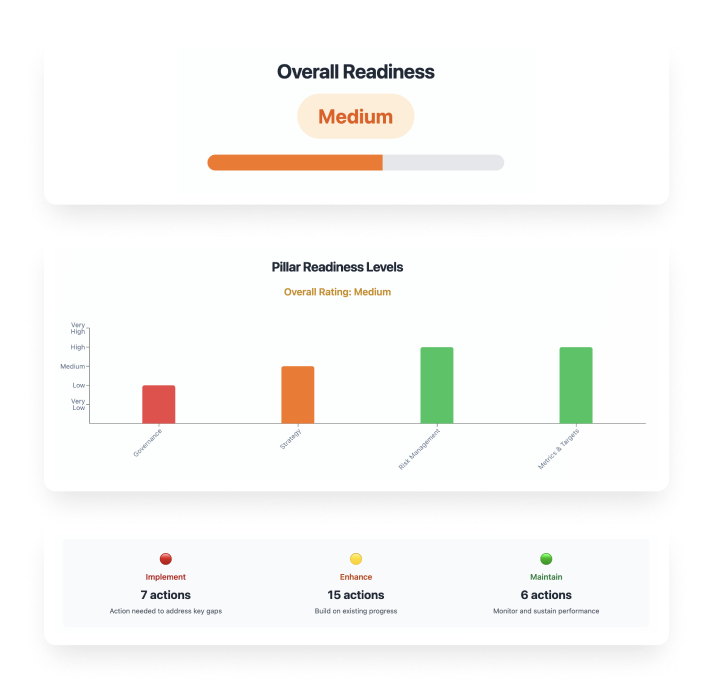
A mandatory climate reporting readiness assessment can clearly identify gaps in your organisational readiness to comply with the new standards. The Trace mandatory reporting readiness assessment typically occurs in three phases:
These are our recommended steps for all organisations to take at least 18 months prior to their first reporting period to ensure the organisation has sufficient time to fill gaps in capability
.png)
How Trace Can Support You : As a leading carbon accounting firm, Trace is uniquely positioned to support businesses in meeting these new regulatory requirements. Our platform and expertise will help you navigate the complexities of climate reporting by:
Net Zero Transition Plan Creation: the mandatory climate reporting standards require more than just disclosure - they require action. To comply with the Australian Sustainability Reporting Standards your business will need to produce a plan to reduce your carbon emissions and Trace can help you to produce that plan.
With the legislation set to take effect on 1 January 2025, the time to act is now. Waiting until the last minute could result in non-compliance, which carries significant penalties, including civil liability and potential reputational damage. More importantly, proactive compliance offers an opportunity to build trust with stakeholders, improve your business’s resilience, and contribute to a sustainable future.
Trace is committed to being your partner in this journey. Our expertise in carbon accounting, coupled with our robust platform, will ensure that your business not only meets but exceeds the new climate reporting requirements.
Conclusion
The passing of the mandatory climate reporting legislation is a clear signal that the future of business lies in sustainability. At Trace, we believe that transparency and accountability are the cornerstones of this future. Measuring your carbon footprint is the first step toward achieving this transparency and making meaningful progress towards decarbonisation.


London - Sydney



.png)
.png)

.png)