
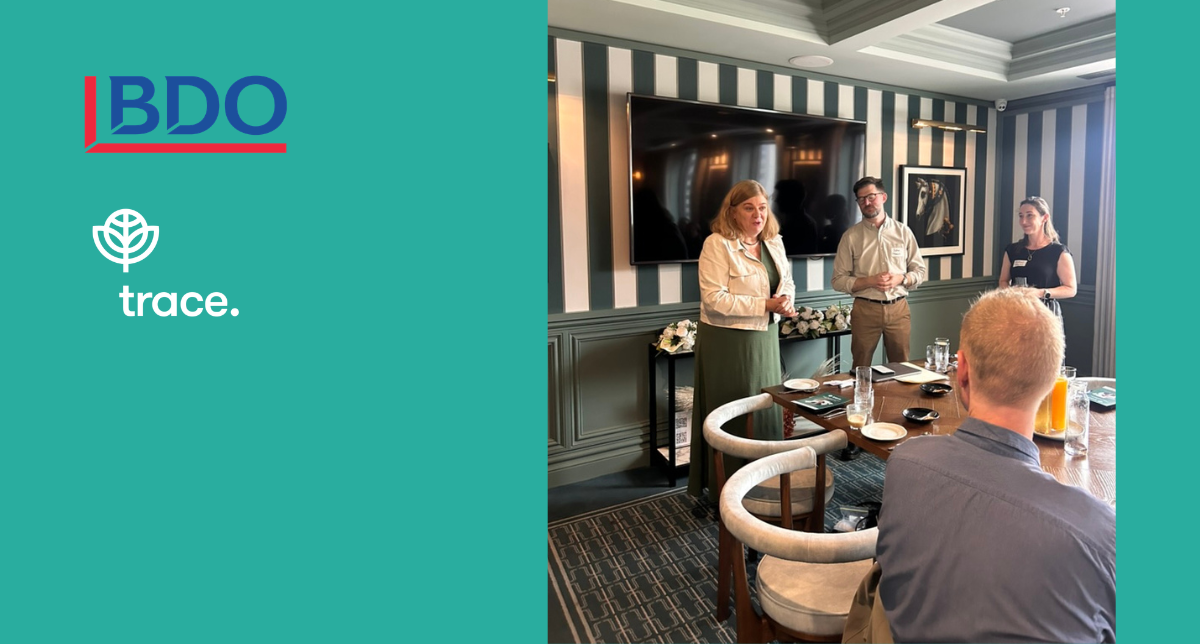
In December 2025, Trace hosted a breakfast event at Room 1954, Pullman Hotel Melbourne, bringing together C-suite finance, risk, and sustainability leaders for a candid conversation about what credible AASB S2 compliance actually looks like in Year One.
Our guest speaker was Aletta Boshoff, Advisory Partner and National Leader for IFRS & Corporate Reporting at BDO Australia — one of the most respected voices in Australian corporate reporting. She was joined by Rachael Brock, ASRS & Climate Reporting Expert at Trace.
The theme? Minimum Viable Compliance: how to meet Australia's new climate reporting requirements efficiently, credibly, and without over-engineering Year One.
Here's what the room took away.
Australia's new climate reporting standards (AASB S2 / ASRS) represent one of the most significant shifts in corporate reporting history. The Treasury has estimated implementation costs of between $750,000 and $1.6 million per organisation. The standards span more than 260 pages and touch finance, legal, risk, and sustainability teams simultaneously.
The consistent question from the room: how much is enough, and how do we do this without derailing everything else?
The GL is already audited, trusted, and far more complete than manually collected external data. Rather than building new data-gathering workflows from scratch, organisations can start with what already exists and work outward. This single reframe saves significant time and cost.
Aletta noted that when auditors review climate data gathered manually, they frequently find large gaps compared to the GL. Much of that manual work ends up being unusable. Starting with spend-based approaches and systematically improving data quality over time is far more defensible.
Before investing in detailed activity data collection, spend-based emissions measurement offers a practical and auditor-friendly starting point. It's not perfect — but it's proportionate for Year One and creates a foundation to build from.
AASB S2 is fundamentally built around climate risk and opportunity disclosures. Without identifying them, the rest of the standard cannot be applied properly. This is often the step organisations rush past — with consequences that show up later in the audit process.
Most businesses begin with emissions measurement because of customer or investor pressure. But Aletta was direct: risk identification cannot be an afterthought. The two workstreams need to run together from the outset.
There's no need to create a separate climate risk methodology. Using the business's existing risk management framework — its rating language, thresholds, and integration points — keeps climate risks credible and connected to the broader risk register.
One of the most consistent failure modes: sustainability teams build a climate risk assessment in isolation, then hand it to risk for sign-off. Effective ASRS compliance requires risk professionals to be involved from the very start, not after the fact.
Ending up with a register of 20 disconnected climate risks, scored separately from the rest of the business, is both unhelpful and potentially misleading. Climate risks need to be calibrated using the same standards applied to operational, financial, and strategic risks.
This was one of the most-discussed points of the morning. Examples covered during the session included: invoice extraction, emissions-factor suggestions, mapping emissions to activities, and generating initial long-lists of climate risks. The efficiency gains are real and material.
Aletta's framing landed well with the room. AI is fast, capable, and genuinely useful — but it needs to be reviewed for accuracy, relevance, and alignment with your specific context. The value isn't in removing human judgement; it's in removing manual work so that human judgement can focus where it matters.
Throughout the session, Trace's framework of Minimum Viable Compliance provided the practical organising principle. Rather than over-engineering Year One reporting, MVC focuses on meeting the essential requirements of AASB S2 credibly and defensibly, while building a foundation that strengthens over time.
The key insight from both speakers: the goal isn't perfection. It's a report that stands up to auditor scrutiny, reflects the business accurately, and doesn't cost more than the problem warrants.
This event was hosted by Trace with guest speaker Aletta Boshoff from BDO Australia. BDO is one of Australia's leading professional services firms, with deep expertise in IFRS and corporate reporting.
We are proud to be working alongside firms like BDO to help Australian organisations navigate the ASRS transition with confidence.
If you're a finance, risk, or sustainability leader grappling with AASB S2 preparation, we'd be happy to walk you through the Minimum Viable Compliance approach and where technology can genuinely reduce the burden.
Get in touch with the Trace team or explore our Minimum Viable Compliance toolkit.


London - Sydney
.png)



.png)
.png)
.png)