
ASRS assurance costs are priced in hours, and the largest variable is how many times the assurance provider has to read the report. A well-prepared first-year engagement takes two review passes. Assurance teams commonly describe five or six with poorly prepared clients, and each round is a full re-review.
Most of the cost in a first-year ASRS engagement is not set by the standard. It is set by two things the reporting entity controls: how much rework the disclosure generates, and when in the reporting year the work actually happens. Year one carries a modified liability regime and assurance providers are being pragmatic about first attempts, so the expensive failure in practice is rarely a technical error in a disclosure. It is a process that generates questions nobody can answer quickly, at the point in the calendar when answering them costs the most.
Ask an assurance provider what drives their fee and the answer is hours. Ask what drives hours in a first-year climate engagement and the answer is consistent across firms: the number of times they have to read the report.
A well-run engagement is two passes. The provider reviews one strong draft, returns feedback, the client addresses it, and version two is close to final. What assurance teams describe seeing instead, commonly, is five or six versions.
Additional rounds are expensive because they are not quick re-reads. Each one is a full re-review:
Assurance partners describe the fee difference between a well-prepared and a poorly prepared client, for an identical set of disclosures, as substantial. Those figures are indicative rather than published, so no single multiple holds across engagements. The direction is not in dispute among the teams doing the work.
The practical implication for anyone weighing up how much to invest in preparation is that money saved by preparing lightly does not disappear. It reappears on an invoice from a firm the reporting entity has considerably less room to negotiate with, at a point in the year when suppliers cannot be changed.
Between roughly July and October, Australian assurance teams are at capacity. Every June balance date client in the country wants attention in the same eight weeks, at the same time as the financial audit. An organisation that arrives in that window needing four rounds of review is competing for the attention of people who have none left, and pays for it in both fees and elapsed time.
This is why assurance providers have started actively encouraging pre-assurance, which moves the reviewing into a quieter part of the year. It is the most useful development in this market for anyone trying to control cost, and it is one reason a multi-year ASRS timeline is cheaper to run than a single compressed year.
A valuable early engagement, according to the assurance managers who run them, looks like this: the client arrives with a basis of preparation that already covers the organisational boundary, how that boundary was assessed, and the methodology used. Once those are settled, the remaining questions narrow to how the data was collected, what proportion of it is estimated, and whether those estimates are reasonable. That is a short list.
Assurance teams have also been clear that they would rather see a draft early even when it is incomplete. A skeleton full of gaps is useful to them. Finance teams already accept exactly this arrangement in the financial audit, where the audit team reviews a pro forma before the numbers are populated, so the practice is familiar even if applying it to climate disclosure is not.
One caveat is worth stating plainly, because it cuts against the obvious conclusion. Going early will not on its own earn a discount from an assurance provider. The fee reflects hours, not enthusiasm, and reviewing a report in March costs the same as reviewing it in September. The case for starting early is rework and calendar risk, not price. Where timing does affect price is with advisers, whose delivery costs genuinely vary by season.
When budget pressure arrives, the component organisations remove first is almost always review. Keep the checklist, drop the expert review of what was produced with it. Keep the template, drop the feedback rounds. It feels like removing padding. It removes the quality control on everything else that was purchased.
The pattern is easiest to see in governance, where the artefacts are cheap to produce and expensive to get wrong. An organisation that buys a governance checklist and an evidence tracker, then declines the review of the evidence it gathers with them, has removed the only step that would have told it whether the evidence it collected is the evidence its auditor actually wants. The saving is real and the exposure is larger than the saving. What assurance providers look for in this area is set out in more detail in how to document climate governance for ASRS audit assurance.
There is a second-order effect that is less obvious and does more damage. A reduced scope, offered in good faith and genuinely reasonable, tends to get carried into a board meeting not as a smaller proposal but as evidence that the work is compressible. The board then reasonably asks why it cannot be compressed further. Nobody in that room has read the standard, and everybody is reasoning about a number.
Descoping also has a habit of converting one planned cost into several unplanned ones. One organisation declined a bundled engagement in February in order to run a cost-benefit assessment first, which was an entirely sensible decision on the information available. Over the following six months it bought three separate pieces of support, each triggered by something its assurance provider asked for. The last and largest was a climate risk assessment scoped and priced against a deadline the auditor set rather than one the organisation chose. Total spend exceeded the original bundle, the timeline was compressed, and there was no negotiating position left. No individual decision in that sequence was wrong. The sequence was expensive.
.png)
Trace works with businesses at every stage of their mandatory reporting journey, from first emissions measurement to audit-ready ASRS S2 disclosure. Talk to our team to see how we can help.
More disclosure is not more value. It is more surface area to assure. Every additional claim in the report is a claim the assurance provider has to test, and every additional page is more content to check for consistency against the pages around it.
One assurance lead expected to cut a 56 page first-year report to around 30 pages or fewer. The objection was not length for its own sake. It was that unnecessary content buries the handful of claims the report exists to make, and obscures what is genuinely material to an investor. The client paid to write those pages and would then have paid again to have them assured.
Year one leaves more room to scope tightly than most first drafts assume:
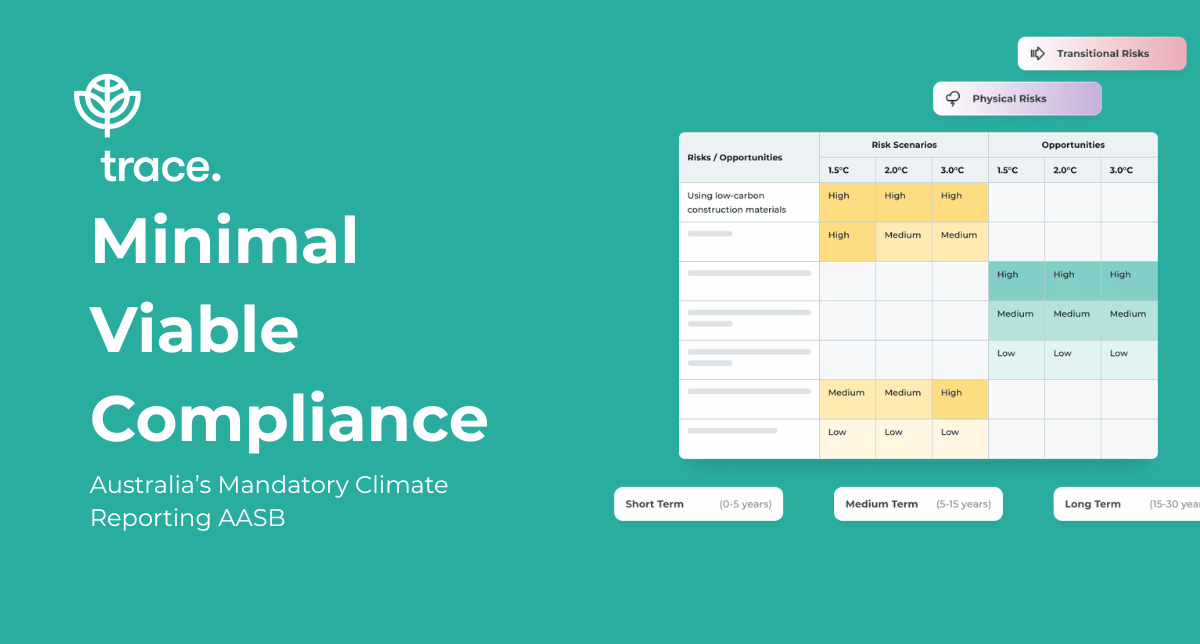
There is an important distinction inside this, because minimum viable compliance can be two very different things wearing the same name. It is a legitimate scoping decision when it is set against the entity's actual risk profile and documented as such. It becomes something else when it is set against what is palatable internally. Assurance providers can tell the difference, and the gap between the two narrows sharply in year two as assurance expectations step up.
In interviews with assurance teams at large and mid-tier firms, one requirement recurs in different words every time: they want the working, not the conclusion.
Assurance providers do not object to a risk being excluded, or an emissions source being deemed immaterial. They object to not being able to see why. One assurance lead's single largest challenge on a report she reviewed concerned a risk that had been correctly and defensibly excluded, but where the reasoning had never been written into the register. The judgement was right. The record of it was missing, and reconstructing it cost a review round.
This is harder than it sounds, because it requires writing reasoning down at the moment the decision is made, knowing that a stranger will read it eighteen months later. People instinctively write down the answer, not the argument. It is a learned habit.
Traceability applies regardless of what produced the number. A spreadsheet built at speed by someone who has since left the organisation creates the same problem as a figure generated by an AI tool. What AI changes is the rate at which untraceable outputs get produced, and how convincing they look on the way past. A rushed spreadsheet looks rushed. An AI-drafted methodology paragraph looks authoritative, which is a worse failure mode because it does not invite scrutiny.
The test to apply to any figure in a draft disclosure is whether there is a source document a third party could use to reperform it. If there is not, the figure is not audit evidence, whatever produced it.
There is a related cost that recurs every year and appears in no budget: reasoning that lives in one person's head. Where a single owner holds the boundary decisions, the exclusion rationale and the methodology choices, that knowledge leaves when they do. Reopening a boundary decision weeks before a draft deadline, with no record of why it was made, is one of the more expensive positions an organisation can find itself in, and it is entirely a documentation failure rather than a capability one.
Most of the cost decisions above resolve more cleanly when the delivery question is split by workstream rather than argued as a single build or buy choice.
Work that is usually cheaper and better done internally:
Work where external support most often prevents rework:
One question worth asking any prospective partner has nothing to do with price: which assurance teams have already seen their outputs. Reporting teams have described an auditor who already knows the tooling as removing weeks of explaining how numbers were produced.
A second question is a better test of value than any line in a proposal: what will the team be able to do itself in year three that it cannot do today. If a year three engagement is set to cost the same as year one, something has gone wrong, and it probably went wrong at the start.
Step 1: Set and document the organisational boundary at site level, first. Boundary is the single largest cause of audit rework. The failure is rarely that an assurance provider disagrees with a boundary judgement. It is that the assessment was never done at site level in the first place, so there is no judgement to disagree with.
Step 2: Write reasoning down at the point of decision, including exclusions. The rationale for what was left out matters more to an assurance provider than the rationale for what was kept, because exclusions are where they cannot see the thinking.
Step 3: Scope to what year one requires, and state what is being deferred. Name the optional elements not being disclosed and why. A deliberate, documented scope is defensible. A thin disclosure with no stated reasoning is not.
Step 4: Protect the review layer when budget gets cut. Cut scope, cut depth, cut optional disclosures. Do not cut the step that checks the rest.
Step 5: Share a draft with the assurance provider before the reporting period closes. A skeleton with gaps is genuinely useful to them and moves review effort out of the July to October crush.
Step 6: Build the year two asset while building the year one report. A documented boundary assessment, a risk register with the reasoning intact, and a repeatable data process are the difference between preparing once and paying to reconstruct annually.
How much does ASRS assurance cost in Australia?
Assurance fees are not published and vary widely with entity size, data complexity and the number of review rounds required. Fees are built from hours, so the largest controllable variable is preparation. Assurance partners describe a substantial difference between a well-prepared and a poorly prepared client for an identical set of disclosures. No fixed market rate exists.
What drives the cost of ASRS assurance?
Hours, and hours are driven by the number of times the assurance provider has to read the report. A well-prepared client typically needs two passes. Assurance teams commonly describe five or six with poorly prepared clients, and each additional round is a full re-review rather than a quick re-read, including repeated specialist and partner review.
Does engaging an assurance provider early reduce the fee?
Not directly. Assurance fees reflect effort, so reviewing a draft in March costs the same as reviewing it in September. Going early reduces cost indirectly by reducing rework and by moving the engagement out of the July to October period when Australian assurance teams are at capacity. Adviser costs, unlike assurance fees, often do vary by season.
Is it cheaper to prepare an ASRS disclosure in-house?
For some workstreams, yes. Governance documentation, data collection and risk ranking are usually cheaper and better done internally. Boundary definition, materiality judgement, scenario analysis and financial effects are where errors are most expensive and where first-time preparers have no benchmark for what good looks like. Splitting the decision by workstream produces a lower total cost.
Can AI reduce the cost of ASRS reporting?
It compresses the mechanical work substantially. What it does not create is traceability. An output nobody can trace to a source document is not audit evidence, and AI generates untraceable outputs faster and in more convincing prose than a person would. Used inside a workflow with expert review and an audit trail it lowers cost. Used as the workflow, it moves cost into the assurance round.
What is the most expensive mistake in a first-year ASRS disclosure?
Not documenting the reasoning behind judgement calls at the time they are made. Assurance providers rarely dispute a well-made decision. They query decisions they cannot see the basis for, and answering those queries months later, often after the person who made the decision has left, generates the review rounds that drive the fee.
The cheapest version of a first-year ASRS engagement is the one where the boundary, the reasoning and the review sequence were settled before the reporting period closed. For entities still deciding what year one should cover, an AASB S2 readiness assessment is the step that sets that scope. To find out where a current ASRS approach is likely to generate avoidable cost, book a free 30-minute call with the Trace team.
Trace is a climate reporting platform specialising in ISSB and AASB standards, helping businesses navigate mandatory climate disclosure with clarity and confidence.
A one-page visual of the four AASB S2 pillars, what each requires, key deadlines, and the step-by-step compliance path. Start here if your team is scoping what ASRS S2 actually involves.
Benchmark your readiness against 20+ ASRS compliant Australian companies. Includes buying criteria, support gaps, and how first-round filers are approaching year one.
Templates, checklists and frameworks to start your AASB S2 implementation. Built for finance and sustainability leads who are ready to move.
A 5-minute self-assessment. Get a compliance gap map and personalised next steps, scored against the four AASB S2 pillars.


London - Sydney


.png)
.webp)
.png)