“If I was to do it again, I'd just use one partner that aligns with your business.”
Tuesday, 27 October 2026 | The Tasting Room, The Grounds of the City, Sydney
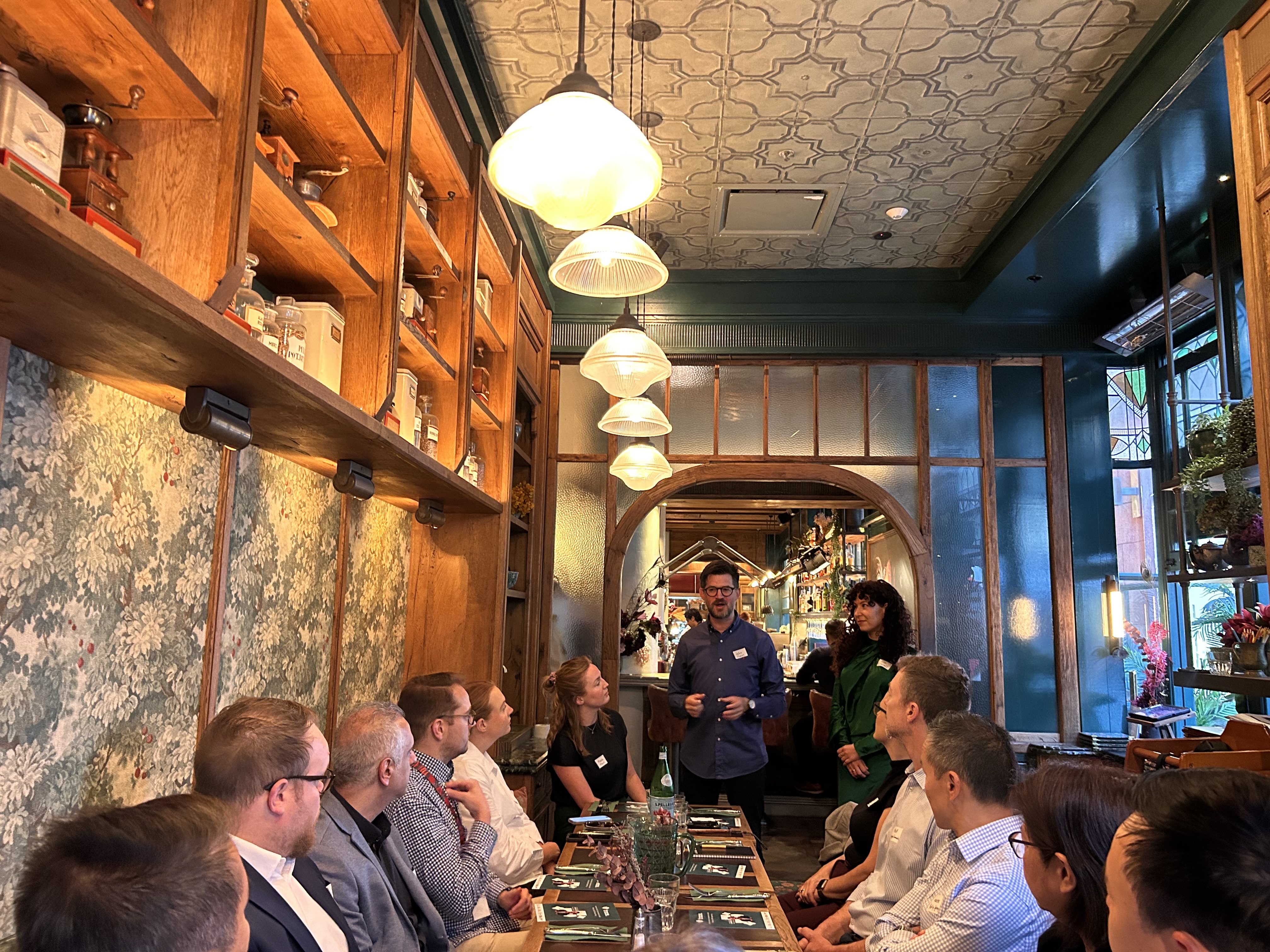
Twelve senior leaders joined us in The Tasting Room at The Grounds of the City for an invite-only breakfast on a question most of them are asking right now: where do we actually start with mandatory climate reporting under the Australian Sustainability Reporting Standards (ASRS)?
With Group 2 reporting periods now underway, attendees asked more questions than at any of our previous seven ASRS breakfasts, continuing a trend we've seen since mandatory reporting began in January 2025.
Around the table were general counsel, finance managers, a head of financial control, sustainability leads, and procurement and facilities managers. They came from data centres, banking, property, construction, engineering, legal services, travel retail and facility services, with Group 1, 2 and 3 reporters all in the room.
Our guest speaker was Liza Gubska, Senior Enterprise Risk Manager at Cuscal, who has just taken a Group 1 payments business through its first mandatory climate disclosure and assurance. She was joined by Morna McGuire, Senior Climate Reporting Manager at Trace and formerly of KPMG Climate Advisory, with Trace's John Claridge moderating.
“Start early, stay proportionate, and know when to push back.”
Much of the session was audience questions, covering auditor comments, working with outside partners and what Liza would do differently. Here are eight lessons from the morning.
Group 1 reporters have now been through a full cycle of disclosure and limited assurance. For many Group 2 businesses, the first reporting period is already underway, and Group 3 isn't far behind. The standards, including AASB S2 Climate-related Disclosures, run to more than 260 pages, and the work lands on finance, risk, legal and sustainability teams at the same time, usually on top of their day jobs. Treasury has estimated preparation costs of $750,000 to $1.6 million for large organisations.
Cuscal started 18 months ahead of its deadline, and Liza said:
“We started early and I'm still surprised by how much there is to do and how long it takes.” Liza Gubska, Cuscal
Liza described the feedback from her first assurance like this:
“Comments on top of comments and it was extremely overwhelming.” Liza Gubska, Cuscal
Her first instinct was to address every one, assuming that would close things out. Instead, new comments came back on what she had already fixed. Over time she learned to push back. Morna put that in context: auditors are doing this for the first time too, and anything that aligns with the standard is justifiable. The practical test is whether a comment points to a genuine gap against the standard or reflects a preference, and only a genuine gap needs a change.
Morna explained that the standard is designed to be built on year by year, and only some areas are rigorously assured in Year 1. If a comment goes beyond what Year 1 requires, it's reasonable to raise that. Cuscal's auditor also shared helpful feedback on areas outside the assurance scope, and many of those comments became recommendations for Year 2 rather than Year 1 rework.
A travel retail attendee asked whether any Group 1 reports had been rejected. Morna's answer: none for their content, only for being late, and there has been a lot of grace. She also cautioned against treating the disclosure as a marketing exercise, because it's an accounting exercise.
Asked what surprised her most, Liza pointed to the level of detail a first assurance involves:
“They went into minuscule things that I wasn't prepared for.” Liza Gubska, Cuscal
Cuscal had brought its auditor in early for a gap assessment, which helped show where the disclosure needed bulking out. Governance, which she expected to take longest, went smoothly. Plan for that level of detail across the whole disclosure, and allow time for answering auditor questions as well as drafting.
A Group 3 finance manager explained that her auditor has a consulting arm, but independence rules mean it can't advise her, and asked how an outside partner can help. Liza listed the support Cuscal had through Trace: end-to-end reporting, recommendations, report drafting, templates, advice and regular check-ins. The part she valued most was help with the auditor discussions themselves, including how to respond to comments with confidence. For more on this, see our guide to what auditors actually test.
A Group 2 procurement and sustainability lead asked Liza to spell out who Cuscal worked with. In Year 1 it was the auditor plus Trace, with a climate risk assessment that had already been done by a separate provider, which Trace then brought together with the rest of the disclosure. Her advice was to choose one partner that aligns with your business. One partner keeps the work joined up from the start and gives you consistent advice through the year, which mattered for a small team like Cuscal's. Liza said working with Trace was like assurance on top of assurance, asking the hard questions before the auditor did.
A sustainability lead at a Group 1 property business, now in Year 2, raised the gap he has found between finance and sustainability, and how hard it is to bridge. At Cuscal, the governance team ran the disclosure without access to the full annual report, which made reconciling the two difficult, and Liza would have liked finance to own the whole thing. Her answer was to bring risk, finance and governance together early and keep doing it consistently. There was, she admitted, a lot of staring at each other across the table: “no idea what you've just said”, and her advice was to keep going until everyone understands.
This matters because these are new numbers, often ranges, not backed by much data, and if finance and the board aren't brought along early, they may not want to publish them at the end.
Asked whether Cuscal pre-assured the whole report, Liza described a very collaborative process, with Cuscal's financial auditor suggesting where it could come in and check along the way. In Year 2, Cuscal's auditor will join the process even earlier for pre-assurance and board training, and was happy to, because it reduces pressure on them too. It's worth asking yours what it can do early, rather than waiting for year end.
Cuscal had assumed Year 2 would mostly mean updating figures, but there's more to it. The business acquired an entity one month before its reporting deadline, so much was acknowledged as Year 2 work. Its own targets had been met, but the new entities hadn't met them, so Cuscal left them out to set group-level targets next year, “even though it was a lovely story”.
Morna added that Year 1 is about identifying exposure and later years about the financial impact of risk. Quantifying isn't always better: a Group 1 bank estimated 4% losses, where describing what that impact really looks like would have been more useful. Auditors will also be more experienced next year, so expect either a more practical review or a deeper one in areas they now know companies get wrong.
Thank you to Liza and Cuscal for being so open about Year 1, including the parts that didn't go to plan. Thanks also to everyone who came along and shared their own experience.
To receive an invitation to the next breakfast session, subscribe to our newsletter here.
If your first reporting period has started, or starts soon, book a 20-minute ASRS readiness conversation. We'll walk you through a proportionate Year 1 approach against your own timeline, so you're not overbuilding or leaving gaps an auditor will find.
Trace is the end-to-end climate reporting platform. From collecting your data to the final disclosure, every step is managed, evidenced and in one place, with AI doing the heavy lifting and our experts guiding the decisions.


London - Sydney