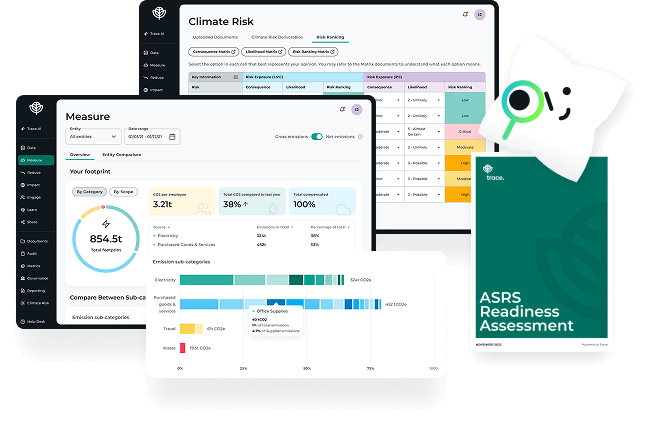
What are Australia's ASRS teams actually asking about climate disclosure?

This guide distils 60+ real conversations with Australian businesses navigating mandatory ASRS S2 compliance. From governance and climate risk to Scope 3 and assurance, these are the questions your peers are asking, and the straight answers they needed.

CFOsFinance DirectorsSustainability ManagersRisk & ComplianceBoard Members
FREE DOWNLOAD

Get the ebook

AASB Australia's Mandatory Climate Reporting

Trusted by Mandatory Reporters

“Trace’s AI capabilities have significantly streamlined our data collection and validation processes, reducing manual effort and giving us greater confidence .”

Name

CFO, Allied credit

“Trace’s AI capabilities have significantly streamlined our data collection and validation processes, reducing manual effort and giving us greater confidence .”

CFO, Allied credit

“We’ve worked with Trace for over 4 years and they’ve always given us confidence that our carbon data is accurate, audit-ready and aligned with evolving reporting standards.”

CEO, EnVATO

" Starting early [with the Trace platform] meant we avoided the scramble - saving time, money, and a lot of stress"

HEAD OF ESG, PADDY PALLIN

See Whats Inside

The questions your peers are actually asking.

This guide is organised by the five disclosure areas of AASB S2, plus the practical questions around timing, ownership and cost that come up in every conversation.

What ASRS S2 actually requires

Emissions are one of five required disclosure areas and arguably the smallest by effort. This chapter explains what the standard actually covers, why existing emissions reports only get you started, and what the majority of the work actually involves.

Governance: what your auditor wants

What auditors are looking for is evidence that climate-related risks and opportunities were actively considered. This chapter covers who needs to own it, what documents carry the most weight, and the governance trap that creates audit risk instead of compliance.

Climate risk and scenario analysis

Two scenarios minimum, at or below 1.5 degrees and above 2.5 degrees. This chapter covers what you must disclose, whether you need to put a dollar figure on every risk, and what "practicable approach" actually means in year one.

Scope 1, 2 and 3: the basics and the traps

For most services businesses, Scope 3 represents 80 to 95 percent of total emissions. This chapter covers the Scope definitions, the certificate confusion already costing companies money, and what net zero actually requires under AASB S2.

Key Findings

Five things that surprise every organisation navigating ASRS.

After 60+ conversations with Group 1, 2 and 3 entities, five themes come up in every engagement. None of them appear in the guidance documents.

The hardest part is data, not climate risk

A Group 1 CFO who completed the full disclosure process was clear: the real challenge was getting emissions data clean and attributable back through invoices to the general ledger. Not governance. Not scenario analysis. Data.

Your auditor is still learning too

Multiple Group 1 clients reported their audit partner describing themselves as still learning from earlier audits. The companies that navigate year one best are the ones who lead the process, not wait to be told what is required.

ASRS is a financial reporting obligation

Companies that frame this as a sustainability project consistently struggle to get CFO attention and board ownership. Frame it as financial risk management and director liability. That is what moves it into the financial reporting cycle where it belongs.

First-round disclosures are already filed

Group 1 disclosures are running 30 to 40 pages. The best performers targeted 8 pages by being selective and precise. Group 2 and 3 entities now have real benchmarks to plan against, not just guidance documents.

Who This Is For

Written for the people
making ASRS decisions

This ebook is written at CFO grade, with enough detail to be genuinely useful to sustainability leads and risk teams. Not a primer. Not a sales deck.

CFOs & Finance Directors

Responsible for signing off on the disclosure. Needs to understand what auditors will scrutinise in year two, and where the financial integration gaps are in first-round disclosures.

Sustainability Managers & ESG Leads

Building the disclosure internally. Needs to understand what peers are doing on Scope 3, scenario analysis and materiality so the internal benchmark is calibrated correctly.

Risk & Compliance Teams

Needs to understand where governance documentation is falling short in first-round disclosures and what auditors are already flagging as areas for year-two improvement.

Board Members & Audit Committee

Accountable for climate risk oversight under AASB S2. Needs a clear picture of what comparable entities are disclosing and what the governance standard looks like in practice.

This ebook is particularly relevant if:

Your entity is likely to fall under ASRS Group 1, 2 or 3 (or you're not yet sure which group applies)

Your board or audit committee has asked about climate disclosure obligations for the first time

You're preparing a Group 2 first disclosure and want to learn from what Group 1 entities got right and wrong

You need to brief internal stakeholders on what AASB S2 actually requires versus what others are choosing to include

What Comes Next

From ebook to
compliant disclosure.

01

Download the ebook

Understand what first reporters did. Where they focused, where they struggled, and what auditors are already signalling for year two.

Get it now

02

Run your readiness assessment

Trace maps your current data, governance and reporting position against ASRS requirements. You get a clear picture of where you are and a prioritised gap list.

See how it works

03

Build your compliance roadmap

Trace turns your readiness assessment into a sequenced plan: what to do now, what to prepare for year two, and how to keep your board and audit committee informed throughout.

Book a call with our team

Questions we hear most from ASRS teams

These are the questions Traces team hears most often from CFOs and sustainability leads starting their ASRS journey. The full ebook answers all of them in depth.


What is ASRS S2 and who does it apply to in Australia?
ASRS is Australia's mandatory climate-related financial disclosure regime. AASB S2 is the climate-specific standard within it, requiring entities to disclose across five areas: governance, strategy, climate risk and opportunity, metrics and targets, and emissions. Group 1 entities (the largest, by size thresholds set by Treasury) reported first in FY2025. Group 2 entities follow, with Group 3 entities phasing in after that. AASB S1, covering broader sustainability disclosures, is currently voluntary. Only AASB S2 is mandatory.
Is ASRS the same as AASB S2?
ASRS is the regime; AASB S2 is the climate-specific standard within it. The two terms are often used interchangeably, but ASRS refers to the Australian Sustainability Reporting Standards framework as a whole, while AASB S2 is the specific standard governing climate-related financial disclosures. Companies subject to ASRS must comply with AASB S2. AASB S1, covering broader sustainability, is currently voluntary.
What climate scenarios are required under ASRS S2?
AASB S2 requires scenario analysis using at least two scenarios: one at or below 1.5 degrees Celsius and one above 2.5 degrees Celsius. Companies must disclose which scenarios they used, the time horizons applied, what was deemed material versus immaterial, and their methodology and assumptions. Advanced quantitative modelling is not required in year one. Qualitative risk rankings supported by quantitative context where available are considered a practicable approach.
What is the difference between Scope 1, 2 and 3 emissions under ASRS?
Scope 1 covers emissions from sources directly owned or controlled by the organisation, such as fuel combustion. Scope 2 covers emissions from purchased electricity. Scope 3 covers all other indirect emissions across 15 categories, including supply chain, business travel, and product use. For most services businesses, Scope 3 represents 80 to 95 percent of total emissions. Under AASB S2, all three scopes must be disclosed. Large-scale generation certificates can be applied to Scope 2 for renewable electricity claims, but offsets cannot be used to substitute for actual Scope 1 reductions.
What is the difference between limited and reasonable assurance under ASRS S2?
Limited assurance, which applies in year one for most entities, involves a lower level of auditor scrutiny. Reasonable assurance, required in year two for most Group 1 entities, means methodology, assumptions, and how numbers were derived will be examined far more carefully. Year one is effectively a runway to build the data infrastructure, governance evidence, and disclosure processes that will withstand reasonable assurance. Disclosures not subject to audit in year one still need to be made under the Corporations Act.
How long does ASRS S2 compliance preparation take?
Most organisations underestimate the lead time required. The core challenge is not governance or scenario analysis: it is getting emissions data clean, attributable, and traceable back through invoices to the general ledger. This data infrastructure takes months to build. Stacking ASRS preparation on top of financial year-end is unmanageable. Entities that begin with a scoped year-one plan, assign named owners to each disclosure component, and engage their auditor early consistently perform better than those who start late.

Want deeper answers? The ebook has entity benchmarks, worked examples and expert commentary.

Download the full ebook

Questions we hear most from ASRS teams

These are the questions Traces team hears most often from CFOs and sustainability leads starting their ASRS journey. The full ebook answers all of them in depth.

What is ASRS S2 and who does it apply to in Australia?
ASRS is Australia's mandatory climate-related financial disclosure regime. AASB S2 is the climate-specific standard within it, requiring entities to disclose across five areas: governance, strategy, climate risk and opportunity, metrics and targets, and emissions. Group 1 entities (the largest, by size thresholds set by Treasury) reported first in FY2025. Group 2 entities follow, with Group 3 entities phasing in after that. AASB S1, covering broader sustainability disclosures, is currently voluntary. Only AASB S2 is mandatory.
Is ASRS the same as AASB S2?
ASRS is the regime; AASB S2 is the climate-specific standard within it. The two terms are often used interchangeably, but ASRS refers to the Australian Sustainability Reporting Standards framework as a whole, while AASB S2 is the specific standard governing climate-related financial disclosures. Companies subject to ASRS must comply with AASB S2. AASB S1, covering broader sustainability, is currently voluntary.
What climate scenarios are required under ASRS S2?
AASB S2 requires scenario analysis using at least two scenarios: one at or below 1.5 degrees Celsius and one above 2.5 degrees Celsius. Companies must disclose which scenarios they used, the time horizons applied, what was deemed material versus immaterial, and their methodology and assumptions. Advanced quantitative modelling is not required in year one. Qualitative risk rankings supported by quantitative context where available are considered a practicable approach.
What is the difference between Scope 1, 2 and 3 emissions under ASRS?
Scope 1 covers emissions from sources directly owned or controlled by the organisation, such as fuel combustion. Scope 2 covers emissions from purchased electricity. Scope 3 covers all other indirect emissions across 15 categories, including supply chain, business travel, and product use. For most services businesses, Scope 3 represents 80 to 95 percent of total emissions. Under AASB S2, all three scopes must be disclosed. Large-scale generation certificates can be applied to Scope 2 for renewable electricity claims, but offsets cannot be used to substitute for actual Scope 1 reductions.
What is the difference between limited and reasonable assurance under ASRS S2?
Limited assurance, which applies in year one for most entities, involves a lower level of auditor scrutiny. Reasonable assurance, required in year two for most Group 1 entities, means methodology, assumptions, and how numbers were derived will be examined far more carefully. Year one is effectively a runway to build the data infrastructure, governance evidence, and disclosure processes that will withstand reasonable assurance. Disclosures not subject to audit in year one still need to be made under the Corporations Act.
How long does ASRS S2 compliance preparation take?
Most organisations underestimate the lead time required. The core challenge is not governance or scenario analysis: it is getting emissions data clean, attributable, and traceable back through invoices to the general ledger. This data infrastructure takes months to build. Stacking ASRS preparation on top of financial year-end is unmanageable. Entities that begin with a scoped year-one plan, assign named owners to each disclosure component, and engage their auditor early consistently perform better than those who start late.

Want deeper answers? The ebook has entity benchmarks, worked examples and expert commentary.

Download the full ebook

Your deadline is coming.
Start with the data.

Download the free ebook and see what Australias first AASB S2 reporters have already disclosed. Then talk to Trace about where you stand.

Newsletter:  Climate Reporting Simplified.
This monthly edition unpacks what mandatory climate reporting really requires and how to minimise cost, disruption & confusion.

💚 Don’t worry, we won’t spam!

London - Sydney

© Copyright 2026 Trace | All Rights Reserved