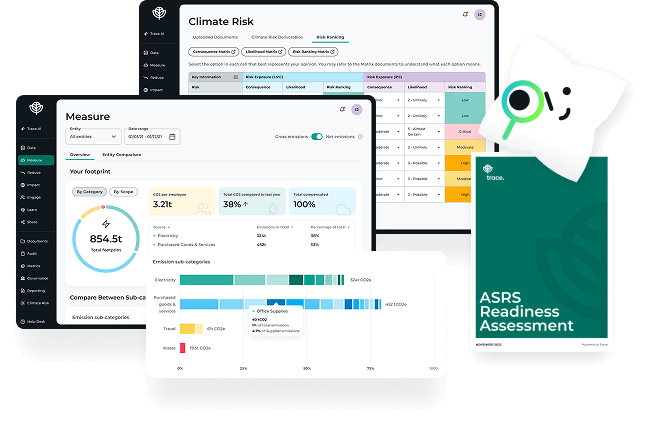
How do you run audit-ready scenario analysis under AASB S2?

A free guide for finance and sustainability teams working through mandatory climate disclosure. Covers the two scenarios AASB S2 requires, a repeatable method for rating climate risks across 2030, 2040 and 2050, and an honest read on where AI tools help and where they create audit risk.

CFOsFinance DirectorsSustainability ManagersRisk & ComplianceBoard Members
FREE DOWNLOAD

Get the ebook

AASB Australia's Mandatory Climate Reporting

Trusted by Mandatory Reporters

“Trace’s AI capabilities have significantly streamlined our data collection and validation processes, reducing manual effort and giving us greater confidence .”

Name

CFO, Allied credit

“Trace’s AI capabilities have significantly streamlined our data collection and validation processes, reducing manual effort and giving us greater confidence .”

CFO, Allied credit

“We’ve worked with Trace for over 4 years and they’ve always given us confidence that our carbon data is accurate, audit-ready and aligned with evolving reporting standards.”

CEO, EnVATO

" Starting early [with the Trace platform] meant we avoided the scramble - saving time, money, and a lot of stress"

HEAD OF ESG, PADDY PALLIN

See Whats Inside

Five chapters covering the complete scenario analysis method

The guide follows the sequence of a real AASB S2 engagement, from choosing your scenarios to ranking risks to stress-testing your AI use. Each chapter addresses a decision point where finance teams commonly stall.
What AASB S2 actually requires from scenario analysis

AASB S2 requires a minimum of two climate scenarios: one consistent with 1.5°C warming and one greater than 2.5°C. Risks must span physical and transition categories, cover short, medium and long-term horizons, and be expressed as financial effects, not narrative descriptions. This chapter sets out exactly what the standard demands and what auditors will test.

How to choose the right two scenarios for your business

The guide covers the two most commonly used scenario pairs: SSP1-RCP2.6 (a 1.5°C world of rapid decarbonisation and high transition risk) and SSP2-RCP4.5 (a 3°C world where physical risks compound across the century). It explains why each was chosen, what drives risk in each pathway, and how to document your selection so it holds under review.

Building a ranking framework that holds up to audit

Every risk in your register needs a likelihood and consequence rating across three time horizons, in both scenarios. The guide explains how to set consequence bands in dollar terms, why your climate risk framework must sit on the same scale as enterprise risk, and what limited assurance in year one actually rewards: a defensible, evidenced trail, not a perfect model.

The honest case on AI for scenario analysis

AI tools can summarise the standard, draft a first-pass risk list, and tighten narratives. They cannot identify which risks apply to your specific sites and supply chain, facilitate the workshop where ratings are agreed, or stand behind a materiality threshold when an auditor pushes back. This chapter explains exactly where AI is useful and where teams get into trouble by using it unsupervised.

Key Findings

Four things that catch finance teams off guard

These are the points that come up on every AASB S2 scenario analysis engagement. None of them are spelled out in the standard itself, which is part of why teams get caught.

Scenario analysis is where ASRS stops feeling like accounting

Most of AASB S2 rewards finance teams for what they already do well: gather data, document it, report consistently. Scenario analysis is different. It requires judgement about two versions of the future that have not happened yet, and that judgement has to be defensible to an auditor. Teams that treat it as a data exercise stall when they realise the standard does not tell them which scenarios to pick or how to rate exposure.

AI gives you a faster start and a worse finish

General AI tools are genuinely useful for explaining the standard and generating a first-pass risk list. The problem is that AI does not know your operations, so it produces risks that do not apply and misses the ones that do. An AI chat transcript is not assurance evidence. The teams who get value use AI inside a controlled, evidenced process, not instead of one.

Limited assurance rewards a defensible trail, not a perfect model

Year one assurance under AASB S2 does not require a perfect quantitative model. It requires evidence that someone decided who was responsible, what threshold counted as material, and why each risk was rated the way it was. Defining consequence bands in dollars turns each rating from an opinion into something an auditor can test.

Undisclosed risks still need to be documented

Setting a materiality threshold means some risks will not cross it. Those risks still need to be documented. Auditors want evidence that you considered the full list, not just the risks you chose to disclose. A well-maintained risk register that includes sub-threshold risks is one of the clearest signals of a defensible process.

Who This Is For

Written for the people
making ASRS decisions

This ebook is written at CFO grade, with enough detail to be genuinely useful to sustainability leads and risk teams. Not a primer. Not a sales deck.

CFOs & Finance Directors

Responsible for signing off on the disclosure. Needs to understand what auditors will scrutinise in year two, and where the financial integration gaps are in first-round disclosures.

Sustainability Managers & ESG Leads

Building the disclosure internally. Needs to understand what peers are doing on Scope 3, scenario analysis and materiality so the internal benchmark is calibrated correctly.

Risk & Compliance Teams

Needs to understand where governance documentation is falling short in first-round disclosures and what auditors are already flagging as areas for year-two improvement.

Board Members & Audit Committee

Accountable for climate risk oversight under AASB S2. Needs a clear picture of what comparable entities are disclosing and what the governance standard looks like in practice.

This ebook is particularly relevant if:

Your entity is likely to fall under ASRS Group 1, 2 or 3 (or you're not yet sure which group applies)

Your board or audit committee has asked about climate disclosure obligations for the first time

You're preparing a Group 2 first disclosure and want to learn from what Group 1 entities got right and wrong

You need to brief internal stakeholders on what AASB S2 actually requires versus what others are choosing to include

What Comes Next

From ebook to
compliant disclosure.

01

Download the ebook

Understand what first reporters did. Where they focused, where they struggled, and what auditors are already signalling for year two.

Get it now

02

Run your readiness assessment

Trace maps your current data, governance and reporting position against ASRS requirements. You get a clear picture of where you are and a prioritised gap list.

See how it works

03

Build your compliance roadmap

Trace turns your readiness assessment into a sequenced plan: what to do now, what to prepare for year two, and how to keep your board and audit committee informed throughout.

Book a call with our team

Questions we hear most from ASRS teams

These are the questions Traces team hears most often from CFOs and sustainability leads starting their ASRS journey. The full ebook answers all of them in depth.


What two climate scenarios does AASB S2 require for scenario analysis?
AASB S2 requires a minimum of two climate scenarios: one low-emissions scenario consistent with limiting warming to around 1.5°C, and one higher-emissions scenario consistent with warming greater than 2.5°C. The most commonly used pair is SSP1-RCP2.6 for the 1.5°C pathway and SSP2-RCP4.5 for the higher-emissions case, which tracks a trajectory of around 2.7 to 3°C. Entities must document why they selected each scenario and how the scenarios relate to their specific business risks. The standard requires both physical risks, covering acute events like floods and bushfires as well as chronic changes like heat and water stress, and transition risks from policy, market, technology and reputation shifts.
Can I use AI tools like ChatGPT or Claude to run AASB S2 scenario analysis?
AI tools can support parts of the scenario analysis process but cannot replace the judgement required to complete it. They are useful for summarising the standard, generating a first-pass risk list, and drafting narrative language. They fall short because they do not know your specific sites, contracts, or supply chain, so they produce generic risks that may not apply and miss material risks that are specific to your operations. AI chat transcripts are also not assurance evidence. Auditors expect a documented process showing who agreed the ratings, what threshold determined materiality, and why specific risks were included or excluded. AI used inside a controlled, evidenced process adds value; AI used instead of one creates audit risk.
How should climate risks be rated across time horizons under AASB S2?
Each climate risk in your register should be rated by likelihood and consequence for the short, medium and long term, commonly 2030, 2040 and 2050, in both your 1.5°C and higher-emissions scenarios. The rating should start from current exposure and then reflect how that exposure is expected to shift in each scenario across time. What makes ratings defensible is consistency: climate risk should sit on the same scale as enterprise risk, with consequence bands defined in financial terms rather than narrative descriptions. This turns each rating from an opinion into something an auditor can test against your enterprise risk framework.
How do you decide which climate risks are material enough to disclose under AASB S2?
Materiality under AASB S2 scenario analysis requires setting a clear financial threshold and applying it consistently across your full risk register. Only risks that cross the threshold belong in the disclosure, but risks that fall below it still need to be documented, because auditors expect evidence that you considered the full list. Defining consequence bands in dollar terms is the most reliable way to move from narrative ratings to testable materiality decisions. In year one, limited assurance rewards a defensible, evidenced decision trail: who set the threshold, who agreed the ratings, and why specific risks were included or excluded.
What is the difference between physical and transition climate risks under AASB S2?
Physical climate risks are the direct effects of a changing climate on your operations and assets. Acute physical risks are event-driven, including storms, floods and bushfires. Chronic physical risks are gradual, including heat stress, water scarcity and sea level rise. Transition climate risks arise from the shift to a lower-emissions economy: policy and regulatory changes such as carbon pricing, market shifts in demand or asset values, technology disruption, and reputational exposure. AASB S2 requires both categories to be assessed across at least two climate scenarios and three time horizons, with exposure described in financial terms in each case.
What does audit-ready mean for climate scenario analysis under AASB S2?
Audit-ready scenario analysis under AASB S2 means producing a documented process that an assurance provider can test and a board can stand behind. The key elements are: a clear rationale for why each scenario was selected, a risk register covering physical and transition risks tailored to your specific operations, consequence bands defined in financial terms, ratings that are consistent with your enterprise risk framework, and documentation of risks that were considered but fell below your materiality threshold. In year one of limited assurance, the standard does not require a perfect quantitative model. It requires evidence of a structured, repeatable process with clear ownership of each decision.

Want deeper answers? The ebook has entity benchmarks, worked examples and expert commentary.

Download the full ebook

Questions we hear most from ASRS teams

These are the questions Traces team hears most often from CFOs and sustainability leads starting their ASRS journey. The full ebook answers all of them in depth.

What two climate scenarios does AASB S2 require for scenario analysis?
AASB S2 requires a minimum of two climate scenarios: one low-emissions scenario consistent with limiting warming to around 1.5°C, and one higher-emissions scenario consistent with warming greater than 2.5°C. The most commonly used pair is SSP1-RCP2.6 for the 1.5°C pathway and SSP2-RCP4.5 for the higher-emissions case, which tracks a trajectory of around 2.7 to 3°C. Entities must document why they selected each scenario and how the scenarios relate to their specific business risks. The standard requires both physical risks, covering acute events like floods and bushfires as well as chronic changes like heat and water stress, and transition risks from policy, market, technology and reputation shifts.
Can I use AI tools like ChatGPT or Claude to run AASB S2 scenario analysis?
AI tools can support parts of the scenario analysis process but cannot replace the judgement required to complete it. They are useful for summarising the standard, generating a first-pass risk list, and drafting narrative language. They fall short because they do not know your specific sites, contracts, or supply chain, so they produce generic risks that may not apply and miss material risks that are specific to your operations. AI chat transcripts are also not assurance evidence. Auditors expect a documented process showing who agreed the ratings, what threshold determined materiality, and why specific risks were included or excluded. AI used inside a controlled, evidenced process adds value; AI used instead of one creates audit risk.
How should climate risks be rated across time horizons under AASB S2?
Each climate risk in your register should be rated by likelihood and consequence for the short, medium and long term, commonly 2030, 2040 and 2050, in both your 1.5°C and higher-emissions scenarios. The rating should start from current exposure and then reflect how that exposure is expected to shift in each scenario across time. What makes ratings defensible is consistency: climate risk should sit on the same scale as enterprise risk, with consequence bands defined in financial terms rather than narrative descriptions. This turns each rating from an opinion into something an auditor can test against your enterprise risk framework.
How do you decide which climate risks are material enough to disclose under AASB S2?
Materiality under AASB S2 scenario analysis requires setting a clear financial threshold and applying it consistently across your full risk register. Only risks that cross the threshold belong in the disclosure, but risks that fall below it still need to be documented, because auditors expect evidence that you considered the full list. Defining consequence bands in dollar terms is the most reliable way to move from narrative ratings to testable materiality decisions. In year one, limited assurance rewards a defensible, evidenced decision trail: who set the threshold, who agreed the ratings, and why specific risks were included or excluded.
What is the difference between physical and transition climate risks under AASB S2?
Physical climate risks are the direct effects of a changing climate on your operations and assets. Acute physical risks are event-driven, including storms, floods and bushfires. Chronic physical risks are gradual, including heat stress, water scarcity and sea level rise. Transition climate risks arise from the shift to a lower-emissions economy: policy and regulatory changes such as carbon pricing, market shifts in demand or asset values, technology disruption, and reputational exposure. AASB S2 requires both categories to be assessed across at least two climate scenarios and three time horizons, with exposure described in financial terms in each case.
What does audit-ready mean for climate scenario analysis under AASB S2?
Audit-ready scenario analysis under AASB S2 means producing a documented process that an assurance provider can test and a board can stand behind. The key elements are: a clear rationale for why each scenario was selected, a risk register covering physical and transition risks tailored to your specific operations, consequence bands defined in financial terms, ratings that are consistent with your enterprise risk framework, and documentation of risks that were considered but fell below your materiality threshold. In year one of limited assurance, the standard does not require a perfect quantitative model. It requires evidence of a structured, repeatable process with clear ownership of each decision.

Want deeper answers? The ebook has entity benchmarks, worked examples and expert commentary.

Download the full ebook

Your deadline is coming.
Start with the data.

Download the free ebook and see what Australias first AASB S2 reporters have already disclosed. Then talk to Trace about where you stand.

Newsletter:  Climate Reporting Simplified.
This monthly edition unpacks what mandatory climate reporting really requires and how to minimise cost, disruption & confusion.

💚 Don’t worry, we won’t spam!

London - Sydney

© Copyright 2026 Trace | All Rights Reserved