
Where will your auditor find gaps in your first climate report?
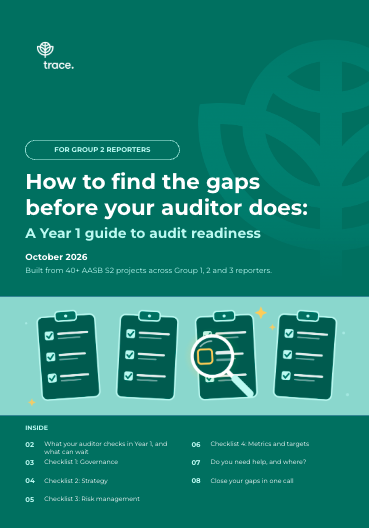
A free guide for Group 2 reporters, built from 40+ AASB S2 projects across Group 1, 2 and 3. Four printable checklists show what your auditor will test in your first report under the Australian Sustainability Reporting Standards (ASRS), what's required but not assured, and what can wait.
Get the ebook
AASB Australia's Mandatory Climate Reporting
Trusted by Mandatory Reporters







“Trace’s AI capabilities have significantly streamlined our data collection and validation processes, reducing manual effort and giving us greater confidence .”
CFO, Allied credit
“Trace’s AI capabilities have significantly streamlined our data collection and validation processes, reducing manual effort and giving us greater confidence .”
CFO, Allied credit

“We’ve worked with Trace for over 4 years and they’ve always given us confidence that our carbon data is accurate, audit-ready and aligned with evolving reporting standards.”
CEO, EnVATO

" Starting early [with the Trace platform] meant we avoided the scramble - saving time, money, and a lot of stress"
HEAD OF ESG, PADDY PALLIN
Four checklists, one for each pillar of AASB S2
It opens with what your auditor checks in year one, then gives you a checklist for each pillar and a one-minute check on how much help you need.
What your auditor checks in year one
Limited assurance in year one covers governance, your climate risks and opportunities, and your Scope 1 and 2 emissions. Apart from Scope 3 and prior-year comparatives, everything else in AASB S2 is still required, and your auditor still reads it. A single table shows what's assured now and what's assured from year two.
Governance, the gap you can't fix later
Seven checks cover who oversees climate, how often the board is briefed and whether the minutes show it. Your auditor looks for oversight across the whole reporting period, so a first briefing in month ten leaves nine months with no evidence. Print it and take it to your next board or audit committee meeting.
Strategy and risk management
Thirteen checks cover identifying and classifying each climate risk, time horizons, effects on your business model and finances, scenario analysis and how your risk process works. Each item is tagged as assured in year one or required but not assured, so you know which gaps carry the most weight.
Metrics, targets and where to get help
Six checks cover Scope 1 and 2 emissions, the cross-industry metrics and any targets you've set or must meet. A one-minute check then shows whether your team can close its gaps in house, needs a hybrid model or should outsource, based on the experience it already has.
What auditors and Group 1 reporters told us
These lessons came up again and again across first-year AASB S2 reports. Most of them aren't obvious from the standard itself, and they decide where your effort should go first.
Governance can't be backfilled
Auditors look for board oversight that operated across the whole reporting period, backed by agendas and minutes. If the board's first climate briefing happens in month ten, there's no way to create evidence for the months before it. That's why governance is the one area to get running now.
Not assured doesn't mean not read
Your auditor reads the whole report and checks it for consistency with the assured sections and your financial statements. Group 1 reporters who treated unassured sections as optional still got feedback on them. Give those sections the same discipline as everything else.
Every risk needs a line to the financials
Auditors often saw climate risks that weren't connected to financial consequences, with materiality judgements left undocumented. Group 1 reporters said choosing the right risks, and defending why some were material, was the hardest part. Write down each judgement and its reasoning as you make it.
Everyone underestimates the effort
Preparation, coordination and evidence requests were consistently bigger than first-wave reporters budgeted for, and the requests arrived at the busiest time of year. Auditors want a documented source, method and sign-off behind every number and judgement. Building that trail as you go keeps year end manageable.
Written for the people
making ASRS decisions
This ebook is written at CFO grade, with enough detail to be genuinely useful to sustainability leads and risk teams. Not a primer. Not a sales deck.
Responsible for signing off on the disclosure. Needs to understand what auditors will scrutinise in year two, and where the financial integration gaps are in first-round disclosures.
Building the disclosure internally. Needs to understand what peers are doing on Scope 3, scenario analysis and materiality so the internal benchmark is calibrated correctly.
Needs to understand where governance documentation is falling short in first-round disclosures and what auditors are already flagging as areas for year-two improvement.
Accountable for climate risk oversight under AASB S2. Needs a clear picture of what comparable entities are disclosing and what the governance standard looks like in practice.
This ebook is particularly relevant if:
Your entity is likely to fall under ASRS Group 1, 2 or 3 (or you're not yet sure which group applies)
Your board or audit committee has asked about climate disclosure obligations for the first time
You're preparing a Group 2 first disclosure and want to learn from what Group 1 entities got right and wrong
You need to brief internal stakeholders on what AASB S2 actually requires versus what others are choosing to include
From ebook to
compliant disclosure.
01
Download the ebook
Understand what first reporters did. Where they focused, where they struggled, and what auditors are already signalling for year two.
Get it now02
Run your readiness assessment
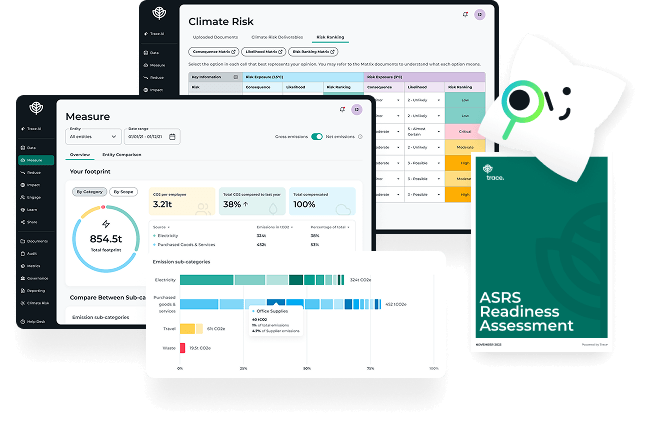
Trace maps your current data, governance and reporting position against ASRS requirements. You get a clear picture of where you are and a prioritised gap list.
See how it works03
Build your compliance roadmap
Trace turns your readiness assessment into a sequenced plan: what to do now, what to prepare for year two, and how to keep your board and audit committee informed throughout.
Book a call with our teamQuestions we hear most from ASRS teams
These are the questions Trace’s team hears most often from CFOs and sustainability leads starting their ASRS journey. The full ebook answers all of them in depth.


Your deadline is coming.
Start with the data.
Download the free ebook and see what Australia’s first AASB S2 reporters have already disclosed. Then talk to Trace about where you stand.


London - Sydney