
Can you DIY your first ASRS disclosure with AI?
A free guide for Group 2 reporters in scope now. Drawn from more than 40 AASB S2 engagements, interviews with Group 1 CFOs and auditor feedback, it sets out three ways to resource your first climate disclosure, what to hand to AI, and what your auditor will insist a person did.
Get the ebook
AASB Australia's Mandatory Climate Reporting
Trusted by Mandatory Reporters







“Trace’s AI capabilities have significantly streamlined our data collection and validation processes, reducing manual effort and giving us greater confidence .”
CFO, Allied credit
“Trace’s AI capabilities have significantly streamlined our data collection and validation processes, reducing manual effort and giving us greater confidence .”
CFO, Allied credit

“We’ve worked with Trace for over 4 years and they’ve always given us confidence that our carbon data is accurate, audit-ready and aligned with evolving reporting standards.”
CEO, EnVATO

" Starting early [with the Trace platform] meant we avoided the scramble - saving time, money, and a lot of stress"
HEAD OF ESG, PADDY PALLIN
Five workstreams, three resourcing models, one clear recommendation
The guide moves from what AASB S2 requires to how to resource it. Each of the five workstreams gets a plain verdict: own it, prompt it, or get support.
What Group 1 actually published
Look past the standard to what 241 first-wave reporters lodged: around 30 pages on average, between 1 and 12 material risks, and fewer than half disclosing Scope 3 in year one. Every one of them used the available reliefs. First-year reporting did not mean doing everything at once.
Minimum Viable Compliance for year one
A deliberately narrow definition of your first disclosure: every mandatory requirement delivered, everything optional deferred, and the standard's reliefs used where they apply. Everything you submit gets audited, so extra pages mean extra claims to test and extra hours on the invoice. Take the scope to your executive team before any resourcing discussion.
Build in house, hybrid or fully outsourced
A side-by-side comparison of the three resourcing models on internal hours, external fees, assurance fee exposure, rework risk and capability in year three. Building in house wins on the first invoice, but assurance is priced on hours. The hybrid model typically needs 35 to 50 internal hours and no additional headcount.
Where AI works, workstream by workstream
Each of the five workstreams is tested against five AI failure modes, from the provenance gap to the audit expectations gap. You get a clear verdict on what to prompt, what to keep and where external support pays for itself. Includes two prompts that look alike and produce very different audit outcomes.
Four things first-year reporters learn too late
These come up again and again across our engagements and auditor conversations. None of them appear in the standard, and most only surface once assurance begins.
Governance evidence cannot be recreated later
Governance is assured in full from year one, and it is the one workstream where seeing how you go is not a strategy. No model can make a board meeting have happened if it did not. Keep climate on the agenda, minute the decisions and capture training evidence as it happens.
Unassured sections still drive auditor comments
Financial effects and scenario analysis are not formally assured in year one, yet assurance teams report they generate the bulk of auditor comments. The auditor still reads them and tests them for contradiction against the assured sections. Treat them with the same discipline as everything else.
A correct number can still fail audit
One construction business used an AI tool to estimate refrigerant emissions from fleet hours. The figure looked reasonable, but their own director caught it: no source document, no published reference and no way for the auditor to recalculate it. Auditors sample line items and trace each back to the raw invoice.
The costliest failure is an unwritten judgement
One listed company correctly excluded a risk from its material list, and the auditor accepted the reasoning. But the rationale had only been discussed out loud, and it became the largest point of friction on the engagement. The fix would have cost one sentence written at the time.
Written for the people
making ASRS decisions
This ebook is written at CFO grade, with enough detail to be genuinely useful to sustainability leads and risk teams. Not a primer. Not a sales deck.
Responsible for signing off on the disclosure. Needs to understand what auditors will scrutinise in year two, and where the financial integration gaps are in first-round disclosures.
Building the disclosure internally. Needs to understand what peers are doing on Scope 3, scenario analysis and materiality so the internal benchmark is calibrated correctly.
Needs to understand where governance documentation is falling short in first-round disclosures and what auditors are already flagging as areas for year-two improvement.
Accountable for climate risk oversight under AASB S2. Needs a clear picture of what comparable entities are disclosing and what the governance standard looks like in practice.
This ebook is particularly relevant if:
Your entity is likely to fall under ASRS Group 1, 2 or 3 (or you're not yet sure which group applies)
Your board or audit committee has asked about climate disclosure obligations for the first time
You're preparing a Group 2 first disclosure and want to learn from what Group 1 entities got right and wrong
You need to brief internal stakeholders on what AASB S2 actually requires versus what others are choosing to include
From ebook to
compliant disclosure.
01
Download the ebook
Understand what first reporters did. Where they focused, where they struggled, and what auditors are already signalling for year two.
Get it now02
Run your readiness assessment
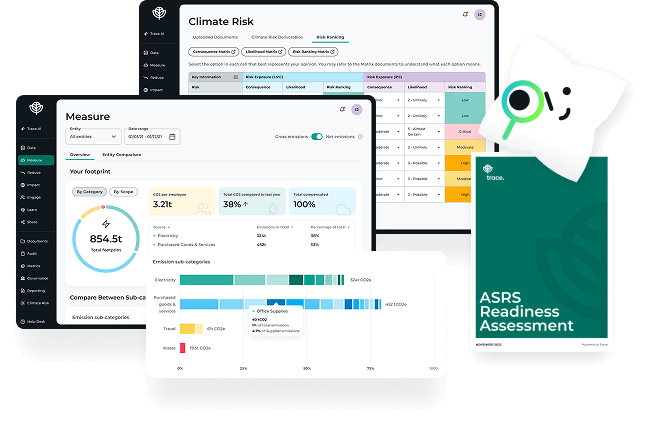
Trace maps your current data, governance and reporting position against ASRS requirements. You get a clear picture of where you are and a prioritised gap list.
See how it works03
Build your compliance roadmap
Trace turns your readiness assessment into a sequenced plan: what to do now, what to prepare for year two, and how to keep your board and audit committee informed throughout.
Book a call with our teamQuestions we hear most from ASRS teams
These are the questions Trace’s team hears most often from CFOs and sustainability leads starting their ASRS journey. The full ebook answers all of them in depth.


Your deadline is coming.
Start with the data.
Download the free ebook and see what Australia’s first AASB S2 reporters have already disclosed. Then talk to Trace about where you stand.


London - Sydney