
What must your board disclose about climate under AASB S2?
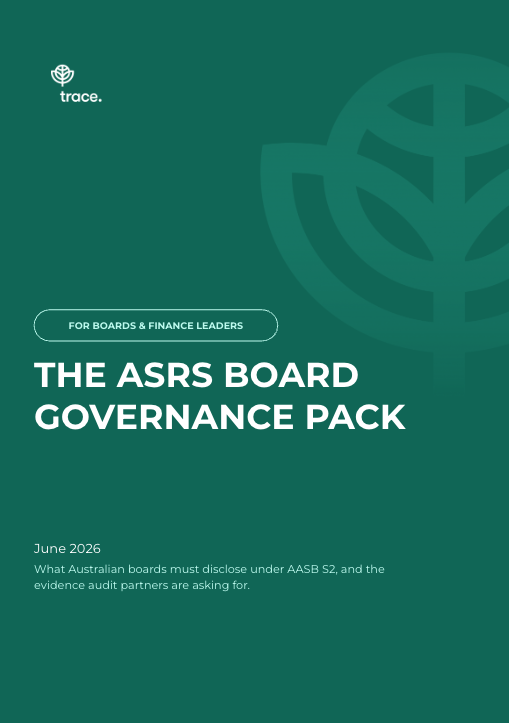
A practical pack for boards and finance leaders on the governance pillar of AASB S2: what you must disclose, the evidence audit partners actually ask for, and how to close the gap before your first report. Free to download, built from real questions boards are asking.
Get the ebook
AASB Australia's Mandatory Climate Reporting
Trusted by Mandatory Reporters







“Trace’s AI capabilities have significantly streamlined our data collection and validation processes, reducing manual effort and giving us greater confidence .”
CFO, Allied credit
“Trace’s AI capabilities have significantly streamlined our data collection and validation processes, reducing manual effort and giving us greater confidence .”
CFO, Allied credit

“We’ve worked with Trace for over 4 years and they’ve always given us confidence that our carbon data is accurate, audit-ready and aligned with evolving reporting standards.”
CEO, EnVATO

" Starting early [with the Trace platform] meant we avoided the scramble - saving time, money, and a lot of stress"
HEAD OF ESG, PADDY PALLIN
Three chapters plus a governance checklist and review process
The pack works through the governance pillar in three short chapters, then shows how a Trace review turns your existing documents into an AASB S2-aligned disclosure. It covers disclosure requirements, evidence and next steps.
What your board must disclose
AASB S2 asks you to name the body responsible for climate oversight and show how that oversight works. You learn how it sits in the mandate, how the board keeps the right skills, and why disclosure is process evidenced, not intent stated.
The evidence auditors look for
Assurance providers cannot rely on a process they cannot see. The pack lists the consistent file to build, from a charter naming climate as a board responsibility to a sign-off calendar, and explains why governing in practice is not the test.
Closing the gap before your first report
A step-by-step path for boards with nothing formal in place. Fix ownership first, then update charters, set information cadence and document sign-off. Each step produces an artefact, and those artefacts are the disclosure.
The governance checklist and review process
An illustrative extract maps AASB S2 governance clauses to what to prepare and how critical each is. You also see how a focused Trace review aligns your documents to specific S2 clauses and flags gaps, without rebuilding your systems.
Four things boards keep getting wrong on governance
These come up repeatedly across board and finance conversations. They are not spelled out in the standard guidance, but they decide whether your governance disclosure holds up under assurance.
Governing well is not the same as evidencing it
Most boards oversee risk competently, but cannot show where climate sits. As one Audit and Risk Committee Chair put it, the problem was that no one could point to it. Auditors test documented process, not intent, so undocumented good governance still fails.
Climate ownership falls through the middle
Responsibility often sits between sustainability, finance and the board, so nobody truly owns it. The fix is to name accountability explicitly and write it into terms of reference, at both board and management level, before anything else.
Governance artefacts cannot be backdated
Charters, skills matrices and reporting logs take months to build and cannot be created retrospectively. Starting early is the cheapest path. Leaving governance until last, as most boards do, is what turns it into a scramble before the first report.
The approach you choose drives the cost
Treasury estimates ASRS preparation at $750k to $1.6m under a consultancy-led approach. A structured, software-supported process makes it repeatable instead: SEE Group cut its climate risk assessment from 13 weeks to 2.
Written for the people
making ASRS decisions
This ebook is written at CFO grade, with enough detail to be genuinely useful to sustainability leads and risk teams. Not a primer. Not a sales deck.
Responsible for signing off on the disclosure. Needs to understand what auditors will scrutinise in year two, and where the financial integration gaps are in first-round disclosures.
Building the disclosure internally. Needs to understand what peers are doing on Scope 3, scenario analysis and materiality so the internal benchmark is calibrated correctly.
Needs to understand where governance documentation is falling short in first-round disclosures and what auditors are already flagging as areas for year-two improvement.
Accountable for climate risk oversight under AASB S2. Needs a clear picture of what comparable entities are disclosing and what the governance standard looks like in practice.
This ebook is particularly relevant if:
Your entity is likely to fall under ASRS Group 1, 2 or 3 (or you're not yet sure which group applies)
Your board or audit committee has asked about climate disclosure obligations for the first time
You're preparing a Group 2 first disclosure and want to learn from what Group 1 entities got right and wrong
You need to brief internal stakeholders on what AASB S2 actually requires versus what others are choosing to include
From ebook to
compliant disclosure.
01
Download the ebook
Understand what first reporters did. Where they focused, where they struggled, and what auditors are already signalling for year two.
Get it now02
Run your readiness assessment
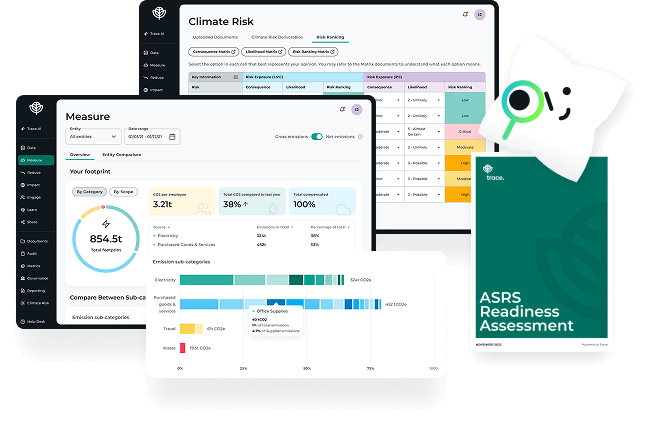
Trace maps your current data, governance and reporting position against ASRS requirements. You get a clear picture of where you are and a prioritised gap list.
See how it works03
Build your compliance roadmap
Trace turns your readiness assessment into a sequenced plan: what to do now, what to prepare for year two, and how to keep your board and audit committee informed throughout.
Book a call with our teamQuestions we hear most from ASRS teams
These are the questions Trace’s team hears most often from CFOs and sustainability leads starting their ASRS journey. The full ebook answers all of them in depth.


Your deadline is coming.
Start with the data.
Download the free ebook and see what Australia’s first AASB S2 reporters have already disclosed. Then talk to Trace about where you stand.


London - Sydney