
What must your board decide and sign on climate reporting?
A free, editable board briefing kit for CFOs, risk leads and company secretaries taking climate reporting under the Australian Sustainability Reporting Standards (ASRS) to their board. Fill in the brackets yourself or with your company's AI assistant, present it in 30 to 45 minutes, and leave with the key decisions minuted.
Get the ebook
AASB Australia's Mandatory Climate Reporting
Trusted by Mandatory Reporters







“Trace’s AI capabilities have significantly streamlined our data collection and validation processes, reducing manual effort and giving us greater confidence .”
CFO, Allied credit
“Trace’s AI capabilities have significantly streamlined our data collection and validation processes, reducing manual effort and giving us greater confidence .”
CFO, Allied credit

“We’ve worked with Trace for over 4 years and they’ve always given us confidence that our carbon data is accurate, audit-ready and aligned with evolving reporting standards.”
CEO, EnVATO

" Starting early [with the Trace platform] meant we avoided the scramble - saving time, money, and a lot of stress"
HEAD OF ESG, PADDY PALLIN
Five questions your board needs answered, in order
The kit works through five questions, from what AASB S2 Climate-related Disclosures requires to the decisions you need today. Speaker notes carry the detail, so you don't need to be a climate expert to present it.
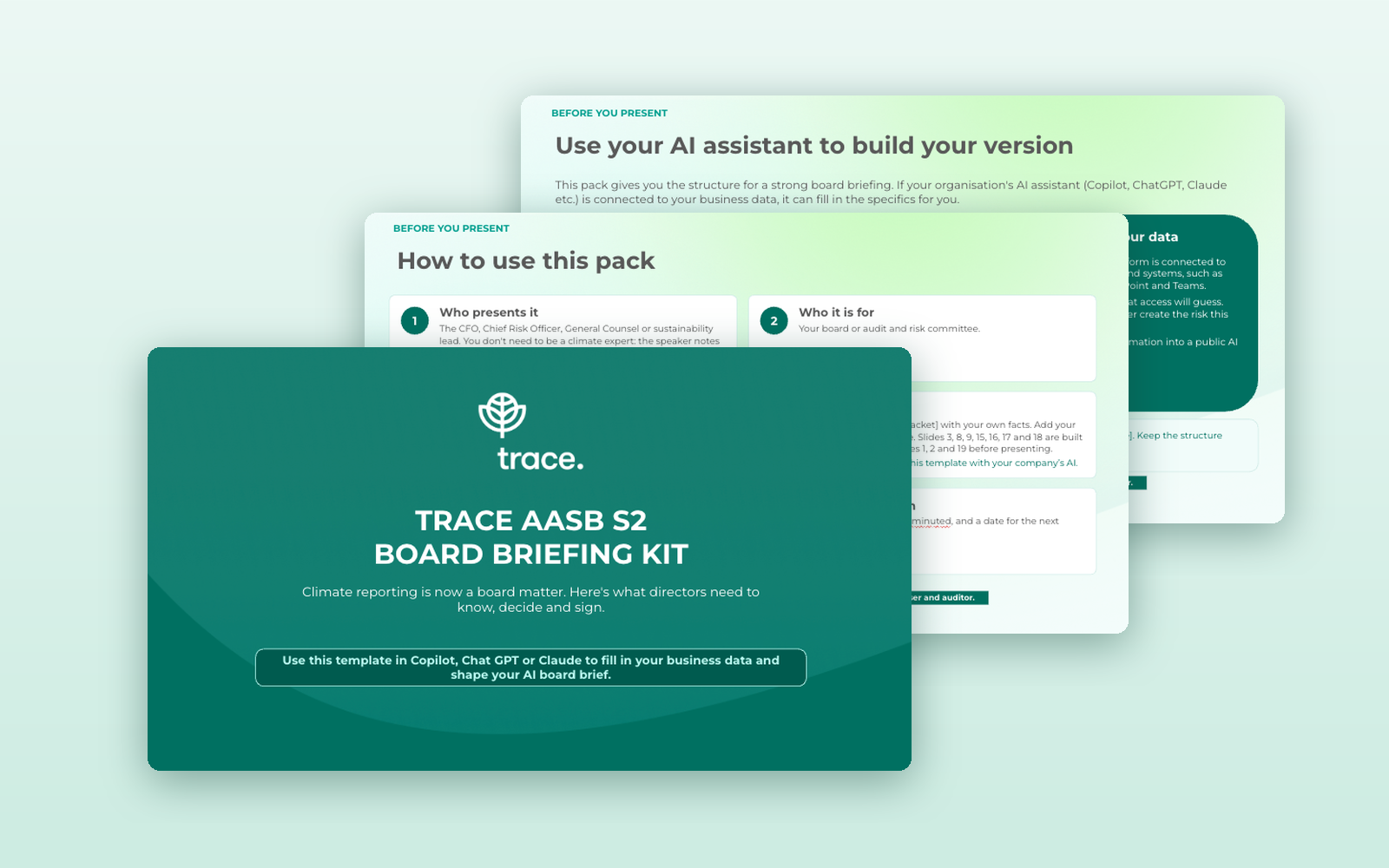
What it is and when it lands
Two slides explain why climate reporting follows the same path as your financial report: prepared by management, assured by an auditor and approved by the board. A table sets out the three reporting groups, their thresholds and start dates, with space to add your own first reporting year.
Your readiness, pillar by pillar
The four disclosure areas are explained in plain language, followed by a three-year view of how assurance and the directors' declaration step up. A traffic-light readiness table lets you show the board your honest starting point and which gaps need time and budget.
What directors are responsible for
Slides on liability, the directors' declaration and ASIC's expectations in Regulatory Guide 280 explain why climate reporting sits with the board, not only with finance. Eight questions give directors a ready-made way to challenge management at every update.
A roadmap, delivery options and decisions
A five-phase roadmap runs from readiness to board approval, and a comparison sets out in-house, outsourced and hybrid delivery. The kit closes with six decisions to minute, from the oversight body to reporting cadence, and a schedule for keeping the board informed.
Four things boards tend to underestimate
These come up again and again with first-year reporters and their auditors. Most aren't obvious from the standard, and they decide how ready your board is to sign.
Your first briefing is part of the evidence
Your governance disclosure covers the whole reporting year, and auditors have asked Group 1 entities how many board meetings discussed climate, and when. That record starts with your first briefing. Hold it before your reporting period starts, or at the next meeting if it already has, and minute every decision.
Reasonable steps is not a lower bar
For financial years starting before 1 January 2028, directors declare the entity has taken reasonable steps to ensure the report complies. To make that declaration, the board needs to show what steps it took. After that it becomes a full opinion on compliance, so the processes you build now need to mature quickly.
Liability relief is narrower than most expect
Temporary protection from private lawsuits covers only statements about Scope 3 emissions, scenario analysis and transition plans. Governance, risk management and Scope 1 and 2 emissions aren't protected from year one, and nor are climate claims on your website or in investor materials. ASIC can still act, so the safest disclosure is an accurate one.
Climate risk work takes longer than planned
Climate risk assessment and scenario analysis is usually the longest piece of work, because what it finds has to reach strategy and the risk register before you disclose. First-year reporters who started late, or relied on one person holding all the knowledge, felt it at year end. Getting the order right protects both the report and the declaration.
Written for the people
making ASRS decisions
This ebook is written at CFO grade, with enough detail to be genuinely useful to sustainability leads and risk teams. Not a primer. Not a sales deck.
Responsible for signing off on the disclosure. Needs to understand what auditors will scrutinise in year two, and where the financial integration gaps are in first-round disclosures.
Building the disclosure internally. Needs to understand what peers are doing on Scope 3, scenario analysis and materiality so the internal benchmark is calibrated correctly.
Needs to understand where governance documentation is falling short in first-round disclosures and what auditors are already flagging as areas for year-two improvement.
Accountable for climate risk oversight under AASB S2. Needs a clear picture of what comparable entities are disclosing and what the governance standard looks like in practice.
This template deck is particularly relevant if:
Your entity is likely to fall under ASRS Group 1, 2 or 3 (or you're not yet sure which group applies)
Your board or audit committee has asked about climate disclosure obligations for the first time
You're preparing a Group 2 first disclosure and want to learn from what Group 1 entities got right and wrong
You need to brief internal stakeholders on what AASB S2 actually requires versus what others are choosing to include
From ebook to
compliant disclosure.
01
Download the ebook
Understand what first reporters did. Where they focused, where they struggled, and what auditors are already signalling for year two.
Get it now02
Run your readiness assessment
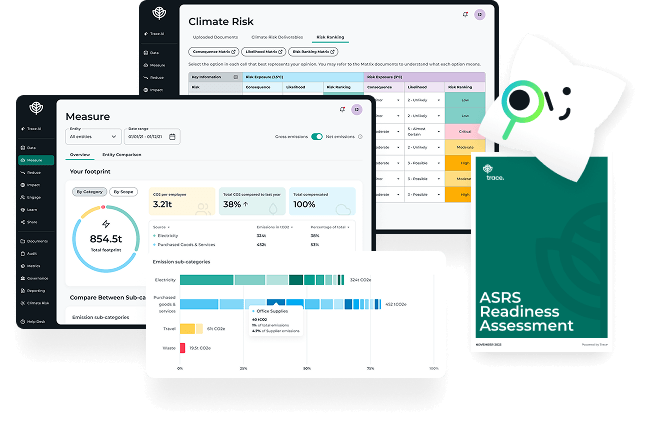
Trace maps your current data, governance and reporting position against ASRS requirements. You get a clear picture of where you are and a prioritised gap list.
See how it works03
Build your compliance roadmap
Trace turns your readiness assessment into a sequenced plan: what to do now, what to prepare for year two, and how to keep your board and audit committee informed throughout.
Book a call with our teamQuestions we hear most from ASRS teams
These are the questions Trace’s team hears most often from CFOs and sustainability leads starting their ASRS journey. The full ebook answers all of them in depth.


Your deadline is coming.
Start with the data.
Download the free ebook and see what Australia’s first AASB S2 reporters have already disclosed. Then talk to Trace about where you stand.


London - Sydney